
1. Weekly News
Global
Global Avocado Market to Reach USD 19.27 Billion by 2024, Driven by Health Benefits and Skincare Applications
The global avocado market is projected to reach USD 19.27 billion by 2024, with a compound annual growth rate (CAGR) of 5.9% from 2024 to 2034. The North American market is expected to account for USD 8.31 billion of this valuation. The growth is driven by the health benefits of avocados, including their potential to treat leukemia and their rich nutritional profile, which includes essential vitamins and monounsaturated fatty acids. Additionally, avocados are becoming increasingly popular in skincare products for their anti-inflammatory and anti-aging properties, which help to relieve inflammation, soothe peeling skin, and reduce wrinkles and expression lines. The market is also expanding among health-conscious consumers who prioritize holistic nutrition.
Colombia
"Aguacates de Colombia" Brand Launches to Showcase Sustainable Hass Avocado Production and Boost Colombia's Global Image
Colombia's Hass Avocados are exported to over 30 countries, supporting at least 240 thousand jobs. The brand "Aguacates de Colombia | Avocados from Colombia" highlights sustainable practices and emphasizes avocados' role in sustainable development, resource protection, and economic impact. Colombian avocados benefit from abundant rainfall, which can irrigate as many as 35 thousand hectares (ha). The brand was launched in Antwerp, Belgium, to enhance Colombia's global reputation and showcase the country's authenticity and diversity.
Peru
Avocado Production in Peru Declined by 16% YoY in 2024
Peruvian avocado production decreased by 16% year-over-year (YoY) in 2024, with the northern zone contributing about 50% of the harvest. The fruit has reached maturity with a dry matter content of 23% to 24%, and the market is responding to the expected growth. Large sizes are scarce globally, including in Peru, Mexico, Colombia, and South Africa. By W21, 43% of the total volume of Peruvian avocado had been exported, with 9.5 thousand of 22 thousand containers shipped last season. Fruit quality and condition have improved, with no significant quality issues reported. Avocado prices are higher than in 2023, although smaller sizes are worth less. The industry faces challenges from the El Niño phenomenon, climatic deviations, and unpredictable harvesting and sizes. The season is expected to end by W31, with around 800 containers remaining, and officially concludes in W40.
South Africa
South Africa's Expanding Avocado Production Sees New Growth and Markets, with First Exports to China Expected in 2024
South Africa's avocado production has expanded to include regions beyond Limpopo and Mpumalanga, now encompassing KwaZulu-Natal and the Eastern Cape, with contributions from the Southern and Western Cape regions. The Cape region alone has 1 thousand ha dedicated to avocado cultivation, accounting for 5% of the country's total production. In 2018, South Africa's avocado exports reached a record high of over 20 million boxes. Although export volumes declined afterward, they have stabilized, with 15 million boxes shipped in 2022 and 2023. In Aug-23, South African fresh avocados received customs approval, paving the way for the first batch to be exported to China in 2024.
2. Weekly Pricing
Weekly Avocado Pricing Important Exporters (USD/kg)
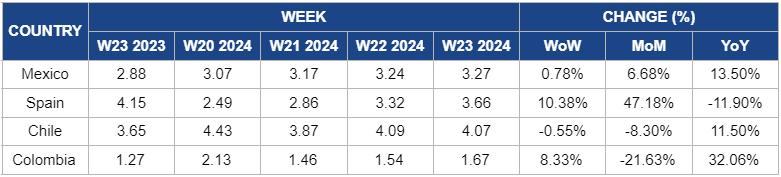
Yearly Change in Avocado Pricing Important Exporters (W23 2023 to W23 2024)

Mexico
The 0.78% week-over-week (WoW) increase in Mexican avocado prices to USD 3.27 per kilogram (kg) in W23, compared to USD 3.24/kg in W22, can be attributed to seasonal fluctuations in avocado production and changes in consumer demand. The 6.68% month-on-month (MoM) increase and 13.5% YoY growth indicate sustained market trends, potentially driven by factors like the popularity of avocado-based products and global market dynamics.
Spain
The price of avocados in Spain increased again in W23 by 10.38% WoW to USD 3.66/kg, compared to USD 3.32/kg in W22. This rise, along with a 47.18% MoM increase, is likely due to the continued off-season, leading to decreased supply. Despite the 11.90% YoY decrease, the persistent low supply has kept pressure on prices, contributing to the ongoing increase.
Chile
In W23, the price of Chilean avocados slightly decreased by 0.55% WoW, dropping to USD 4.07/kg from USD 4.09/kg in W22. This minor price reduction can be attributed to a combination of factors, including a slight easing of international demand and minor improvements in supply chain logistics. Despite this WoW decrease, prices remained relatively high due to the ongoing challenges in production, such as water scarcity and climate issues, which continue to constrain supply.
Colombia
In W23, avocado prices in Colombia rose again, reaching USD 1.67/kg, an 8.33% WoW increase. This price rise can be attributed to short-term fluctuations in demand, which boosted prices despite the ongoing peak flowering season leading to an influx of supply. While there was a 21.63% month-on-month (MoM) decrease from Apr-24's USD 2.13/kg, the WoW increase reflects strong market dynamics and robust demand, especially with Colombia's peak season. This trend will continue as volumes remain high, ensuring steady supply through Aug-24.
4. Actionable Recommendations
Strengthening Peruvian Avocado Production
To strengthen Peruvian avocado production, the industry should focus on diversifying its export markets, particularly targeting regions with high demand for large-sized avocados. This diversification can reduce dependency on specific markets and increase resilience to price fluctuations. Additionally, investments in climate-smart agricultural practices, such as efficient irrigation and agroforestry, are crucial to adapting to the effects of climate change and ensuring consistent yields. Improving supply chain efficiency and reducing post-harvest losses can also enhance the competitiveness of Peruvian avocados in the global market. Lastly, research and development efforts should prioritize the development of avocado varieties that are more resistant to climatic variations, ensuring a more stable and sustainable supply chain.
Enhancing South Africa's Avocado Industry
To enhance South Africa's avocado industry, it is recommended to focus on expanding cultivation into new regions like KwaZulu-Natal and the Eastern Cape. Increase export volumes, especially to emerging markets like China, leveraging recent customs approval. Invest in research for resilient varieties, improve infrastructure for supply chain efficiency, and promote avocado consumption domestically and internationally.
Source: Tridge, Freshplaza, PortalFruticola, MXfruit, Portaldelcampo


