.jpg)
1. Weekly News
Brazil
Brazil's Rice Exports Peaked in Jul-24 but It Faces Trade Balance Deficit
According to the Brazilian Rice Industry Association (ABIARROZ), Brazil's rice exports achieved their highest performance of the year in Jul-24, reaching 175 thousand metric tons (mt) and generating USD 70.1 million in revenue. However, despite this solid monthly performance, the overall rice trade balance remains in deficit due to imports surpassing exports. Total export values in 2024 have decreased by 16% year-on-year (YoY) compared to the previous year. Although processed rice exports increased in volume and value in Jul-24 compared to Jul-23, high domestic prices and growing competition from other countries have reduced demand for Brazilian rice. This has resulted in Mexico ceasing to be a customer and has contributed to an anticipated trade deficit in Brazil's rice sector by the end of 2024.
India
India Approves Export of 200 Thousand MT of Non-Basmati White Rice to Malaysia
India approved the export of 200 thousand mt of non-basmati white rice to Malaysia on August 20 as part of the Malaysian Prime Minister's State Visit. This move aligns with India's strategy that allows limited rice exports to address the food security needs of other countries following the export ban imposed in Jul-23. The exports to Malaysia will be managed through National Cooperative Exports Limited (NCEL), in addition to existing rice exports to countries such as Nepal, Cameroon, and the Philippines.
Kazakhstan
Kazakhstan's 2024 Rice Harvest Expected to Exceed 500 Thousand MT
In Kazakhstan, the 2024 rice harvest forecast for the central rice-growing region, the Kyzylorda region, is projected to exceed 500 thousand mt. The rice harvesting campaign recently commenced, with the Minister of Agriculture participating in the opening ceremony. Of the total harvest, approximately 1 thousand mt will be allocated to the domestic market through stabilization funds, aiming to saturate the market and stabilize prices.
Thailand
Thailand's Department of Agricultural Extension Issues Warning on Rice Grain Stain Disease
Thailand's Department of Agricultural Extension has warned farmers to regularly inspect their rice fields, particularly those in the germination stage and nearing ear emergence, for signs of rice grain stain disease. This advisory follows a recent report from agricultural extension officers in Saraburi Province, where the disease affected 41 rai (approximately 6.56 hectares) of rice fields. In response, authorities have taken urgent measures to prevent the movement or use of diseased rice seeds in the upcoming growing season. Additionally, they have provided farmers in Saraburi and nearby areas with monitoring information to prevent and eliminate rice grain stain disease, aiming to raise awareness and preparedness during the rainy season.
United States
USA Rice Federation Expands Promotional Program to Scandinavia in 2024
Earlier in 2024, USA Rice Federation expanded its European promotional program to include Scandinavian countries like Norway, which have high purchasing power. From May-24 through Aug-24, USA Rice partnered with a local importer in Norway to boost awareness of the United States (US) rice through a campaign that featured eye-catching posters in 10 Bambus sushi stores across Oslo and nearby cities such as Asker, Strømmen, and Sandvika. Additionally, USA Rice developed materials in Norway to assist the importer’s sales team promote US rice to food service buyers. Norway remains a crucial market for US rice in Europe, importing over USD 1 million in 2023.
2. Weekly Pricing
Weekly Rice Pricing Important Exporters (USD/kg)
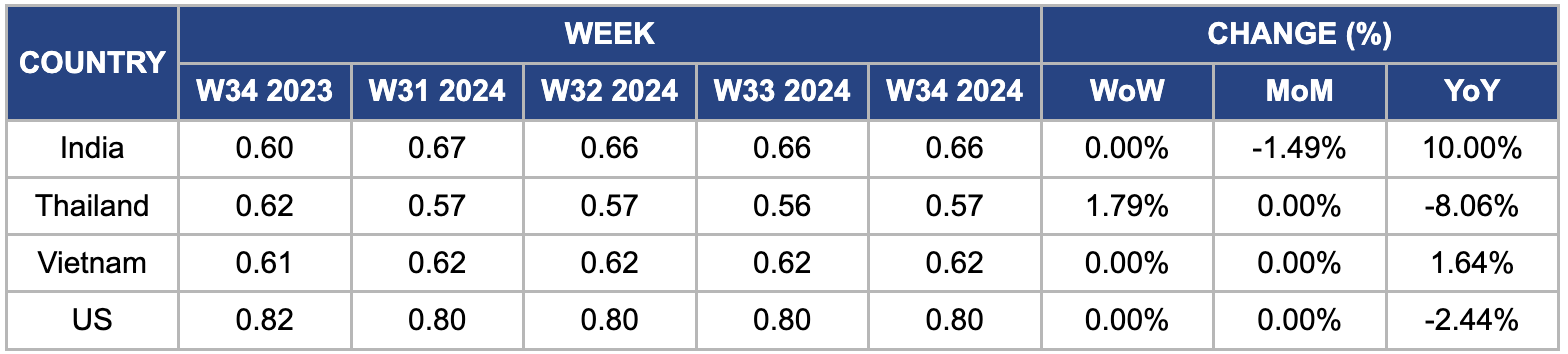
Yearly Change in Rice Pricing Important Exporters (W34 2023 to W34 2024)

India
In W34, wholesale rice prices in India held steady week-on-week (WoW) at USD 0.66 per kilogram (kg) but fell by 1.79% month-on-month (MoM). This price decrease comes amid a significant increase in the area of paddy sowing, which reached 16.61 million ha by July 19, 2024, compared to 5.56 million ha on the same date in 2023. The sowing area expansion suggests a potential rise in rice production, with estimates for the Kharif crop year 2024/25 ranging between 135.5 and 138 million metric tons (mmt), up from 111.46 mmt the previous year. However, prices could rise if the monsoon fails and actual output falls short of expectations.
Thailand
In W34, wholesale rice prices in Thailand increased by 1.79% WoW, rising to USD 0.57/kg from USD 0.56/kg in W33. This uptick is due to concerns about rice grain rot disease, which has affected 41 rai rice fields in Saraburi Province. The Department of Agricultural Extension has warned farmers to inspect their fields for signs of the disease, which is caused by fungi and leads to brown or black spots on grains. The department is actively managing the situation and providing farmers with guidance on prevention and surveillance, contributing to the rise in rice prices.
Vietnam
In W34, wholesale prices for Vietnamese regular rice remained stable in both WoW and MoM but saw a 1.64% increase YoY to USD 0.62/kg, up from USD 0.61/kg in W34 2023. With significantly rising prices, Vietnamese rice is now among the most expensive globally. Despite this, Vietnam projects rice exports to hit record volume and value, driven by increased imports from traditional partners. This trend contrasts with the price movements of rice in countries like Thailand and Pakistan. The elevated export prices of Vietnamese rice are due to its unique quality and specific varieties, which are unavailable from other major producers. The demand for Vietnamese rice remains strong, and exports are expected to exceed 8 mmt, generating over USD 5 billion, setting a new industry record.
United States
In W34, the wholesale price of US-milled white long rice in Arkansas remained stable at USD 0.80/kg, marking a 2.44% YoY decrease. The US milled rice market has shown resilience despite challenges such as Iraq's banking issues and the crisis in Haiti over the summer months. Favorable harvest conditions have played a crucial role in maintaining market stability. Iraq has resumed purchasing US rice after uncertainties caused by American financial restrictions. Current efforts are focused on strengthening export markets and improving internal relations to sustain this stability.
3. Actionable Recommendations
Address Supply Dynamics and Manage Price Fluctuations
Vietnamese rice prices have been surging due to high demand and quality, presenting an opportunity to manage price fluctuations and expand export markets. To maintain this growth, Vietnam should focus on addressing supply dynamics by investing in production efficiency and market diversification. Expanding into new and emerging markets such as South Korea, the Middle East, and Eastern Europe will reduce reliance on traditional buyers and help balance global supply and demand. By leveraging its reputation for high-quality rice and supporting continued export growth, Vietnam can achieve record export volumes and reinforce its position as a leading global rice exporter, benefiting domestic producers and international markets.
Improve Disease Management and Support Farmer Resilience
Thailand's rising rice prices due to rice grain stain disease highlight the importance of effective disease management and farmer support. The Department of Agricultural Extension's efforts to monitor and manage disease outbreaks are crucial, but Thailand should also enhance its support systems for farmers. Providing targeted resources and disease management training, especially in critical rice-growing regions like Saraburi and Roi Et, will help mitigate production losses. Furthermore, collaborating with neighboring markets such as Myanmar and Laos can support regional rice stability and address the cross-border supply dynamics influenced by disease outbreaks. Strengthening these measures will help maintain rice production levels and support price stability in domestic and regional markets.
Enhance Export Performance and Market Diversification
Brazil's rice sector must address its trade deficit by improving export performance and diversifying markets. Despite reaching its highest export level of the year in Jul-24, Brazil faces a trade imbalance due to imports surpassing exports. To mitigate this, Brazil should target emerging markets with growing rice demand, such as West African countries (e.g., Nigeria and Ghana) and Southeast Asian nations (e.g., Vietnam and the Philippines). By strengthening trade relations and negotiating long-term agreements, Brazil can enhance its market presence and stabilize its rice exports. This strategy will help Brazil increase its global market share and support importing countries with reliable and diverse sourcing options.
Sources: Zol, Yonhap News Tv, Planeta Arroz, RYT9, USA Rice Daily, UkrAgroConsult, 24h newspaper