
In W1 in the maize landscape, weather conditions and supply dynamics caused Brazilian prices to fluctuate significantly. Prices fell during the first half of 2024, reaching their lowest point in Jul-24 due to expectations of a strong second crop and global production growth. Despite a 12.3% YoY production drop to 115.7 mmt, Brazil’s corn exports for the 2023/24 season reached 40.42 mmt, reflecting a 19% decline from the prior season. However, favorable weather conditions are expected to boost yields for the Brazilian 2024/25 corn crop. On the global stage, the US-Mexico-Canada Agreement panel ruled against Mexico's ban on GM corn, which could impact future trade flows. Meanwhile, US corn sales were below expectations in Dec-24, but total sales for 2024 surpassed 38.8 mmt. Regarding pricing, Brazilian maize prices remained stable with no WoW, MoM, or YoY changes, as balanced supply and demand dynamics stabilized the market.
1. Weekly News
Brazil
Brazilian Corn Prices Fluctuate as Supply Declines Due to Weather Challenges
Brazilian corn prices in 2024 faced significant fluctuations from seasonal supply dynamics and weather conditions. During the first half of 2024, prices were under pressure due to the summer harvest, strong development of the second crop, and expectations of record global production. Prices fell continuously, reaching their lowest levels in Jul-24, as buyers delayed acquisitions in anticipation of further declines with the progression of the second harvest. From Aug-24 to Nov-24, prices began to recover due to reduced domestic availability. Hot and dry weather conditions raised concerns about planting the summer and second crops for 2025. However, improved rainfall from late Oct-24 eased these concerns, favoring summer crop sowing.
Despite the improved weather, Brazilian corn production for the 2023/24 season totaled 115.7 million metric tons (mmt), down 12.3% year-on-year (YoY) due to earlier weather challenges. The export surplus fell to 40.42 mmt, 19% lower than the prior season and the weakest since 2021/22. Meanwhile, global corn supply increased during the 2023/24 season, contrasting Brazil's reduced output.
Brazil's 2025 Summer Corn Crop Poised for High Yields
In Brazil, producers of the 2024/25 summer corn crop have maintained high technological standards, reflecting their traditional expertise in this crop. Favorable weather conditions across the center-south region, especially in southern and southeastern states, are expected to boost average yields above normal levels. This improved productivity could offset a reduced planting area, helping to stabilize domestic supply until the 2025 second crop. However, the approaching soybean harvest is likely to strain logistics, limiting the efficient movement of corn within the domestic market. Corn shipments have reached 36.5 mmt on the export front, bolstered by recent vessel appointments for Jan-25. The line-up increased by 1 mmt weekly, raising expectations of achieving the annual export target of 38 to 39 mmt. Key factors driving this performance include available port capacity and the devaluation of the Brazilian real (BRL), which enhances price competitiveness at ports.
Mexico
USMCA Panel Rules in Favor of US in Dispute Over Mexico’s GM Corn Ban
Representing producers from Argentina, Brazil, and the United States (US), the International Corn Producers Alliance (MAIZALL) expressed approval of the US-Mexico-Canada Agreement (USMCA) panel's final report, released on December 20, 2024, addressing Mexico's biotechnology measures. The panel sided with the US government, which challenged Mexico's 2023 Decree banning the import of genetically modified (GM) corn for human consumption and phasing out GM yellow corn for animal feed and industrial use. The report concluded that Mexico's decree was not grounded in scientific evidence and overlooked decades of safe use and trade involving GM corn. This ruling highlights the importance of science-based policies in international trade and underscores the significance of GM corn to the economies of major producers and global food systems.
United States
Weekly Export Sales of US Corn Fall Short of Expectations
In the week ending December 26, 2024, a United States Department of Agriculture (USDA) report showed that weekly corn sales from the US were below market expectations, totaling 777 metric tons (mt), falling short of the expected range of 800 thousand mt to 1.4 mmt. Mexico was the largest buyer of US corn during this period. With this, the total corn sold by the US so far has reached 38.8 mmt, surpassing last year's figure of just over 29.7 mmt. The USDA projects that US corn exports for the 2024/25 season will reach 62.87 mmt.
2. Weekly Pricing
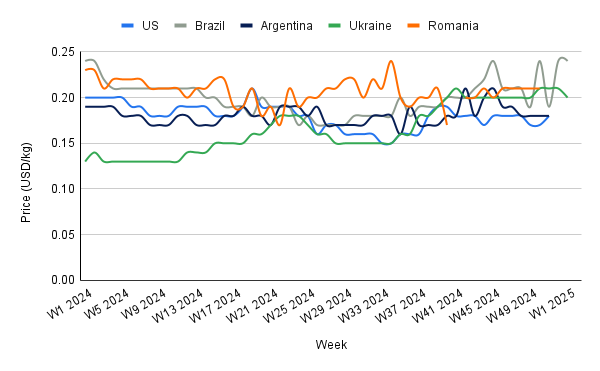
Weekly Maize Pricing Important Exporters (USD/kg)

Yearly Change in Maize Pricing Important Exporters (W1 2024 to W1 2025)
Brazil
In W1, wholesale maize prices in Brazil stood at USD 0.24 per kilogram (kg), remaining unchanged week-on-week (WoW), month-on-month (MoM), and YoY. This stability is primarily due to balanced supply and demand dynamics in the Brazilian maize market during this period. The USDA Foreign Agricultural Service reported that Brazil's maize production for the 2024/25 marketing year (MY) is estimated at 128 mmt, reflecting a slight increase from the previous year. This production level has contributed to a stable supply, which, combined with consistent domestic demand, has helped maintain price stability in the market. The BRL's devaluation has also influenced maize prices, making exports more competitive and supporting domestic prices.
Ukraine
In W1, wholesale maize prices in Ukraine decreased 4.76% WoW and MoM to USD 0.20/kg. This decline is despite a smaller corn production in the 2024/25 marketing year (MY). The USDA reports that Ukraine's corn production is smaller due to lower yields, which has reduced supply in the market, exerting downward pressure on prices. Moreover, the strengthening of the Ukrainian Hryvnia (UAH) against the US Dollar (USD) has made Ukrainian maize more expensive for foreign buyers, reducing demand and contributing to the price decrease. The exchange rate fluctuations have impacted the competitiveness of Ukrainian maize in international markets.
3. Actionable Recommendations
Invest in Climate-Resilient Farming Practices
Brazilian producers should invest in climate-resilient farming practices to address weather-related challenges, such as the hot and dry conditions that affected the 2023/24 season. Practices like drought-resistant seed varieties, improved water management systems, and soil conservation techniques can help mitigate the risks associated with unpredictable weather patterns. By enhancing the resilience of the 2024/25 summer crop, Brazil can maintain consistent yields despite climate variability and safeguard domestic supply and export performance. Moreover, integrating climate-smart practices will contribute to long-term sustainability and competitiveness in global markets.
Strengthen Export Partnerships and Market Diversification
Brazilian corn producers should diversify their export markets by strengthening partnerships with countries outside traditional markets like the US and Mexico. Focusing on emerging markets in Asia, the Middle East, and Africa, such as India, Bangladesh, and Nigeria, where corn consumption is rising, will help reduce dependency on a few buyers and ensure better price stability. This strategic expansion could enhance Brazil's competitiveness, especially with the devaluation of the BRL, which would make Brazilian corn more attractive to international buyers.
Enhance Logistics and Export Infrastructure
Brazil should improve logistics and export infrastructure to minimize bottlenecks during the soybean harvest, which often strains corn shipments. Expanding port capacity, upgrading storage facilities, and optimizing transportation networks will ensure smoother movement of corn to export terminals, particularly during peak harvest periods. Investing in these areas will reduce delays, help Brazil meet its export targets of 38 to 39 mmt for the 2024/25 season, and enhance its position in global markets, especially when competing with other corn-producing nations.
Sources: Tridge,Chacra Magazine, NoticiasAgricola, PortalDBO, UkrAgroConsult