.jpg)
1. Weekly News
Brazil
Price Surge in Brazilian Potato Markets Amidst Harvest Disruptions
The Center for Advanced Studies on Applied Economics (Cepea) revealed a significant increase in the price of special agate potatoes in the São Paulo, Brazil wholesale market. In W22, the average price reached USD 38.96 per 25 kilogram (kg) bag, marking a 41.07% increase compared to the previous week. Notably, in other major cities in Rio de Janeiro, the price rose by 35.55% to USD 37.64 per bag, and in Belo Horizonte, the price increased by 34.56% to an average of USD 37.64 per bag. This price surge is due to the rainfall in the key producing regions, with Paraná experiencing significant disruptions in the dry season harvest, particularly in the Guarapuava area.
Bolivia
Decline in Bolivia's Potato Production Amid Climatic Challenges
According to the data from Bolivia's National Statistics Office (INE), during the agricultural season from 2019 to 2020, Bolivia's potato production exceeded 1.3179 million metric tons (mmt) with a yield of about 7.2 metric tons (mt) per hectare (ha). In the following season (2020 to 2021), production slightly decreased to 1.2726 mmt, with the planting area exceeding 191,300 ha, resulting in a year-on-year (YoY) decrease in yield per hectare. Cochabamba was the largest potato-producing region in Bolivia, contributing 30.3% to the national total, followed by La Paz at 27.3%. In Morochata, Cochabamba, there are over 100 varieties of native potatoes. Around 95% of the local population is involved in potato cultivation, producing approximately 50 thousand mt of Waycha potatoes annually for sale, while a certain proportion is reserved for continued cultivation. In recent years, specifically in 2022 and 2023, the highland region, including Morochata, faced unfavorable climatic events such as drought, frost, and hail. These conditions resulted in a significant loss of 80% of potato production, exacerbating concerns about the livelihood of local farmers and the overall potato output.
Egypt
Egyptian Potato Prices Surge to USD 0.42/kg Amid Seed Shortage and Increased Cultivation Costs
The price of Egyptian potatoes has increased to approximately USD 0.42/kg in the local market. The summer season for potatoes, planted from mid-Dec-23 to mid-Feb-24 with imported seeds, accounts for about 30% of Egypt's 600 thousand acres of potato cultivation. Egypt produces roughly 7.5 mmt of potatoes annually across three main cycles: summer, winter, and Nile. The drop in cultivated area and production is due to the price increase of imported potato seeds, which have risen to about USD 2096.89/mt because of a shortage. This season, only 110 thousand mt of seeds were available out of the 140 thousand mt needed. This shortage has forced some farmers to use less productive local seeds or avoid planting potatoes altogether to prevent losses, as seeds account for about 60% of the cost of growing potatoes. The high cost of cultivation and the involvement of multiple intermediaries have further increased potato prices for consumers. Additionally, with reduced production, merchants tend to store potatoes to sell at higher prices later.
Germany
Waxy Potato Prices Spiked to USD 1.76/kg in W23 Due to Weather Delays
The average price for waxy potatoes in Germany increased to USD 1.76/kg in W23, up from USD 1.66/kg in 2023, due to heavy rainfall delaying planting and harvesting. The tight supply of early potatoes has driven prices higher, exacerbated by reduced imports from Israel, Egypt, and Spain, and a shortage of seed potatoes caused by decreased production and a ban on certain pesticides. Consumers are expected to see prices decrease by Jul-24, with the main potato harvest for supermarkets starting in mid-Jun-24. The delays were particularly severe in the Lower Rhine, Netherlands, and Belgium, where persistent rain prevented farmers from planting on time.
Russia
Astrakhan Farmers Trial Belarusian Potato Varieties for Improved Yield and Climate Resilience
Farmers in the Astrakhan region, Russia, are experimenting with growing Belarusian potato varieties known for their good yield, climatic resistance, and excellent taste. The Regional Minister of Agriculture and Fishing Industry announced that the results of these tests will be available in the fall. The experiment aims to develop potato-growing technologies and select breeding materials suited to the region's climate. The regional Ministry of Agriculture is committed to providing comprehensive support, information, and consulting assistance for these projects, including possible state support measures.
2. Weekly Pricing
Weekly Potato Pricing Important Exporters (USD/kg)
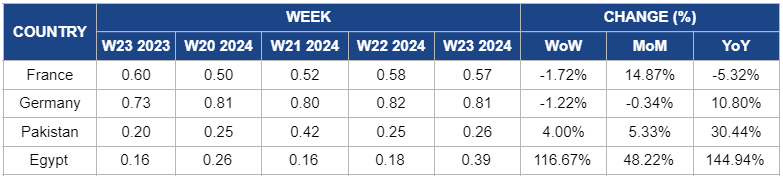
Yearly Change in Potato Pricing Important Exporters (W23 2023 to W23 2024)
.png)
France
In W23, the wholesale price of French potatoes slightly declined by 1.72% WoW, dropping to USD 0.57/kg. This decline could be attributed to the devaluation of the Euro (EUR) against the US Dollar (USD) during that period.
Germany
Germany's wholesale potato prices experienced a minor weekly decline of 1.22% to USD 0.81/kg, following a previous increase. Despite this, prices have risen significantly by 10.80% YoY compared to W23, 2023. This increase is primarily due to a scarcity of early potatoes in 2024. Farmers in Germany faced challenges in planting due to heavy rainfall in Feb-24 and early Mar-24, particularly impacting southern and southwestern regions. The excessive rain hindered field access and delayed starch storage, further complicating the harvest process.
Pakistan
Pakistan's wholesale potato prices rose by 4% WoW to USD 0.26/kg from USD 0.25/kg in W22. This increase is due to the approaching festive season of Eid al-Adha, during which prices of vegetables, including onions and potatoes, typically rise. Additionally, the inflation rate in early June 2024 surged, reaching a high of 21.69% across the country.
Egypt
Egypt's wholesale potato prices surged significantly by 116.67% WoW and 144.94% YoY to USD 0.39/kg from USD 0.16/kg in W22. This sharp increase was due to the reduced availability of potatoes from the new season and heightened demand from buyers. Additionally, Egypt exported fewer potatoes to Russia, contributing to the price hike in the market. Moreover, the noticeable devaluation of the Egyptian pound (EGP) significantly impacted the European potato market. This devaluation coincided with the peak season of potato exports from Egypt. Given that potatoes are a top export crop for Egypt and considering that potato prices in Europe were already at record highs, the devaluation came at an opportune moment.
3. Actionable Recommendations
Enhancing Potato Production in Bolivia
To address the challenges faced by Bolivian potato farmers, particularly in Morochata and Cochabamba, the government should enhance agricultural infrastructure and provide financial support for farmers affected by climatic events. Investing in research and development for resilient potato varieties and implementing effective pest and disease management programs can help improve yield stability. Moreover, promoting crop diversification and sustainable farming practices can reduce dependency on traditional potato varieties and enhance agricultural productivity.
Addressing Seed Shortage in Egyptian Potato Cultivation
Policymakers should prioritize initiatives to increase domestic seed production and reduce reliance on imported seeds to alleviate the impact of seed shortages on potato cultivation in Egypt. This includes incentivizing local seed production through subsidies and technical support for farmers. Implementing measures to enhance seed quality and availability can help stabilize production costs and ensure consistent potato yields across different planting cycles. Moreover, streamlining regulatory processes and promoting transparent market practices can facilitate access to quality seeds for Egyptian potato farmers.
Stabilizing Potato Prices in Germany
In response to the volatility in waxy potato prices in Germany, stakeholders should consider measures to enhance supply chain resilience and market transparency. This involves improving logistics and storage capacities to better manage seasonal fluctuations and reduce dependency on imports during periods of reduced local production. Collaborating with neighboring countries like Israel, Egypt, and Spain to diversify sourcing options for potatoes can mitigate supply disruptions caused by adverse weather conditions. Furthermore, supporting farmers with access to innovative farming technologies and financial incentives can enhance production efficiency and market competitiveness.
Sources: Foodmate, Portal Do Agronegócio, Almalnews, Merkur.de, Urdupoint


