
1. Weekly News
Global
2024/25 Global Corn Production Forecast Revised Down
In the latest 2024/25 corn campaign projections, production forecasts have been revised downward for the European Union (EU) and Ukraine, while expectations for the United States (US) and Argentina have improved. Global corn production is now projected at 1.22 billion metric tons (mt), reflecting a slight 0.3% decrease from the 1.223 billion mt estimated for the 2023/24 campaign. US corn production is forecasted to reach 384.7 million metric tons (mmt), a 1.3% decline compared to the previous cycle. In contrast, China's corn harvest is expected to grow by 1.1%, reaching 292 mmt. Ukraine faces a significant reduction, with production dropping 16.3% to 27.2 mmt. Brazil is forecasted to produce 127 mmt, an increase of 4.1%, while Argentina’s output is set to rise by 2%, reaching 51 mmt.
Global corn exports are expected to decrease by 4.5%, from 200.6 mmt to 191.5 mmt. The US will lead with 58.4 mmt, a 2.2% increase, followed by Brazil, Argentina, and Ukraine, with exports of 49 mmt, 36 mmt, and 24 mmt, respectively. China’s demand for imported corn is predicted to remain steady at 23 mmt, while the EU is expected to reduce imports by 7.7% to 18 mmt.
Brazil
Brazil's 2024/25 Corn Planting Reaches 15% Completion in Center-South Region
As of September 5, the planting of the first 2024/25 corn crop, known as summer corn, reached 15% of the estimated area in Brazil's Center-South region. This marks an 8% week-on-week (WoW) increase from the previous week, although it remains slightly below the 17% recorded during the same period in 2023. Planting activities are primarily concentrated in the three southern states, a typical pattern for this time of year. The pace of sowing was particularly accelerated in Rio Grande do Sul and Paraná, where farmers took advantage of favorable soil moisture. In Santa Catarina, which saw significant planting progress the previous week, dry weather conditions have temporarily halted work. Many farmers are awaiting rain forecasts to resume planting efforts more intensively.
Paraguay
Paraguayan Corn Production Forecasts 3.58 MMT in 2024 Amid Yield Reductions
Final estimates for Paraguay's 2024 corn production are nearing completion, with slight adjustments still possible. Paraguayan corn output is expected to reach 3.58 mmt for the 2024 harvest. Projections for the 2025 harvest remain unchanged, with an anticipated production of 4.71 mmt. The average yield for 2024 is forecasted at 4.66 mt per hectare (ha), while the next cycle is expected to achieve 5.90 mt/ha, reflecting a rise in productivity and efficiency. However, several regions have faced yield reductions, primarily due to drought conditions. The northern areas of the Eastern Region experienced the most severe losses. San Pedro, the hardest-hit department in the recent grain campaign, saw the most significant monthly yield decrease. Lower-than-expected yields in Canindeyú, a critical region for corn production, also contributed to the decline. Meanwhile, Itapúa initially promised a strong performance but harvested less than projected.
United States
USDA Reports 5% of US Corn Harvest Completed as of W36
Released on September 9, the United States Department of Agriculture's (USDA) weekly crop monitoring report revealed that farmers have already harvested 5% of the 2024 corn crop. This progress is ahead of last year's 4% and the five-year average of 3%. Texas leads the way, with 75% of its corn harvested due to its earlier planting season. In contrast, Iowa has not seen significant harvesting, while Illinois has completed 2% and Indiana 1%. Regarding crop conditions, 64% of the corn is rated good or excellent, down slightly from 65% the previous week but much higher than last year's 52%. Additionally, 24% of the crops are in fair condition, and 12% are rated poor or very poor.
2. Weekly Pricing
Weekly Maize Pricing Important Exporters (USD/kg)
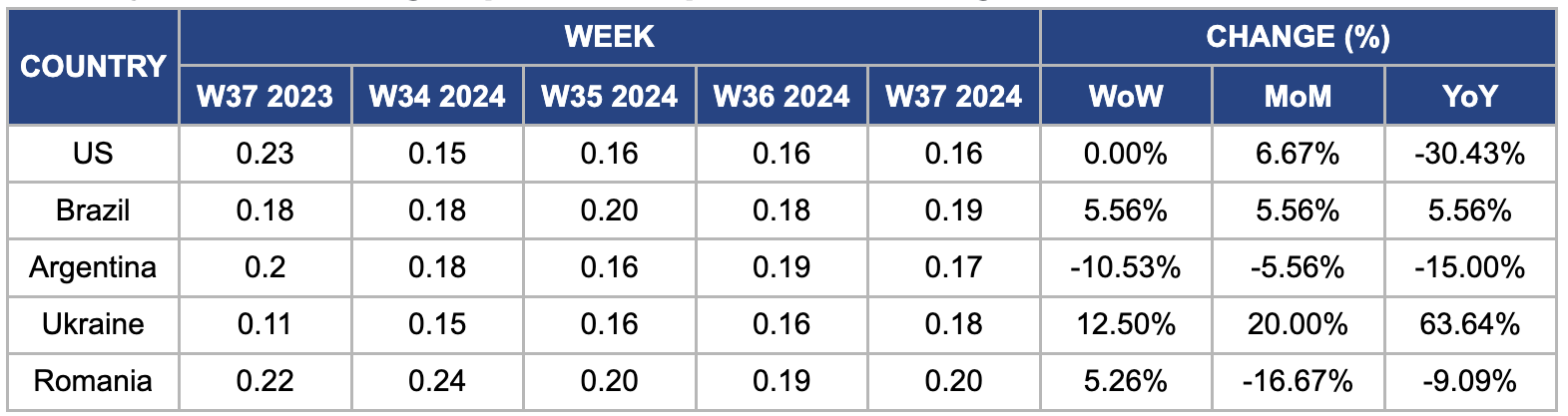
* Varieties: US (feed grade), all others (overall average)
Yearly Change in Maize Pricing Important Exporters (W37 2023 to W37 2024)

* Varieties: US (feed grade), all others (overall average)
* Blank spaces on the graph signify data unavailability stemming from factors like missing data, supply unavailability, or seasonality
US
In W37, US wholesale maize prices remained steady WoW at USD 0.16 per kilogram (kg). However, prices rose by 6.67% month-on-month (MoM). This increase is due to higher demand driven by new export sales the USDA announced and significant purchases from China and Colombia. Additionally, the US 2024/25 corn production forecast has been adjusted downward to 384.7 mmt, reflecting a 1.3% decrease from the previous cycle. This revision is due to a 1-million acre reduction in the predicted corn planting area.
Brazil
In W37, wholesale maize prices in Brazil increased by 5.56% WoW and MoM to USD 0.19/kg, up from USD 0.18/kg in W36. This price rise is due to concerns about weather conditions in Brazil's key summer harvest regions, leading sellers to restrict the volume of maize offered. On the demand side, international interest in Brazilian corn has strengthened, supported by favorable export parity. Domestic buyers have resumed negotiations, either to replenish stocks or in anticipation of further price increases. Brazil's maize shipments totaled 6.06 mmt in Aug-24, nearly double the 3.55 mmt shipped in Jul-24.
Argentina
The wholesale price of Argentine corn significantly declined 10.53% WoW and 5.56% MoM reaching, USD 0.19/kg. This notable decline is primarily due to severe setbacks in Argentina's corn production, triggered by an outbreak of corn stunting disease. The disease has spread from northern regions into central Argentina and parts of the Pampas, adversely affecting corn crops and reducing quality. This outbreak has delayed input sales and reduced planting expectations, which may result in a production shortfall of approximately 21% year-on-year (YoY) to 8 million ha. Farmers are struggling with the spiroplasma bacteria and insufficient rainfall in Sept-24, compounding the production challenges.
Ukraine
Ukrainian wholesale maize prices surged by 12.50% WoW, 20% MoM, and 63% YoY to USD 0.18/kg. This significant price increase resulted from a severe heat wave in Jul-24, which is anticipated to severely impact Ukraine's corn production. The Ukrainian Grain Association (UGA) forecasts a substantial reduction in the 2024 corn harvest, with production expected to drop by 16.3% YoY to 27.2 mmt. In some affected regions, the reduction could be as high as 30% YoY, likely driving prices higher in the coming weeks. Despite these challenges, the Ukrainian government remains cautiously optimistic, with the acting finance minister projecting a more moderate 15% decline in late crop yields.
Romania
In W37, Romanian maize wholesale prices rose by 5.26% WoW to USD 0.20/kg. As Europe's second-largest grain exporter after France, Romania is facing a significant drop in corn harvests due to one of the worst droughts in recent decades, affecting nearly 2 million ha of farmland. Corn output is expected to decline 10 to 15% in the upcoming Oct-24 to Sept-25 season, leading to concerns over tighter supply conditions.
3. Actionable Recommendations
Enhance Production Resilience in Ukraine
Given the significant decline in Ukraine's corn production due to severe weather conditions, focusing on increasing production resilience is essential. To achieve this, Ukraine should prioritize developing and adopting climate-resilient corn varieties. Investing in research to create varieties with improved drought and heat resistance, such as 'DKC 6204' and 'Pioneer P3255,' can help mitigate the impact of adverse weather on yields. Implementing advanced soil moisture management techniques and precision farming technologies can optimize water use and enhance crop resilience. Supporting farmers through training programs on modern agronomic practices will further strengthen production stability. Collaborative efforts between the government and private sector are crucial to provide financial and technical support for seed producers and farmers. Establishing subsidy programs to reduce input costs and facilitate access to high-quality seeds will also play a key role in stabilizing production and supporting the recovery of Ukraine's corn sector.
Optimize Harvest Efficiency in the US
Due to decreased production, the US should implement advanced harvesting technologies and precision agriculture tools to enhance harvest efficiency and minimize crop losses significantly. For example, integrating real-time data systems into harvesting operations can help optimize crop collection and reduce waste. Moreover, fostering partnerships between agricultural technology companies and farmers can accelerate the adoption of these technologies. Training programs to educate farmers on the latest harvesting techniques and technologies will also contribute to more efficient harvest operations. Strengthening support for research and development in harvesting technologies can further drive innovation and efficiency in the sector.
Improve Disease Management in Argentina
Effective disease management strategies are crucial to addressing Argentina's corn stunting disease outbreak. Promoting the use of resistant corn varieties, such as 'Apolka,' can help reduce the impact of the disease. Adopting integrated pest management (IPM) practices, including regular monitoring and early intervention, will be essential in controlling the spread of the disease. Investing in research to develop and disseminate effective treatment solutions and collaborating with agricultural research institutions can enhance disease management efforts. Strengthening extension services to provide farmers with timely information and guidance on disease control measures will also support the sector.
Sources: Elagro, Noticias Agrícolas, 3tres3, Portal Do Agronegocio