
1. Weekly News
Colombia
Strengthening Biosecurity for Banana Producers in Colombia
In La Guajira, Colombia, 50 small banana-growing units will receive enhanced biosecurity support through a collaboration between the Magdalena and La Guajira Banana Growers Association (ASBAMA) and the Colombian Agricultural Institute (ICA). The initiative targets 40 units in Dibulla and 10 in Riohacha, focusing on improving biosecurity measures, phytosanitary monitoring, and understanding the risks of Tropical Race 4 (Foc TR4) disease. The program includes a training workshop, distribution of 50 biosecurity kits containing disinfectants, biological agents, fertilizers, and compost, and a survey to assess phytosanitary practices. In total, 305 banana and plantain farms across northern Colombia will benefit from the program in 2024, which is aimed at preventing and mitigating the impact of Foc TR4. The initiative also involves socioeconomic characterization, which assesses local producers' social and economic conditions to customize interventions better and foster a biosecurity culture.
Mexico
Banana Prices in Tabasco Remain Uncertain Amid Incomplete Harvest
In Tabasco, Mexico, banana prices remain unstable as the harvest is not yet at total capacity. At the Jesus Taracena market, normal-sized plantains are priced at USD 1.06 per kilogram (MXN 20/kg), with regular-sized plantains ranging between USD 0.79 to 1.06/kg (MXN 15 to 20/kg). Green-yellow Roatán bananas are available for USD 1.32/kg (MXN 25/kg), while shopping centers like Walmart list them at USD 1.68 to 1.74/kg (MXN 31.90 to 32.90/kg). Merchants attribute these prices to incomplete production, expecting them to stabilize and decrease in a few weeks once the harvest reaches total capacity.
Peru
Thrips Plague Devastates Banana Exports in Tumbes, Peru
Banana producers in Tumbes, Peru, have reported a significant export loss due to a persistent thrips plague that has damaged their fruit. According to some farmers, the ongoing infestation, which has lasted for six years, has led them to use pesticides beyond safe limits to combat the pests. This misuse resulted in their export permits being revoked. The thrips cause red spots on the bananas, rendering them unsuitable for international markets. Farmers have expressed frustration over inadequate support from the National Agrarian Health Service (SENASA) and the central government, criticizing the lack of effective intervention. The situation has severely impacted their competitiveness and resulted in a 50% loss of exportable production, pushing them to sell primarily in the national market.
Spain
Canary Islands Banana Producers Seek Clarity on POSEI Aid Reforms
The Association of Banana Producers' Organisations of the Canary Islands (ASPROCAN) has called on the Government of the Canary Islands to provide detailed information on the proposed reforms to the Program of Options Specifically Related to Remoteness and Insularity (POSEI) aid program. The primary data, including the impact of the measures, practical implementation timelines, and numerical benefits, are still unknown. The sector is concerned about the lack of transparency regarding the new maximum yield per hectare (ha), income changes, and application deadlines. ASPROCAN is pushing for increased POSEI aid to compensate for income losses due to rising costs. The association has initiated discussions with European Parliament members to secure necessary support and aid for producers.
2. Weekly Pricing
Weekly Banana Pricing Important Exporters (USD/kg)
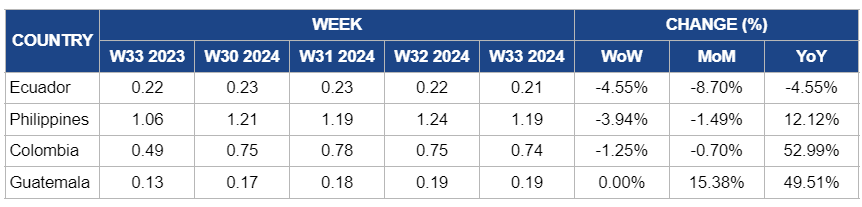
* Varieties: Ecuador and Philippines (overall banana average), Colombia (uraba), and Guatemala (criollo)
Yearly Change in Banana Pricing Important Exporters (W33 2023 to W33 2024)

* Varieties: Ecuador and Philippines (overall banana average), Colombia (uraba), and Guatemala (criollo)
* Blank spaces on the graph signify data unavailability stemming from factors like missing data, supply unavailability, or seasonality
Ecuador
In Ecuador, banana prices decreased by 4.55% week-on-week (WoW) to USD 0.21/kg in W33, despite ongoing challenges from the Moko disease, which significantly affects the quality of the banana production. This decline, which is also reflected in the 8.70% month-on-month (MoM) and 4.55% year-over-year (YoY) drops, is attributed to an oversupply from other banana-producing regions and market adjustments following the initial impact of the disease. Additionally, fluctuations in consumer demand and increased production and exports from other regions have contributed to the price decrease.
Philippines
In W33, banana prices decreased slightly by 3.94% WoW to USD 1.19/kg, returning to the price level seen in W31. There was also a 1.49% MoM decline. This minor reduction follows the previous week's price increase as supply conditions improved. However, ongoing challenges such as flooding, adverse weather, and political unrest continue to affect production levels, indicating that while there is some short-term price relief, the underlying issues impacting the market remain significant.
Colombia
Banana prices in Colombia decreased slightly by 1.25% WoW and 0.70% MoM in W33, which stood at USD 0.74/kg. The slight decline is due to the normalization of supply as production stabilized following the heavy rains in Apr-24, coupled with steady export growth that has helped balance demand. Additionally, improved weather conditions have eased some of the stress on crops, allowing for a modest recovery in output. However, looking at YoY, prices surged by 52.99% YoY, mainly due to the earlier climate-related disruptions from the El Niño phenomenon, which created significant production setbacks and tightened supply earlier in the year.
Guatemala
Guatemalan banana prices remained steady at USD 0.19/kg in W33, with a 15.38% MoM and a 49.51% YoY surge. This price stability reflects a temporary balance between supply and demand in Guatemala despite continued global demand and logistical challenges. While the peak harvest season has moderated further price increases, the sustained YoY growth highlights the ongoing pressure from international market dynamics and export costs, which continue to affect regional banana pricing.
3. Actionable Recommendations
Strengthen Pest Management and Reclaim Export Permits
Banana producers in Tumbes, Peru, should implement integrated pest management (IPM) techniques to address the persistent thrips plague and reduce reliance on excessive pesticide use. This includes using biological control methods, such as introducing natural predators, and improving pest monitoring systems. Additionally, they should work with SENASA to develop a remediation plan to regain export permits and ensure compliance with safety standards. This approach will help restore their export capabilities and enhance competitiveness.
Implement Enhanced Biosecurity Measures for Banana Farms
Small banana-growing units in La Guajira, Colombia, should actively participate in the biosecurity initiative led by ASBAMA and ICA. Specifically, each farm should implement the biosecurity measures provided in the kits, attend the training workshops on phytosanitary monitoring, and complete the survey to improve understanding and practices related to Foc TR4 disease. By adhering to these guidelines and utilizing the provided resources, farms can better prevent and mitigate Foc TR4 impacts and improve overall farm resilience.
Monitor and Adjust Pricing Strategy as Harvest Completes
Merchants in Tabasco, Mexico, should closely monitor banana harvest progress and adjust pricing strategies accordingly. As the harvest approaches total capacity, they should prepare to align their prices with market expectations to stabilize and potentially lower prices. Additionally, they should communicate expected price changes to customers and update pricing in response to supply fluctuations to remain competitive.
Sources: Tridge, Mercados, AgroPeru, Elheraldodetabasco, MXfruit, Portalfruticola, Expreso, Freshplaza, Freshfruitportal, Lahora


