
In W4 in the peanut landscape, some of the most relevant trends included:
- A Kalimundi insect infestation in India has devastated peanut crops, causing financial losses for farmers due to delayed pesticide support.
- A feasibility study showed peanuts can thrive in New Zealand’s Northland region, suggesting potential for a new industry to reduce import reliance.
- The seizure of 33 mt of unquarantined Chinese peanuts in South Korea highlights risks of pest introduction, prompting stricter border controls.
- Peanut prices in Brazil rose 10.64% WoW, influenced by weather conditions across key regions, with Mato Grosso do Sul and São Paulo stabilizing prices, while Paraná faces challenges that may affect future supply.
1. Weekly News
India
Severe Kalimundi Insect Infestation Devastates Peanut Crops in Kendrapara District
A severe infestation of Kalimundi insects has devastated peanut crops across seven blocks in Kendrapara district, impacting hundreds of farmers. Many have invested around USD 230.84 per acre (INR 20,000/acre) but are now facing substantial financial losses. Despite appeals for support, farmers report a lack of adequate assistance and pesticide provision more than a week after the outbreak. Although the agriculture officer noted that the pest issue has not reached an economic threshold, local farmers are frustrated by delayed responses from authorities. Efforts are being made to distribute subsidized pesticides and raise awareness. However, many farmers remain concerned about the lack of timely intervention.
New Zealand
Promising Results From Peanut Feasibility Study in New Zealand's Northland Pave the Way for Potential Industry
A USD 1.01 million feasibility study on peanut cultivation in New Zealand's Northland has yielded promising results, potentially paving the way for a new industry. Led by Picot Productions in collaboration with Manaaki Whenua and the Landcare Research and Plant and Food Research, the three-year project showed that peanuts can thrive in Northland's soil, with yields averaging 4 to 6 metric tons (mt) per hectare (ha), comparable to Australian production levels. The project also highlighted the potential for reducing reliance on international imports. While establishing a full-scale industry will require significant investment in processing, the trial's success suggests a viable future for peanuts in the region.
South Korea
Seizure of 13 MT of Illegally Imported Raw Peanuts Highlights Tightened Quarantine Measures in South Korea
On January 23, the Animal and Plant Quarantine Agency (APQA) reported the seizure of 33 mt of illegally imported Chinese agricultural products, including 13 mt of raw peanuts. These products were found in a logistics warehouse in South Korea's Gimpo, Gyeonggi Province, and were not subjected to the required plant quarantine. Under the Plant Quarantine Act, agricultural products like peanuts must undergo quarantine checks before import and export to prevent the introduction of pests and diseases. Violators may face up to three years of imprisonment or a fine of up to USD 20,778 (KRW 30 million). The agency has recently intensified border checks due to increased demand during the Lunar New Year holiday.
2. Weekly Pricing
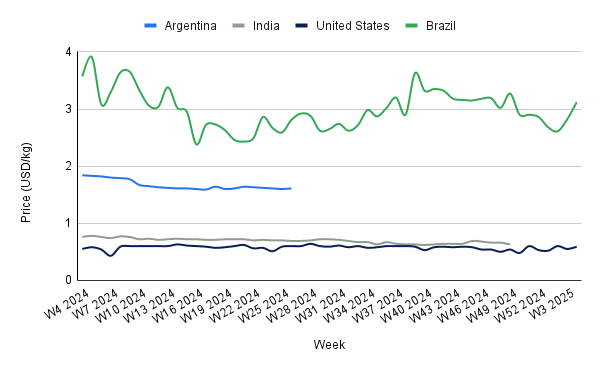
Weekly Peanut Pricing Important Exporters (USD/kg)

Yearly Change in Peanut Pricing Important Exporters (W4 2024 to W4 2025)
United States
The United States (US) peanut prices rose to USD 0.59 per kilogram (kg) in W4, reflecting a 10.64%week-on-week (WoW) rise and a 7.27% year-on-year (YoY) increase, driven by lower yields despite expanded acreage. Arkansas, a growing peanut-producing state, increased plantings by over 30%, yet unpredictable weather patterns—including spring rains and summer drought—lowered yields to approximately 5,200 pounds (lbs) per acre, a 500-lb drop from 2023. While increased acreage partially offset yield declines, overall supply constraints could sustain elevated prices in the near term. If high prices persist, further acreage expansion in 2025 may stabilize or soften prices, depending on weather conditions and demand trend.
Brazil
Brazil's peanut prices rose to USD 3.12/kg in W4, marking a 10.64% WoW increase but a 12.61% YoY decrease. The price fluctuation is influenced by varying conditions across key production states. Mato Grosso do Sul has favorable weather, supporting a promising harvest, which could stabilize or boost prices. Minas Gerais also expects good yields due to favorable conditions, while Paraná faces challenges from inconsistent rainfall, potentially impacting supply and pricing. São Paulo's production recovery, bolstered by favorable weather and integration with sugarcane farming, may help offset declines in other regions and support market stability. Regional weather discrepancies remain a factor that could influence future prices.
3. Actionable Recommendations
Strengthen Pest Control and Support Systems
Given the significant damage caused by Kalimundi insect infestations, it is critical to invest in early pest detection and rapid response mechanisms. Governments and agricultural agencies should prioritize timely pesticide distribution and provide financial assistance or insurance options to affected farmers, minimizing the impact of pest outbreaks on their livelihoods. Exploring public-private partnerships could yield more effective pest management solutions.
Develop a Domestic Peanut Industry
Stakeholders should capitalize on New Zealand's successful feasibility study by investing in processing facilities and other infrastructure to scale peanut production. This could reduce reliance on imports and bolster local production, enhancing food security. Government incentives and private-sector partnerships could help accelerate industry development and address processing challenges.
Enhance Quarantine Enforcement and Trade Compliance
Stricter enforcement of quarantine measures is necessary to prevent the introduction of pests and diseases through illegal imports. Countries should invest in advanced tracking and monitoring systems at borders, ensuring that all agricultural products, including peanuts, undergo proper quarantine checks. Strengthening international cooperation on trade compliance and enforcing penalties for violations can safeguard domestic crops and prevent long-term agricultural damage.
Sources: Tridge, YNA, MSN, NZ Herald


