The Downfall of Chilean Grapes and the Rise of Peru
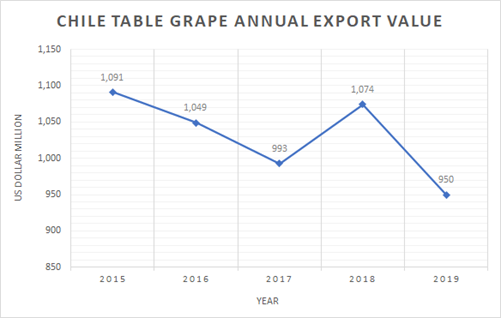
Along with the rise of international competitors, 2020 has posed several challenges for the Chilean grape market: unfavorable weather from heavy droughts, and social unrest moving in tandem against the backdrop of the COVID-19 pandemic. Until 2013, Chile was regarded as the number one exporter of table grapes in the world, performing at an annual export volume exceeding 800K tons, valued at USD 1.3 billion. More than three-quarters of the country’s production volume is intended for the export market, most notably the European Union and the US, which are the largest import markets for grapes.
Chile lags behind others in fulfilling a new demand landscape
Source: 080610 - Fresh grapes, ITC Trade Map
With new competitors on the rise, such as Peru, South Africa, Australia, and China, along with demand for new varieties, Chile is no longer illustrating the promising status it once held in the international market. In contrast to the rest of the global grape industry which has made significant strides in producing in-demand seedless varieties in the last ten years, Chile has been unable to meet this pace of development, and is failing to fulfill the demand for special varieties. 64 percent of North American grapes are protected varieties, which are varieties higher in demand by global consumers such as the prime seedless, and yet only 8 percent of Chile’s is protected. Failure to adjust to this new varietal exchange means the country may lose a big portion of its main markets like the US.
In addition, table grape production has declined sharply since the coronavirus outbreak. Earlier this year, the Chilean government imposed food supply measures on a national scale to focus on domestic supply needs and slowed global export in response to COVID. In addition, Chilean banks have been very reluctant to extend new loans to the country’s agricultural sector despite government guarantees. The lack of financial support for local farmers is one of the reasons for the significant production hindrance within the country’s grape industry.
Chile has suffered from suboptimal weather, specifically severe droughts, for the last decade. This year, such unfavorable conditions have caused a bigger blow to the country’s grape production as water suppliers further dwindled during the peak of COVID.
Table grapes in particular have seen lower profitability which has resulted in important structural changes - namely a decrease in the planted area and varietal replacements. This is troubling for Chile, as international demand for table grapes is continuing to grow and yet the country has been unable to meet buyer needs for new varieties. Since 2008, production areas for table grapes have been in consistent decline. In 2017, there were roughly 47K planted hectares, which was an 8.4% decrease from 2008. In 2020, there are only 37K hectares of table grape production areas in Chile.
Lastly, Chile has been affected by social unrest throughout 2020. Protests have covered the streets of Santiago since late 2019, where citizens have mobilized a movement against the government for a constitutional referendum. This has greatly impacted the country’s agricultural sector, and the grape market has been no exception in being subject to significant logistical obstacles in exporting during such times of political turbulence. Due to a combination of these factors, even though exports to China have risen, exports to the U.S. which is Chile’s biggest market has fallen by 30 percent.
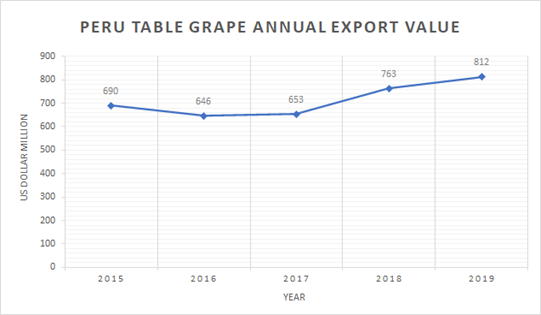
Peru steps into the limelight as the US's new go-to grape source
Source:080610 - Fresh grapes, ITC Trade Map
Amidst Chile’s downfall, Peru has been stealing the spotlight with a consistent increase in annual exports of table grapes. Specifically, Peru has captured a large portion of the US import market share which once used to be Chile’s. Despite experiencing similar challenges with the coronavirus pandemic, Peru is planning to ship more than USD 1billion worth of grapes to the US and setting a new record, with most of the exports occurring in the second half of 2020. The Peruvian Ministry of Agriculture and Irrigation has stated that in August alone, Peru exported more than USD 430K in volume to the US which indicates a 21% increase over the same period in 2019.
One of the main reasons for Peru’s success against a competitive market landscape is that the country has seen a significant increase of 6% in planted tree areas this year in comparison to last year (32K ha in 2020 to 2019’s 20K ha). Additionally, Peru is consistently seeking out new production areas in both the north and south of the country for potential investment opportunities, as a means to expand on its marketing potential. We can expect Peru to continue taking over a larger share of the global grape market, with demand rising in the US, the European Union, and China.
Sources
- Americafruit. "Peruvian grape exports to break US$1bn barrier"
- FreshFruitPortal. "Chilean table grapes: Industry expects lower exports amid drought"
- Blue Book Services. "Chilean fruit exports fall 5% in 2020"
- Fluence Corp. "Chile’s Worst Drought in 60 Years Enters 10th Year"


