
1. Weekly News
Colombia
Colombian Avocado Exports Expected to Surge by 16% to 20% in 2024
Avocado exports from Colombia are projected to increase by 16% to 20% in 2024, potentially reaching a shipment volume of 141 thousand tons. During the peak season, the United States (US) market can expect more than 50 containers of avocados weekly from Colombia, with volumes gradually decreasing as the season progresses. The country's tropical climate allows for the year-round availability of Hass avocados, a primary industry in Colombia's economic development. Over a dozen modern packing houses and more than 400 growers are certified to ship Hass avocados to the US market. The Colombian Avocado Board (CAB) is enthusiastic about supporting avocado growers, exporters, and importers as it invests in Colombia and leverages its logistical advantage to the East Coast of the US. The 2023 season concluded with record shipments exceeding 32 million pounds (lbs), and by 2024, shipments are expected to increase by more than 50%, reaching a total volume of 50 million lbs for the whole year.
Colombian Exporter to Deliver First Avocado Shipment to Chile
A Colombian exporter, part of the Transintercargo group, is set to deliver its first container of avocados to Chile in the first week of Jun-24. The company operates its seedbed in Colombia, producing 120 thousand seedlings annually, highlighting its substantial production capabilities and expansion into new markets. They collaborate with 70 producers and form strategic alliances to support medium and small farmers in delivering quality products. Currently, in the second cultivation season, the Colombian exporter, with offices in Bogotá, Rionegro, and Miami, aims to ship 25 containers from its own and allied fields. The company's expansion into Chile, known for its high avocado consumption, as a primary market marks an important step in its growth strategy.
Indonesia
Indonesia Seeks Investment Opportunities in Mexico's Agricultural Sector
Indonesia is interested in promoting investments in Mexico and importing various agricultural products, including avocado, sugar, berries, livestock industry inputs, oil palm, and tropical fruits. The General Coordination of International Affairs of the Secretariat and the Indonesian Embassy in Mexico aims to meet with primary Mexican associations to facilitate exports. Indonesia also plans to certify Mexican companies under its halal guarantee system. The Indonesian government seeks to strengthen trade relations with Mexico and explore opportunities like visiting palm oil production fields in Chiapas.
Peru
Peru's 2023/24 Avocado Season Sees Reduced Size and Export Quality Challenges
Peru's 2023/24 avocado season is characterized by a lower percentage of large-sized fruit, with only 20% classified as large, 25% as medium, and 55% as small. Production volumes have also significantly decreased. Various defects are hindering the avocados from being suitable for export. The main issues include pests like queresa, heat damage, and damage from basket bugs.
Majes-Siguas II Irrigation Project to Boost Peru's Agro-Exports and Avocado Market
The Peruvian Minister of Agrarian Development and Irrigation announced that the Majes-Siguas II irrigation project will significantly boost agro-exports by enabling avocado harvests to start in January in Arequipa. This timing will complement harvest dates in the north, expanding the fruit's availability in international markets. The minister also emphasized the critical need for investments in Majes I, which requires rehabilitation of canals, intakes, and dams, alongside Majes-Siguas II, which involves investments of USD 800.6 million (PEN 3 billion). The goal is to have these projects approved by Jun-24. Additionally, the minister highlighted the development of a green hydrogen project in Arequipa, positioning Peru to produce fertilizers and reduce reliance on urea imports. The Ministry of Defense is set to transfer land for this project on Jun-24.
Philippines
Philippine Hass Avocado Poised for Entry into Japanese Market
The Philippine Hass avocado is set to enter the Japanese market. The Department of Agriculture (DA) has requested the export of this high-value crop, recognizing its export potential. The industry anticipates the final announcement of market access for avocados this year, with phytosanitary requirements tentatively agreed upon during a visit to Japan last December. In 2023, Japan imported USD 160 million worth of avocados. The first shipment of fresh Philippine avocados arrived in South Korea on Sep-23, marking a significant milestone in the nation's international trade efforts. Current markets for Philippine avocados include China, Malaysia, South Korea, Singapore, Hong Kong, Brunei Darussalam, the United Kingdom (UK), and Northern Ireland.
South Africa
South Africa Expands Avocado Production Beyond Traditional Regions
A report from a South African website on May 28 highlights the country's expansion of avocado production areas. While production has traditionally been concentrated in subtropical regions such as Limpopo and Mpumalanga provinces, the growth in demand and production has led to an expansion into KwaZulu-Natal and Eastern Cape provinces. Avocados are now even being planted in the southern and western Cape regions. Currently, 1 thousand hectares (ha) of avocados have been planted in the Cape region, accounting for about 5% of the national production. The harvest period for avocados in this region lasts from Oct-24 to Jan-25. The region's geographical advantage allows for efficient supply to significant export markets through its eastern ports.
United States
Inflation Leads 24% of US Consumers to Cut Back on Avocado Spending
The Packer's Fresh Trends 2024 report reveals that 51% of US consumers have purchased avocados in the past 12 months, with 23.8% reducing their spending due to inflation. Additionally, 44.6% of consumers feel confident selecting ripe avocados for immediate use, while 41.4% prefer avocados that ripen at home. High-income households, families with two or three children, and residents in the western region report more frequent avocado purchases. Individuals under 60 are the most likely to buy avocados, with 57% of people aged 30 to 39 and 40 to 49 including them in their shopping baskets over the past year.
2. Weekly Pricing
Weekly Avocado Pricing Important Exporters (USD/kg)
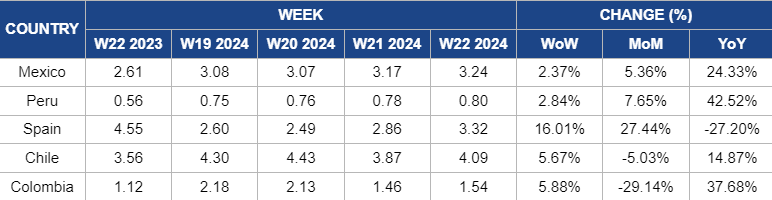
Yearly Change in Avocado Pricing Important Exporters (W22 2023 to W22 2024)

Mexico
Avocado prices in W22 increased by 2.37% week-over-week (WoW) to USD 3.24 per kilogram (kg), up from USD 3.17/kg in W21. This rise also represents a 5.36% MoM increase and a substantial 24.33% YoY growth, driven by reduced supply during the low season in Mexico and sustained high demand.
Peru
In W22, Peruvian avocado prices increased by 2.84% WoW to USD 0.80 per kilogram (kg), compared to USD 0.78/kg in W21. Additionally, there is a 7.65% month-on-month (MoM) increase, reflecting a steady rise in prices since the previous month. This price increase is primarily due to the climatic conditions caused by the El Niño phenomenon, which has impacted the production of key export crops. The lower temperatures in producing areas over the past few months have led to a reduced harvest volume, struggling to meet international market expectations. Furthermore, the previous trend of reduced avocado sizes, particularly in smaller calibers, has exacerbated financial losses for farmers, contributing to the ongoing price rise.
Spain
The price of avocados in Spain increased by 16.01% WoW in W22 to USD 3.32/kg, compared to USD 2.86/kg in W21. This substantial rise can be due to the off-season of avocados in Spain, leading to a decrease in supply. Additionally, there was a 27.44% MoM increase, indicating sustained pressure on prices due to the continued low supply.
Chile
In W22, the price of Chilean avocados increased by 5.67% WoW to USD 4.09/kg, compared to USD 3.87/kg in W21. However, there is a 5.03% MoM decrease. The year-over-year (YoY) increase stands at 14.87%. This recent price rise is due to the ongoing high international demand for avocados, coupled with their premium value. Additionally, production challenges such as water scarcity and climate issues continue to affect supply, contributing to the overall upward trend despite the MoM decline.
Colombia
In W22, avocado prices in Colombia increased by 5.88% WoW to USD 1.54/kg. However, there is a 29.14% MoM decrease but a 37.68% YoY increase. Second to Mexico with 3.3 million lbs imported into the U.S. during W20, Colombia is currently at its peak season, and volumes are expected to remain above 1 million lbs per week until Aug-24. The WoW price increase is primarily due to short-term fluctuations in demand, while the MoM decrease reflects the ongoing peak flowering season, leading to an influx of supply. The significant YoY increase highlights the overall growth in demand and production improvements.
4. Actionable Recommendations
Enhancing Avocado Quality and Market Reach in Peru
To address the challenges faced in the 2023/24 avocado season, Peru should focus on improving pest management practices and implementing better quality control measures. It should also invest in research to develop more resilient avocado varieties and explore new markets to reduce dependence on traditional export destinations.
Ensuring Hass Avocado Compliance and Promotion in Japan
To successfully enter the Japanese market with Hass avocados, the Philippines should ensure compliance with all phytosanitary requirements and quality standards Japan sets. It should also conduct targeted marketing campaigns to raise awareness and create demand for Philippine avocados among Japanese consumers.
Advancing Infrastructure for Avocado Expansion in South Africa
To continue expanding avocado production beyond traditional regions, South Africa should invest in infrastructure and technology to support avocado cultivation in new areas. It should also provide training and support for farmers transitioning to avocado farming, ensuring sustainable practices and high-quality produce.
Strategies for Mitigating Inflation Impact in the Avocado Market Resilience in the US
To counter the impact of inflation on avocado spending, US retailers and producers should focus on offering competitive pricing and promotions to attract price-sensitive consumers. It should also emphasize avocados' health benefits and versatility to maintain consumer interest and drive demand.
Source: Tridge, Freshplaza, MXfruit,Portaldelcampo


