
1. Weekly News
Egypt
Malaysia Explores Market Potential for Egyptian Mango Exports Amidst Growing Agricultural Trade
The Egyptian Agricultural Quarantine recently welcomed a delegation from Malaysia to review plant health procedures, aiming to facilitate the entry of Egyptian mangoes into the Malaysian market. This visit is part of Egypt's broader strategy to expand its agricultural export footprint. The delegation thoroughly assessed quarantine systems and mango packing stations to ensure compliance with plant health standards. Mangoes rank seventh among Egypt's agricultural exports, with over 55.7 thousand tons shipped in 2024. Overall, Egypt's agricultural exports have surpassed USD 3.6 billion in 2024, marking a significant increase compared to 2023 figures.
India
Seminar at ICAR-CISH Aims to Enhance Mango Yield and Quality in India
The Indian Council for Agricultural Research-Central Institute of Subtropical Horticulture (ICAR-CISH) in India hosted a seminar on September 21, 2024 at its Rehmankhera headquarters to discuss improving mango yield and quality. This event brought together agricultural scientists from India and worldwide to discuss advancements in mango production standards, particularly in Uttar Pradesh and North India. Mango production in India is crucial for the livelihoods of millions. However, it faces significant challenges from diseases and pests, leading to yields that fall short of global standards. The seminar addressed these issues and featured contributions from renowned international experts who shared valuable insights. Notably, Uttar Pradesh accounts for 23.6% of India's mango production and is recognized for its diverse varieties.
Mexico
Mexican Mango Exports Decline Amid Drought and USDA Restrictions
Mexican mango exports to the United States (US) and other markets have significantly declined due to drought and restrictions imposed by the United States Department of Agriculture (USDA). Over 3.52 million 4-kilogram (kg) boxes of mangoes remain unsold, impacted by reduced production and limitations on Sunday operations. Despite these challenges, Mexico anticipates exporting 62 million boxes to the US in 2024, down from 66 million in 2023. The US, Mexico's largest mango buyer, also imposed stricter hydrothermal process regulations in southern Mexico, reducing exports by 10 to 15%. Climate conditions continue to pose long-term risks to Mexico's mango production.
Peru
Rising Prices in the Early Weeks of the Peruvian Mango Season
The Peruvian mango season commenced with increasing prices, fueled by strong local and regional demand from Peru, Ecuador, and Colombia. Initial shipments of the Edward mango variety have seen prices rise to USD 0.45/kg (PEN 1.70/kg). The staggered production of this variety enabled continuous harvests, which limited supply and contributed to the price surge. In response, producers are prioritizing top-quality fruit for these key markets. As more companies initiate their acquisitions, additional price increases are anticipated.
2. Weekly Pricing
Weekly Mango Pricing Important Exporters (USD/kg)
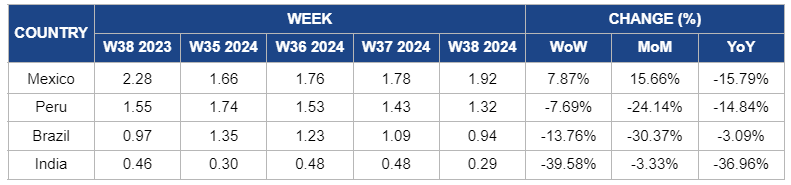
* Varieties: Mexico (Manilla), Peru (Kent), Brazil (Tommy), and India (overall average)
Yearly Change in Mango Pricing Important Exporters (W38 2023 to W38 2024)

* Varieties: Mexico (Manilla), Peru (Kent), Brazil (Tommy), and India (overall average)
* Blank spaces on the graph signify data unavailability stemming from factors like supply unavailability, missing data, or seasonality
Mexico
Mexico's mango prices increased by 7.87% week-on-week (WoW) to USD 1.92/kg in W38, reflecting a 15.66% month-on-month (MoM) increase. This rise can be due to ongoing limited availability caused by unfavorable weather conditions, including droughts and extreme heat in key growing regions such as Sinaloa and Nayarit, which affected harvest volumes. However, mango prices declined by 15.79% year-on-year (YoY) due to improved production levels in 2024, as this year's production is significantly better compared to the severe supply shortages experienced during the same period in 2023.
Peru
In W38, Peruvian mango prices decreased by 7.69% WoW to USD 1.32/kg, marking a significant decline of 24.14% MoM and 14.84% YoY. This price reduction comes despite the initial surge due to strong local and regional demand at the onset of the Peruvian mango season, particularly for the Edward mango variety. The staggered production of this variety had initially limited supply and contributed to price increases. However, as the season progressed, the influx of additional shipments and increased competition among producers led to a broader supply availability, resulting in downward pressure on prices.
Brazil
Mango prices in Brazil dropped by 13.76% WoW to USD 0.94/kg in W38, reflecting a substantial 30.37% MoM decline and a slight 3.09% YoY decrease. This continued price drop is primarily driven by an ongoing surge in domestic supply as the harvest season progresses, particularly in major producing regions like the São Francisco Valley, where peak production is occurring. Additionally, weakening export demand from primary markets compounded the downward price pressure. Although YoY prices have declined, they remain elevated compared to last year's levels, which were significantly impacted by adverse weather conditions that constrained supply and fueled stronger export demand in W38 2023.
India
In India, prices fell to USD 0.29/kg in W38 due to improved weather conditions, leading to better production levels. This increase in supply has contributed to the downward pressure on prices. Moreover, there is also a 3.33% MoM decrease and a significant 36.96% YoY decline, reflecting the ongoing recovery from weather-related disruptions that had previously affected production capacity.
3. Actionable Recommendations
Strengthen Compliance with USDA Regulations and Diversify Export Markets
Mexican mango exporters should improve compliance with USDA hydrothermal process regulations to minimize export disruptions. Additionally, exporters must diversify their markets beyond the US by targeting new international buyers and reducing reliance on a single market. Strengthening partnerships and promotional efforts in regions with less stringent import regulations can help offset reduced exports to the US and ensure continued market access amidst climate and regulatory challenges.
Implement Strategic Marketing to Boost Mango Demand
Brazilian mango producers should implement strategic marketing initiatives to stimulate domestic demand amid rising supply. This can include promotional campaigns highlighting Brazilian mangoes' quality and versatility, targeting local retailers and consumers. Additionally, producers should explore niche markets and value-added products, such as dried or processed mangoes, to diversify their offerings and stabilize prices against fluctuating supply levels. Engaging in collaborations with culinary influencers and chefs can also enhance consumer interest and drive sales.
Prioritize Quality Control to Maximize Mango Profitability
Peruvian mango producers should prioritize quality control measures to enhance the marketability of their Edward mango variety. Producers can consistently deliver top-quality fruit by implementing strict grading standards and ensuring optimal harvesting practices to meet rising demand from local and regional markets. Additionally, investing in post-harvest handling and storage techniques will help maintain fruit quality during transportation, enabling producers to command higher prices and strengthen their competitive position.
Sources: Tridge, Eastfruit, Akhbarelyom, The Hindustan Times, Freshplaza, Agraria


