
1. Weekly News
Argentina
Argentina Introduces Electronic Transit Document for Hass Avocados
Starting December 25, 2024, Argentina will require the electronic Plant Transit Document (DTV-e) to transport fresh Hass avocados, as mandated by the National Service for Food Safety and Quality (SENASA) under Joint Provision No. 1/2024. This regulation aims to improve product traceability and safety in the national market. Consumers prefer Hass avocados, which comprise 87% of the 7.5 thousand tons sold annually at the Central Market of Buenos Aires. While 81% of avocados are imported from countries like Chile, Brazil, and Peru, domestic production mainly comes from the Northwest Argentina provinces (Tucumán, Jujuy, and Salta) and parts of the Mesopotamian region (Misiones, Corrientes, and Entre Ríos).
Australia
Australia's Avocado Production Surged by 30%, While New Zealand Faces Export Decline
Australia's 2023/24 avocado season saw a 30% year-on-year (YoY) production increase, reaching nearly 151 thousand tons due to favorable spring conditions. However, Western Australia and Queensland growers faced challenges like low prices and high input costs, with some abandoning orchards. Meanwhile, New Zealand's avocado export value plummeted from USD 168 million in 2020/21 to USD 20 million in 2023/24. Despite these hurdles, higher demand in Asian markets and reduced competition from Peru offer optimism, with ongoing exports to Canada, Asia, and Australia fueling hopes for better pricing this season.
Chile
Chile's Avocado Industry Grows with Rising Domestic Demand and Export Challenges
Chile’s avocado industry, primarily focused on Hass varieties, has seen remarkable growth, with per capita domestic consumption rising from 1.3 kilograms (kg) in 1973 to 9 kg in 2024, 8.2 kg of which are Hass avocados. While the country exports 56% of its avocado production, the domestic market remains crucial, accounting for nearly half of the output. Chile imports avocados from countries like Peru and Mexico to ensure supply during low production seasons. However, the industry faces challenges balancing export volumes with local availability to stabilize prices, maintain quality, and adapt to changing consumer preferences. Despite these hurdles, Chile’s avocado industry is known for its sustainability, market reach, and efficient logistics, with 93% of households consuming avocados, making them a staple in Chilean diets.
Georgia
Georgia's Rising Role in Global Avocado Trade
In the first 10 months of 2024, Georgia's avocado imports surged to 1.4 thousand tons. This is valued at USD 3.4 million, reflecting a 12.2% YoY increase. The Netherlands was the primary supplier, delivering 591 tons worth USD 2 million, followed by Turkey, the United Arab Emirates (UAE), Kenya, and Peru. In terms of exports, Georgia sold 259.6 tons of avocados to Armenia, earning USD 635 thousand. These trends highlight Georgia's growing appetite for avocados and its emerging significance in the global market.
Kenya
Kenya's Avocado Season Ends Strong Despite Export Challenges
Kenya’s avocado season, which runs from March to October, ended with strong production but mixed commercial outcomes due to export challenges. The Red Sea crisis disrupted shipments to Europe, increasing transport costs and reducing export volumes, while an oversupply in the Middle East led to lower prices. Despite these setbacks, Kenyan exporters benefit from limited competition in East Africa and markets like Morocco, with Latin America being the main rival in the global avocado trade.
2. Weekly Pricing
Weekly Avocado Pricing Important Exporters (USD/kg)
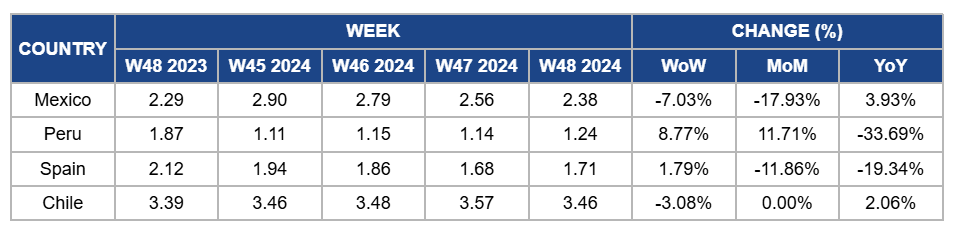
Yearly Change in Avocado Pricing Important Exporters (W48 2023 to W48 2024)

Mexico
Avocado prices in Mexico continued to drop in W48, declining by 7.03% week-on-week (WoW) to USD 2.38/kg, reflecting a 17.93% month-on-month (MoM) dip. The price decline is due to increased harvest volumes as the season progresses, which supported market availability and eased supply challenges from earlier in the year. Additionally, weaker export demand, particularly in primary markets, has pressured prices as buyers adjust to a higher supply. However, prices slightly increased by 3.93% YoY due to the rising global demand for avocados and limited supply in some competing exporting regions, which have supported prices compared to the previous year.
Peru
In Peru, avocado prices increased by 8.77% WoW to USD 1.24/kg in W48, with an 11.71% MoM rise due to steady European demand for high-quality avocados and favorable growing conditions that have optimized harvests. The seasonal transition into preparations for the next cycle has also supported prices as supply stabilizes in line with market demand. However, there is a significant decrease of 33.69% YoY due to intensified competition from Mexico in primary export markets, especially the United States (US), which has exerted downward pressure on Peruvian avocado prices. Ongoing concerns over cadmium levels and logistical challenges have further limited Peru's ability to achieve premium pricing in international markets.
Spain
Spain's avocado prices increased slightly by 1.79% WoW to USD 1.71/kg in W48 due to a gradual adjustment in market supply as early-season oversupply eased and domestic demand showed signs of recovery. Improved marketing efforts for locally produced avocados also contributed to the slight price increase. However, prices dropped significantly by 11.86% MoM and 19.34% YoY due to the lingering effects of market saturation from high green-skinned avocado supplies earlier in the season and intensified competition from imported avocados. Additionally, ongoing water shortages have continued to impact production volume and quality, limiting the ability of Spanish growers to command higher prices in a competitive market.
Chile
Avocado prices in Chile dropped slightly by 3.08% WoW to USD 3.46/kg in W48 but with no MoM change. This is due to easing export demand following the initial seasonal surge and improved availability as harvest activities progress steadily. The minor adjustment reflects balanced market conditions and sufficient domestic supply to meet demand. Moreover, YoY prices slightly increased by 2.06% due to Chile's strengthened market position, supported by its sustainability initiatives and enhanced production efficiency. These factors have bolstered Chile's reputation in export markets, particularly in Europe, where demand remains steady for high-quality, sustainably grown avocados.
3. Actionable Recommendations
Enhance Avocado Trade Opportunities
Avocado importers and exporters in Georgia should strengthen trade relationships with key suppliers, such as the Netherlands and Turkey while exploring opportunities with emerging markets like Kenya and Peru. Exporters should leverage the growing demand in neighboring Armenia by ensuring consistent quality and competitive pricing. By diversifying sourcing channels and streamlining logistics, stakeholders can sustain growth and reinforce Georgia’s role in the global avocado market.
Optimize Supply Chain to Balance Exports and Local Demand
Chilean avocado producers and distributors should streamline supply chain operations to balance export commitments with domestic availability. This includes leveraging imports during low production seasons and improving logistics to stabilize prices and ensure consistent quality. By aligning production strategies with consumer preferences and market demand, stakeholders can maintain Chile’s position as a global avocado leader while supporting local consumption.
Enhance Market Position with Strategic Marketing and Water Management
Spanish avocado growers and distributors should intensify efforts to market locally produced avocados by highlighting their quality, freshness, and sustainable production practices through targeted campaigns and collaborations with retailers to promote regional branding. Stakeholders must also invest in efficient water management solutions such as drip irrigation systems, water recycling, and soil moisture monitoring to improve production volume and quality, ensuring resilience against water shortages and sustaining competitiveness in a challenging market environment.
Sources: Tridge, Bizzone, Eastfruit, Fenesi Growers, Freshplaza, MX Fruit, Rnz, Sbs, Portalfruticola


