Garlic to Remain a Strategic Chinese Export in Coming Years
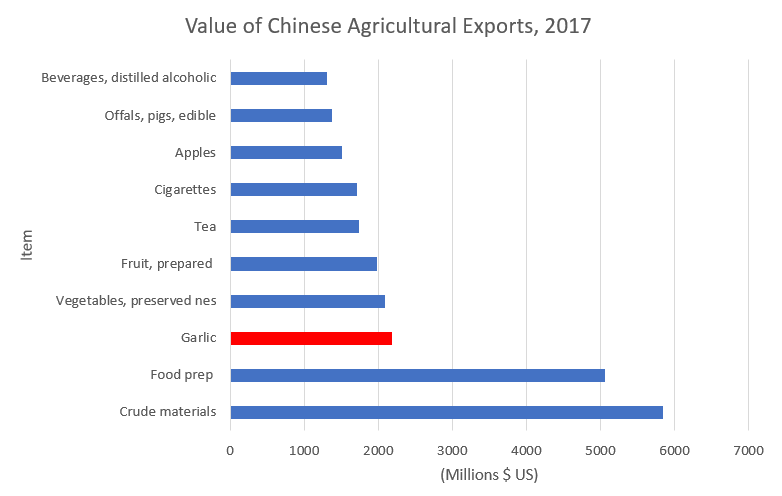
Source: UN FAO
China’s Promotion of Garlic as a Model Export
China’s garlic markets have grown dramatically since 2001 when China entered the WTO. Despite significant manufacturing capabilities at the time, a large portion of the population still relied heavily on agriculture for subsistence. As a result, the promotion of garlic, a cash crop, was seen by the government and industry leaders as a way to promote domestic industries, while also increasing the participation of rural labor in a global commodity market.
As a prelude to many trade sanctions on the crop that followed, in 2000 South Korea imposed tariffs of 300% on Chinese garlic exports following complaints by Korean garlic producers. The measure shocked the Chinese garlic industry at the time. Rather than retaliating with tariffs on a similar category of trade, China imposed a total freeze on Korean mobile phone exports and on certain forms of plastics in response. These aggressive measures forced South Korea to lift the garlic tariffs, and the affected South Korean industries even financed the purchase of Chinese garlic in order to acquiesce to Chinese demands that Korea’s garlic purchases meet certain mandated levels. This highlights the strategic importance to China of its garlic exports in international markets.
Current, industry experts are promoting garlic as a useful commodity for promoting China’s “one belt one road initiative” for furthering China’s influence and economic position in partnering countries. One team of Chinese scholars recently promoted the initiative as a way to escape the “low-price competition trap” of Chinese garlic, in which a rise in production (and exports) generally coincides with a fall in prices and revenues. How this will play out is uncertain, though it seems likely that Chinese one belt one road initiatives will likely eliminate certain tariff barriers to the product.
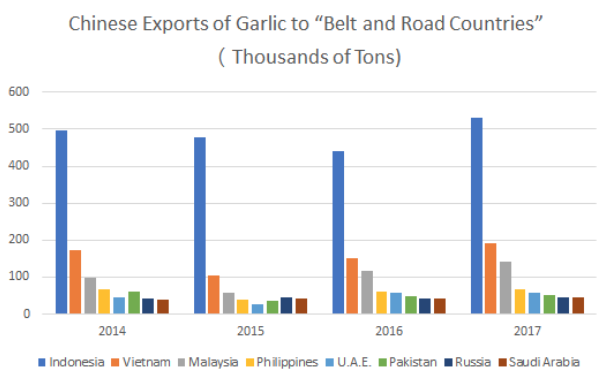
Source: Bei Fang Yiyuan
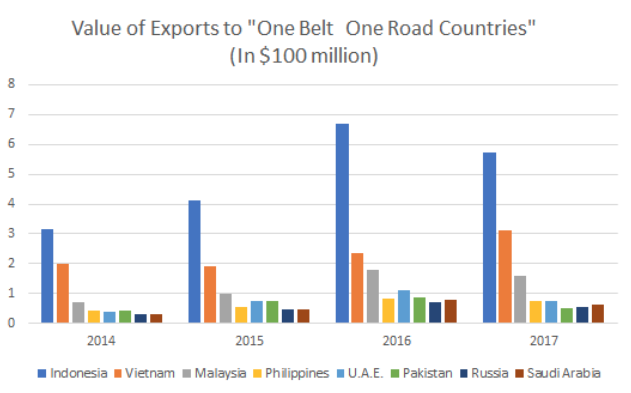
Source: Bei Fang Yiyuan
The Impact of Past and Present Sanctions on Chinese Garlic in the U.S.
A recent trade dispute over Chinese garlic in US markets may offer some insight into future arrangements. In the US, most Chinese garlic importers have been subject to duties of 377% in response to complaints by US producers that the Chinese garlic exports amounted to illegal market dumping. One company, Harmoni, has been spared from these tariffs for years, apparently because of an informal agreement with large US garlic interests represented by the U.S. Fresh Garlic Producers Association.
Last year, reports of prison labor used in Harmoni’s garlic peeling operations were published in the Financial Times, and showcased in the Netflix series Rotten. Attempts to impose duties on its goods were filed in 2014 by a small garlic farmer in Colorado, Stanley Crawford. Counter-accusations and suits followed, claiming that trade complaints in the US against Harmoni were supported by rival Chinese garlic interests and amounted to “racketeering.”
Presently, the reception to tariffs imposed in the wake of the US-Chinese trade war has been mixed. A few of the remaining U.S. corporate garlic producers are grateful that the measures close out loopholes that have allowed Chinese products to get to the market. Others lament the impact on their businesses, which have adapted to relying on Chinese garlic to supply their customers.
This suggests that on a large scale, the ability in China to resolve internal competition between its large garlic interests together with the ability to reach deals with foreign agricultural interests will likely impact its future garlic prospects.
In addition, Chinese exporters will need to continue to adapt to restrictions and duties from countries abroad. It seems this has been done thus far to an extent by facilitating differentiated pricing for different countries. Pricing for China’s top export markets by value (Vietnam, the United States, and Indonesia) are largely independent of prices of garlic on the Chinese market. Despite the record increases in garlic prices this year, prices per ton fell for exports to both Vietnam and the United States (not factoring in additional tariffs).
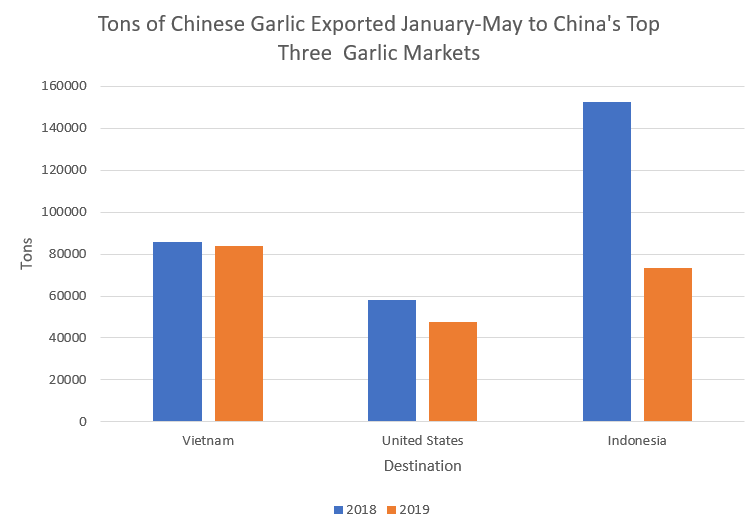
Source: Chinese Ministry of Commerce Statistics
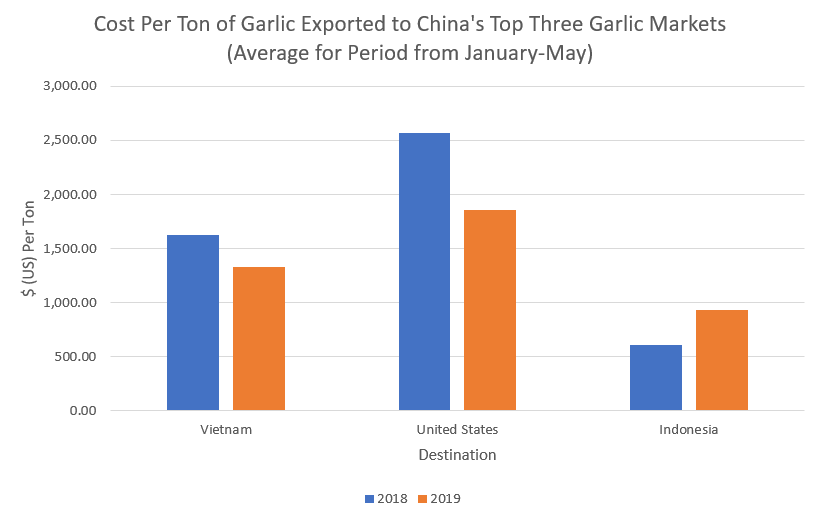
Source: Chinese Ministry of Commerce Statistics
Future Prospects For Chinese Garlic
In the immediate future, unstable pricing and frequent export barriers for Chinese garlic are likely to remain. Overall, Chinese garlic farming is still done at the household level. This makes standardization and safety of the product difficult to maintain, something cited domestically as a barrier to improved competitiveness of the product. Findings of excessive pesticide residues on the product are frequently cited as the basis for levying duties on the product abroad. With the cost of Chinese labor rising, one of the ingredients for cheap Chinese garlic may also be harder to supply.
Speculation has been cited as one of the reasons prices for the product’s all-time high pricing this year. In 2009, a similar escalation led to reports that pricing in the industry was heavily opaque, and that the item was seen as a quick way to turn a profit by traders. Because garlic is only harvested in China once a year and stores well, speculators store the product in warehouses and sell as they see profitable.
Source with Tridge
Through our worldwide network, we identify the most competitive business opportunities for every buyer and supplier. We help discover new trade opportunities with genuine counterparties from more than 150 countries.
Send inquiry: business@tridge.com
Or request for sourcing: https://www.tridge.com/get-offers
Sources
- Chung, Jae Ho. “Interpreting the "Garlic Battle" in Sino-South Korean Relations” Pacific Affairs; Vancouver Vol. 76, Iss. 4, (Winter 2003/2004): 549-568.
- Yang Binbin, Zong Yixiang, Zhao Banghong, Zhongguo “Yidai Yilu” Yanxian Guojia Dasuan Chukou Maoyide Fanzhanlu Jing Yanjiu.” Bei Fang Yiyuan 2019: 9
- 3News. Translated from Chinese. "Pinduoduo Zhongmu garlic premium for poverty alleviation."
- Sohu. Translated from Chinese. "Do more and do more! Selling garlic to the supermarket for a quarter price, but farmers are super happy!"
- Financial Times. "Supply chains: the dirty secret of China’s prisons."
- South China Morning Post. "The garlic case that foreshadowed the US-China trade war."
- Axios. "Meet the U.S. farmers who love Trump’s China trade war."
- BBC. "The garlic farmers who love Trump's tariffs."
- The Colorado Sun. "How a Colorado College professor became a lightning rod for controversy by starting a global garlic war."