Excessive Production Volume over Quality
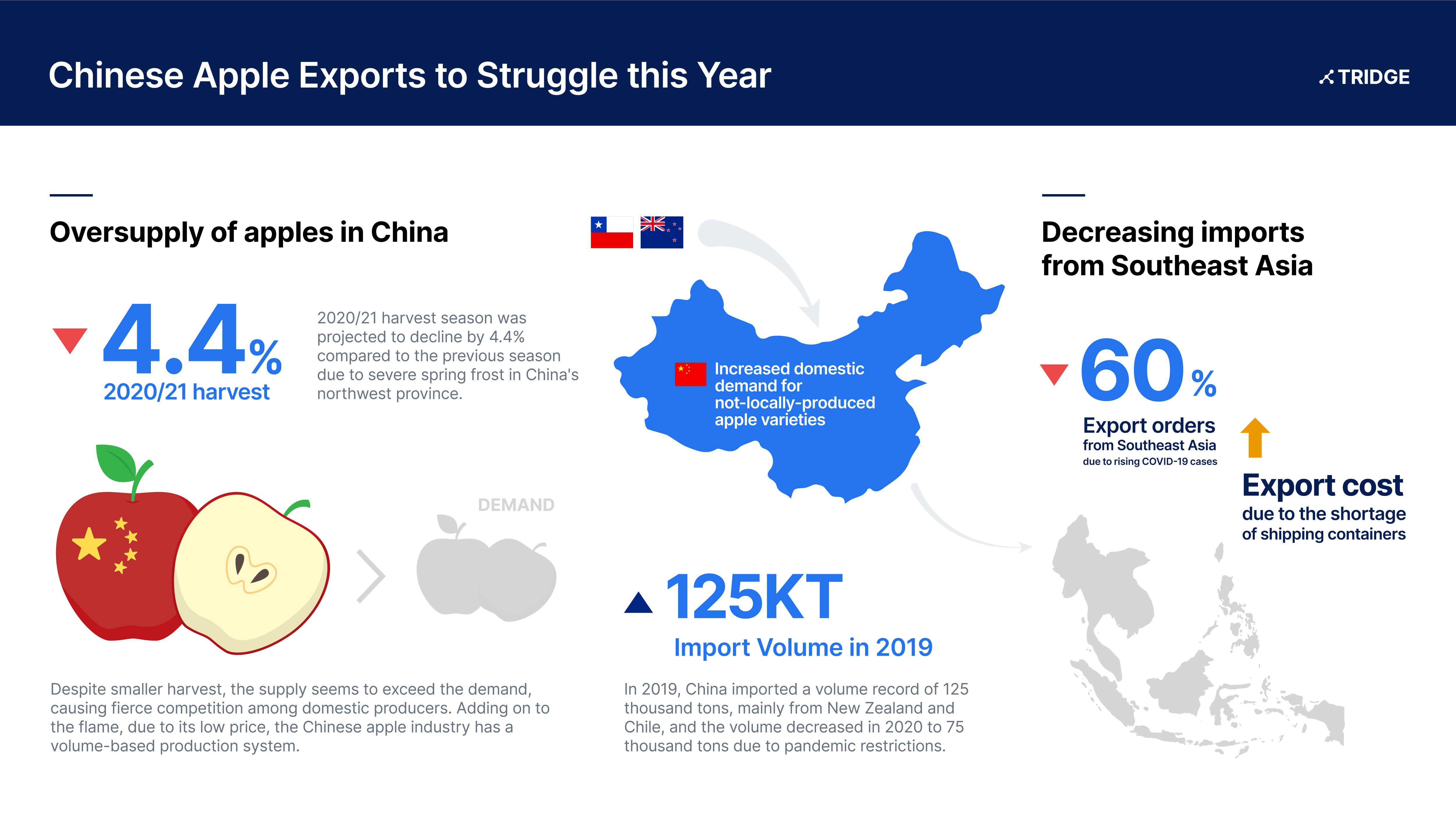
China is by far the largest apple producer accounting for about 55% of the global apple production. In the 2019/2020 season, a total of 42.4 million MT of apples were produced in China, which was one of their most extensive harvest seasons so far. However, in its semestral forecast production, the USDA has estimated a 4.4% decrease in the Chinese apple production for the next 2020/2021 harvest season due to severe spring frost in China’s northwest provinces. This means that around 40.5 million MT will be produced for next season, which would still be more than 50% of the global production, according to the same USDA reports.
China’s overall surface area devoted to apple cultivation continues to expand, to the point that the production volume is now exceeding domestic demand. The accelerated growth of apple production in China has generated fierce domestic market competition among producers. As production volumes are now excessive, producers have focused on a cost-competitive driven market under most of the same variety of apples. According to the China Agricultural and Economic Data, more than 60% of the apples produced in China are Red Fuji variety apples. Red Fuji remains the most common and consumed variety across Asia, particularly in China, where there is a higher volume preference over lower-grade fruit.
Chinese fresh apples are priced lower than those of other large producers, which has set a volume base production system. For farmers and exporters to generate consistent profit on their sales, they have to sell larger quantities. The Red Fiji variety allows a late harvest and a very extended shell life ideal for large volumes of exports.
Increasing Import Volumes for Other Varieties Market
Due to the lack of diversity in the product varieties produced in China, demand for other apple varieties has grown in the country. There is now a market in China for more specific varieties that can’t be met by domestic production, as farmers focus on producing larger volumes at a lower cost. Thus, apple imports into China from various countries have increased in recent years. Countries like New Zealand and Chile have obtained permission to export apples to the Chinese markets and have been able to increase their exports in recent years. In 2019, China imported a volume record of 125 thousand tons from a few global leading producers, and the volume decreased in 2020 to 75 thousand tons due to pandemic restrictions.
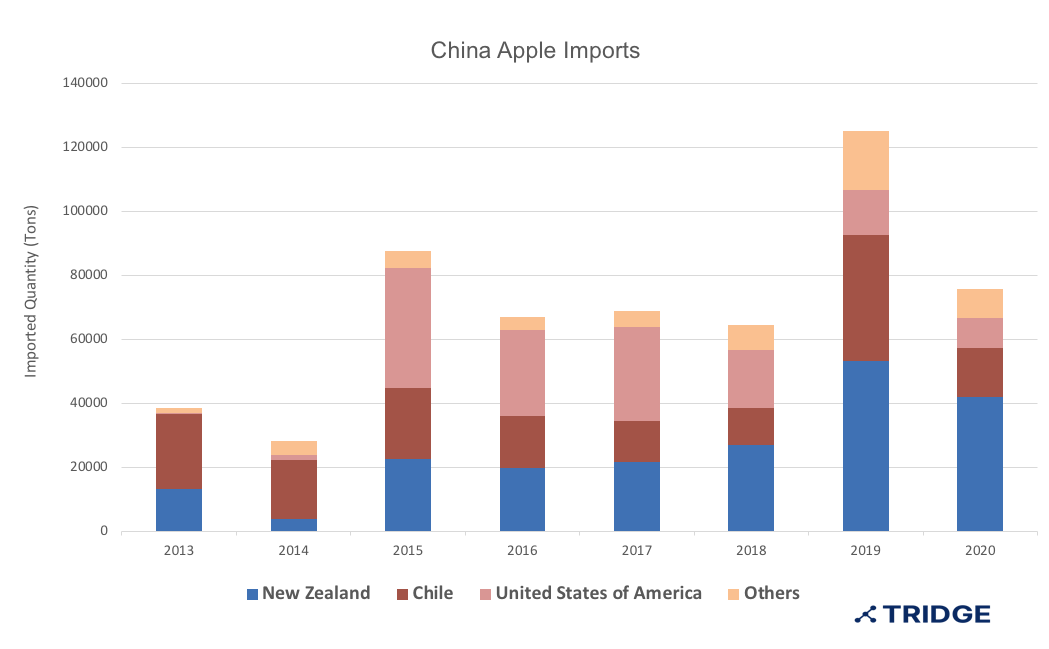
Source: ITC Trade Map, Tridge
New Zealand is the leading supplier of apples to China, accounting for 66.5% of the import share, followed by Chile with 14.3%. Both countries have taken the lead on the Chinese import market due to the fall of US apple imports over the past three years. A US trade conflict in 2018 and then a global health crisis within those years made the US become the third supplier. The shortage of new apple varieties in the Chinese market that was once taken by the US now represents a USD 200 million trade-in value, in which New Zealand took USD 115 million last year.
Commercial Dependency from South-East Asian Markets
In terms of exports, China has suffered poor sales and a drop in prices since 2019 due to the Covid-19 outbreak in South-East Asia, China’s largest market. In fact, more than 70% of Chinese exports are destined for southeast Asian countries. According to the China Customs Authority, export orders from this region have dropped 60% in volume this year. In 2018, total exports were 1.11 million tons, a year-on-year decrease of about 16%. In 2019, exports dropped further to 943,000 tons. The obstruction on China's apple exports by the COVID-19 outbreak in South-East Asia has also brought other challenges for exporters as rising distribution costs. A shortage of shipping containers is pushing export costs higher. If farmers are not able to export apples at the current price, they will have severe losses.
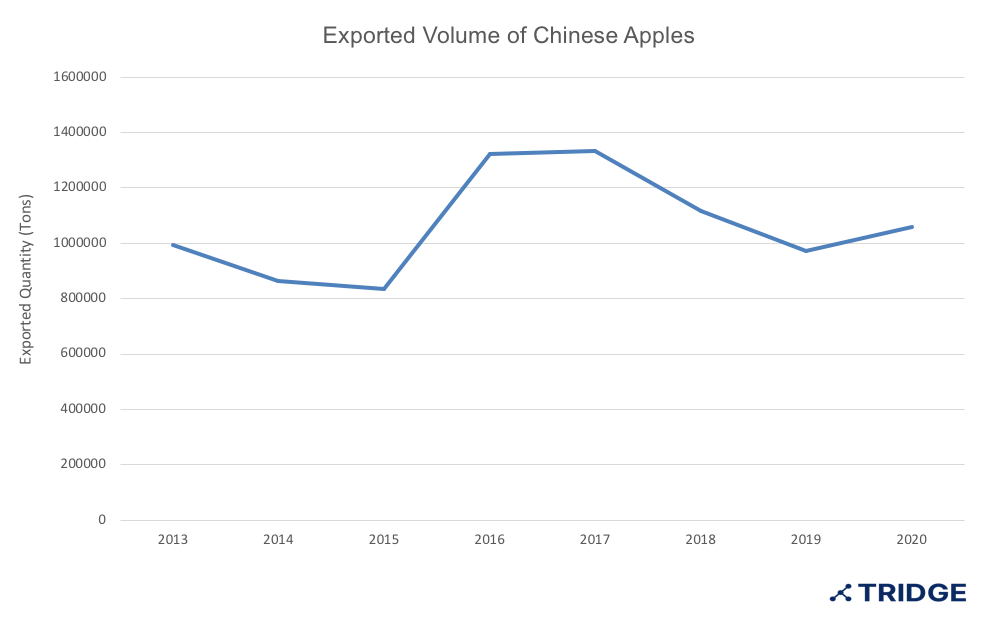
Source: ITC Trade Map, Tridge
Sources:
- Fresh Plaza. "Chinese apples struggle in export market, while the import apple market continues to flourish."
- Global Times. "China's apple exports hit by COVID-19 outbreak in South-East Asia."
- Fruit Net. "Covid resurgence hampers Chinese apple exports."
- Producer Report. "Chinese Apple Exports in 2020 Surpass 1 Million Tons."