PDF 파일 미리보기

The rise in global temperatures due to climate change has influenced the prices of agricultural products, particularly in how it affects the global supply chain and agricultural output.
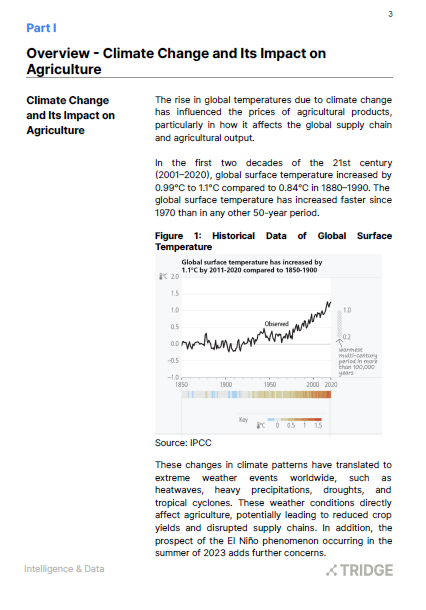
In the first two decades of the 21st century (2001–2020), global surface temperature increased by 0.99°C to 1.1°C compared to 0.84°C in 1880–1990. The global surface temperature has increased faster since 1970 than in any other 50-year period.
These changes in climate patterns have translated to extreme weather events worldwide, such as heatwaves, heavy precipitations, droughts, and tropical cyclones. These weather conditions directly affect agriculture, potentially leading to reduced crop yields and disrupted supply chains. In addition, the prospect of the El Niño phenomenon occurring in the summer of 2023 adds further concerns.
Action to mitigate climate change in the agriculture industry is through the collaboration of stakeholders to produce climate-resilient crop varieties. In addition, the need to fund financial support is increasingly urgent for a more sustainable future.
In the first two decades of the 21st century (2001–2020), global surface temperature increased by 0.99°C to 1.1°C compared to 0.84°C in 1880–1990. The global surface temperature has increased faster since 1970 than in any other 50-year period.
These changes in climate patterns have translated to extreme weather events worldwide, such as heatwaves, heavy precipitations, droughts, and tropical cyclones. These weather conditions directly affect agriculture, potentially leading to reduced crop yields and disrupted supply chains. In addition, the prospect of the El Niño phenomenon occurring in the summer of 2023 adds further concerns.
Action to mitigate climate change in the agriculture industry is through the collaboration of stakeholders to produce climate-resilient crop varieties. In addition, the need to fund financial support is increasingly urgent for a more sustainable future.
목차
Part I - Climate Change and Its Impact on Agriculture
Part II - Regional Cases
- EU
- Asia
- US
- LATAM
Part III - Global Action to Mitigate Climate Change
- Global Policies
- Collaboration on Climate-Resilient Crop Varieties
- Collaboration on Increasing Funds
Part IV - Key Take-away
관련 시장 데이터
관련 콘텐츠 더 보기
'쿠키 허용'을 클릭하면 통계 및 개인 선호도 산출을 위한 쿠키 제공에 동의하게 됩니다.
개인정보 보호정책에서 쿠키에 대한 자세한 내용을 확인할 수 있습니다.
'쿠키 허용'을 클릭하면 통계 및 개인 선호도 산출을 위한 쿠키 제공에 동의하게 됩니다.
개인정보 보호정책에서 쿠키에 대한 자세한 내용을 확인할 수 있습니다.