Recent developments in the current kiwifruit season
Chile Kiwifruit current season
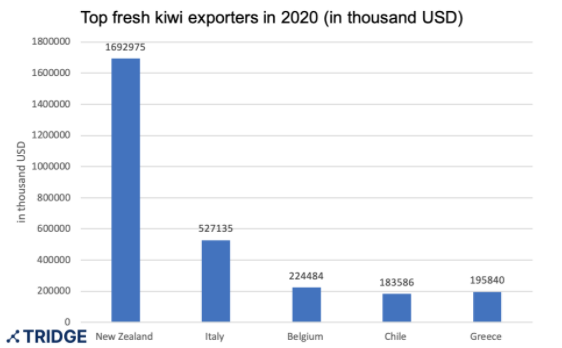
Chile is the fourth largest exporter of kiwifruit to the global market responsible for 5.9% of the world’s exports of 2019. The main variety produced in Chile is the Hayward, available from March to November. Golden and early Green varieties are available in smaller quantities.
The overall favorable weather during summer allowed healthy fruit growth, and a high-quality kiwi is expected. The heavy rain at the beginning of the year had little direct effect on kiwi, but water stains can appear from time to time. The MY 2021 export started at the end of February and mid-March, only for the early varieties. The export volume for this MY is expected to be about 5% lower than the previous year, due to smaller calibers caused by the prolonged drought during 2020 and the replacement of old to new trees that will need more years to reach their peak in production. Exports up to the end of March have been strong, with 5,254 MT exported and buyers securing volumes for the next few months. The high content of vitamin C in kiwis has kept its demand high during the pandemic. This stronger demand and slightly reduced availability have driven prices up by 30% higher than in the same period of last year.
Source: Tridge, ITC
Japanese kiwi market
Japan was the 15th importer of Chilean kiwifruit in 2020 with 4 thousand MT. And in April 2021, the Japanese government has announced the new MRL(Maximum Residue Limits) tolerance for the fungicide Fenhexamid in kiwifruits, to be higher at 15 ppm. The fungicide is widely used in Chilean orchards at flowering, pre-harvesting, and post-harvesting. This new tolerance will virtually allow Chilean kiwi producers to offer their kiwi to the Japanese market. Up to this point, there were orchards specifically grown for the Japanese market to comply with the restrictions of Fenhexamid. This relaxation will possibly reduce Chilean kiwi prices in Japan, and increase availability as more producers will be able to offer their kiwis to the Japanese market.
The general Japanese fruit consumption decreased in 2020 due to high prices, but consumption of kiwi increased to 1.23 kg per household. Japanese imports achieved an all-time record in 2020 with a YoY increase of 11.6%, with New Zealand responsible for the majority of the share (93.8%).
Largest kiwifruit production volume in New Zealand
New Zealand is the world leader of kiwifruit exports with 51.2% of the global share in value. And for the first time, the planted area of the Gold variety has surpassed the Green variety by 4% due to consumers’ preference and higher prices in the market. The harvesting season in 2021 started in March and will continue up to June. Although some producing areas in Motueka were hit by hail this week, the overall export is expected to break the last year’s record of 157 million trays exported of Green and Gold varieties.
Sources:
- Fresh Plaza. “Approximately 30% jump in pricing on Chilean Kiwis”.
- Fruits from Chile. Kiwifruit.
- Simfruit. Translated from Spanish. “Kiwi harvest and first exports of the season”.
- Fresh Plaza. “Chile Kiwifruit harvest and export starts”.
- Sim Fruit. Translated from Spanish. "Progress on Chilean kiwi exports of MY 2021".
- Fresh Fruit Portal. “Largest-ever kiwifruit harvest begins in New Zealand”
- Fresh Plaza. “New Zealand kiwifruit canopy area overtakes green area”