Tea Production Records an Increase in Production and Fall in Prices in 2021

In 2021, the global tea industry saw a slight recovery in terms of production, consumption, and prices compared to when the pandemic first hit in 2020. With economies opening up across the world, the demand for tea started to revive and the tea trade picked up quickly. Even production recorded a YoY increase as laborers working in tea plantations resumed their picking process. As per the Global Tea Digest, the increase in global production has been driven by India and Sri Lanka due to favorable weather conditions and the return of labor to harvest the tea leaves. Production in India increased to 792 thousand mt in 2021 from 670 thousand in 2020, a YoY increase of 18.15%. Similarly, Sri Lanka’s production was up by 18.19% from 177 thousand mt in 2020 to 209 thousand mt in 2021. Out of the top tea-producing countries, only Kenya’s production recorded a YoY decline of about 10%. The decline in production was not enough to offset increased production levels in India and Sri Lanka.
Overall, the global tea market recorded a YoY increase from 1.23 million mt in 2020 to 1.36 million mt in 2021. This is a YoY increase of roughly 11.5% over 2020 according to the Global Tea Digest. The higher supply of tea eased the global prices of tea and impacted the earnings of tea traders. According to FAO Tea Composite Price, the world tea nominal prices were down by 4.4% in 2021 compared to last year. Despite the higher demand, global tea prices managed to fall due to increased supply from major tea-producing regions. The lower prices have resulted in a reduction of exports and profit from selling tea leaves in the global market. In the case of Indian tea, many farmers are not even able to recover their cost of production and are running in losses.
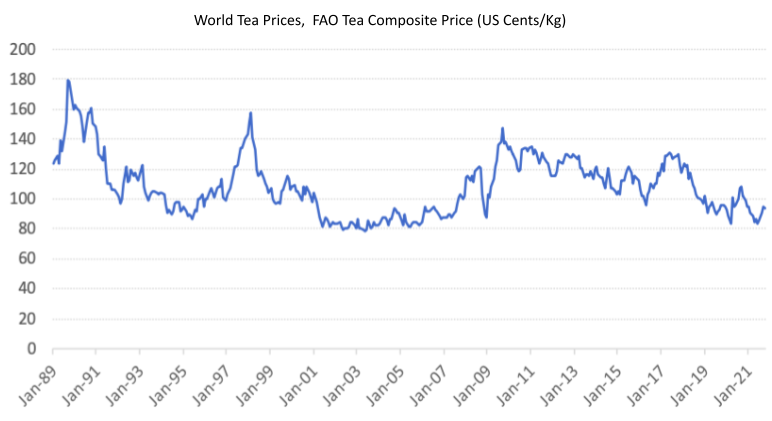
Source: FAO Tea Composite Price
Based on the trend seen in 2021, it can be concluded that booms and busts in tea prices stem from shocks to the production supply. If the prices remain this low in the coming few months, tea production may possibly become less popular among farmers due to reduced profitability. It is important to intervene in the global market, especially if the farmers are not even able to recover their production costs. Furthermore, if the Kenyan tea production revives, the market prices are likely to fall even more in 2022. The global tea market was valued at nearly 200 billion U.S. dollars in 2020 and is expected to rise to over 318 billion dollars by 2025. However, growth in the tea market can be sustained only if the prices come back to normal levels and the exports pick up their pace.