W28 2024: Soybean Oil Weekly Update
1. Weekly News
European Union
EU’s Soybean Imports Increased by 1% YoY in 2023/24 Season
The European Commission (EC) published the final report on imports and exports of agricultural products in the 2023/24 season, which ended on June 30, 2024. In particular, soybean supplies to the European Union (EU) remained the same as the 2022/23 season at 13.07 million metric tons (mmt). Soybean oil imports rose less than 1% year-on-year (YoY) to 518 thousand metric tons (mt), with 212 thousand mt from Ukraine, 134 thousand mt from Argentina, and 68 thousand mt from Norway.
China
China’s Edible Oil Transportation Industry Faces Scrutiny Over Safety Concerns
China’s edible oil transportation industry is under scrutiny following reports that kerosene and chemical tankers are used to transport edible oil without proper cleaning. These reports also indicated that grain and oil companies are aware of the mixed transportation but overlook the fake cleaning certifications. The lack of mandatory standards for particular vehicles and tanks for bulk oil in China exacerbates the issue. Though some grain and oil companies have established edible oil transportation fleets and regulations, many third-party companies still engage in mixed transportation due to inadequate supervision.
Brazil
Brazil's Soybean Oil Exports in Jun-24 Increased MoM But Declined YoY
Brazil's soybean exports reached 139.5 thousand mt in Jun-24, equivalent to 735 thousand mt of soybeans, representing a 14% month-on-month (MoM) increase. However, based on a yearly comparison, the exports were only slightly above half of the volume recorded in Jun-23. The cumulative exports in the first six months of 2024 dropped by 55.7% YoY to 648.4 thousand mt.
2. Weekly Pricing
Weekly Soybean Oil Pricing Important Exporters (USD/kg)
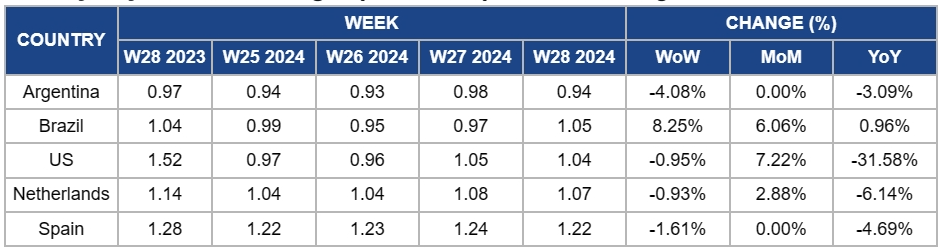
Yearly Change in Soybean Oil Pricing Important Exporters (W28 2023 to W28 2024)

Argentina
In W28, soybean oil prices in Argentina decreased significantly by 4.08% week-on-week (WoW) to USD 0.94 per kilogram (kg) due to weak future prices. According to the United States Department of Agriculture’s (USDA) Jul-24 report, Argentina's soybean production in 2023/24 was cut from Jun-24's 50 mmt to 49.5 mmt, falling behind the market's expectation of 50 mmt. For the 2024/25 season, the forecast remained unchanged at 51 mmt.
Brazil
Brazil's soybean oil price increased significantly by 8.25% WoW to USD 1.05/kg in W28 due to higher exports and biofuel demand. According to the USDA's Jul-24 report, Brazil's 2023/24 and 2024/25 soybean production forecasts remained unchanged from Jun-24 at 153 mmt and 169 mmt, respectively. In addition, the Brazilian soybean oil market also gets pressure from higher pesticide and fertilizer costs, which may lead to reduced margins for oil manufacturers.
United States
In W28, soybean oil prices in the United States (US) decreased by 0.95% WoW to USD 1.04/kg due to the strong US dollar and favorable harvest conditions. The strong US dollar has made US commodities less attractive in the export market. Additionally, the USDA’s minor downward revisions to soybean ending stocks were more neutral than optimistic and failed to overcome the bearish fundamentals of good growing conditions and slow export demand.
Netherlands
Soybean oil prices in the Netherlands decreased by 0.93% WoW to USD 1.07/kg in W28 due to declining global prices. The favorable soybean harvest conditions in the US have put downward pressure on global soybean and soybean oil prices. However, traders are taking advantage of the lower prices to purchase more, which may lead to a price recovery.
Spain
Soybean oil price in Spain decreased by 1.61% WoW to USD 1.22/kg in W28 due to the decreased future prices and weak demand from China. In addition, the United States Department of Agriculture (USDA)’s positive forecasts on the 2024/25 global soybean supply also put downward pressure on prices.
3.Actionable Recommendations
Strengthen Edible Oil Transportation Regulations
China must strengthen regulations and oversight in the edible oil transportation industry to address safety concerns. It should implement mandatory standards for vehicles and tanks used for bulk oil transport and increase inspections to ensure compliance and prevent contamination. Edible oil companies should also encourage the establishment of dedicated edible oil transportation fleets and improve certification processes can also enhance safety and quality in the supply chain.
Adapt to Price Fluctuations and Market Dynamics
Argentina should adapt to price fluctuations and market dynamics by optimizing soybean oil production and export strategies. Despite the recent price decrease, maintaining high-quality standards and exploring new markets can help stabilize revenue. Argentina should invest in agricultural technology and infrastructure that will improve productivity and efficiency, ensuring Argentina remains competitive. Additionally, closely monitoring global market trends and adjusting export volumes can mitigate the impact of weak future prices.
Take Advantage of Lower Prices for Strategic Purchases
The Netherlands should take advantage of lower soybean oil prices by increasing strategic purchases to build reserves. This approach will help stabilize supply and manage price volatility. The Netherlands should encourage domestic production through subsidies and investment in sustainable practices that can reduce reliance on imports. Monitoring global market trends and adjusting import strategies will ensure a stable and cost-effective supply of soybean oil.
Sources: Sinor, Zaobao, Biodieselbr


