W35 2024: Potato Weekly Update
.jpg)
1. Weekly News
Brazil
Significant Drop in Special Agate Potato Prices Across Major Brazilian Cities
A Cepea team survey reveals a notable decline in the wholesale price of special agate potatoes over W35. In São Paulo, the average price fell to USD 17.81 per 25-kilogram (kg) bag, marking a 10.18% drop week-on-week (WoW). Similarly, prices in Belo Horizonte (MG) and Rio de Janeiro dropped WoW by 8.91% and 11.64%, respectively, reaching USD 15.77 per bag and USD 17.15 per bag. This price reduction is attributed to a more consistent harvest rhythm supported by stable weather conditions. Additionally, as the end of the month approaches, demand usually weakens, further driving down prices.
Potato Production Surged in São Paulo Despite Drought
The Institute of Agricultural Economics's Paulista Agency for Agribusiness Technology (IEA-Apta) harvest estimate for the 2023/24 cycle shows notable productivity increases, with wetland potatoes rising by 8.5% year-on-year (YoY) and winter potatoes by 6.7%. Key production regions include São João da Boa Vista, Itapeva, and Mogi-Mirim, which account for over 80% of the total potato production.
Latvia
Potato Yields and Prices in Latvia Affected by Extreme Weather
Due to adverse weather conditions, potato yields and quality in Latvia will decline in 2024. In Semigallia, heavy rains have caused substantial potato loss, with nearly the entire crop destroyed in some areas, although potatoes planted on higher ground may still fare better. Latgale is experiencing drought, negatively impacting potato yield and quality. In Vidzeme, the situation is relatively stable, though some potato tops are rotting. Overall, the harvest is expected to be above average. Potato prices in Riga are around USD 0.72/kg in W35, up from 0.61/kg last year in the same period, and are anticipated to rise further in winter due to additional sorting, labor, and electricity costs.
Romania
Romanian Potato Yields Declined Due to Drought and Heat
The Crop Monitoring Commission Joint Research Centre (JRC) reports that drought and tropical heat have pushed potato yields in Romania below 15 metric tons (mt) per hectare (ha). Romanian potato growers have struggled with yields over the past two years, producing 16.5 to 17 mt/ha in 2021 and 2022 but falling to 14 mt/ha in 2023. This year, they had expected yields to return to 16 mt, but adverse weather conditions have hindered this recovery.
The latest estimate from the European Union's (EU) crop monitoring commission predicts an average yield of 14.8 mt/ha from approximately 78 thousand ha. Romania joined the Netherlands, Belgium, and Greece as one of the four EU countries facing below-average potato yields. The Netherlands is expected to harvest 39.5 mt/ha, unchanged from the Jul-24 estimate. Belgium's harvest is projected at 38.8 mt/ha, consistent with previous estimates. In Greece, the average yield is expected to be 25.7 mt/ha from around 13 thousand ha, down from earlier expectations of over 27 mt/ha.
Switzerland
Switzerland Increased Potato Import Quotas Due to Poor Harvest Forecast
Due to a poor forecast for the potato harvest, the Swiss government has increased the potato import quotas by 15 thousand mt. This spring's wet weather severely hampered potato cultivation, leading to a severe late blight disease. The Federal Department of Agriculture has permitted the import of an additional 15 thousand mt of processed potatoes within the tariff quota starting September 1. This quota increase will remain in effect until the end of 2024.
2. Weekly Pricing
Weekly Potato Pricing Important Exporters (USD/kg)
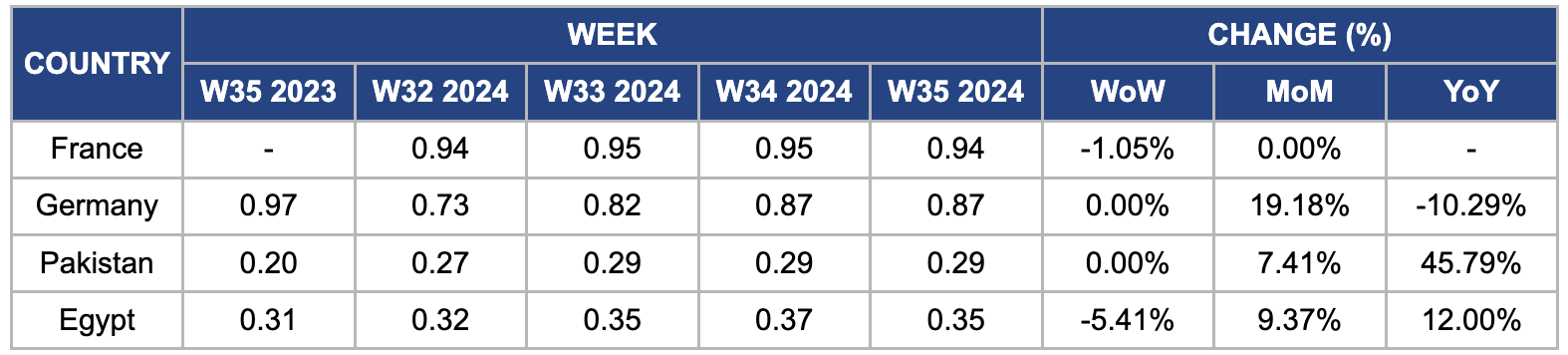
Yearly Change in Potato Pricing Important Exporters (W35 2023 to W35 2024)

France
In W35, the wholesale price of French potatoes slightly declined by 1.05% week-on-week (WoW) to USD 0.94/kg. Despite this, producers face significant challenges, including climate change, which has led to substantial losses for farmers who must now adapt to more frequent extreme weather events. Adverse weather in 2024 forced delays in planting, which are expected to push back the harvest and increase vulnerability to diseases like phytophthora. Given these difficulties, the National Union of Potato Producers (UNPT) president anticipates prices will rise, with no immediate factors expected to drive them down.
Germany
In W35, the wholesale price of German potatoes remained steady WoW at USD 0.87/kg. However, the price rose significantly by 19.18% month-on-month (MoM) from USD 0.73/kg due to wet weather disrupting harvesting in some regions, causing rot and reducing supply. Key EU potato producers, including Germany and Belgium, continued to lower their tuber yield forecasts. The 2023 weather conditions, a hot, dry summer followed by a stormy autumn, resulted in significant quality issues and affected seed potatoes. In 2024, farmers with processing potato contracts found that the seed potatoes had lower yield potential than usual, leading many processors to revise their supply agreements downward. Despite the recent price increase, prices have dropped by 10.29 YoY, attributed to reduced market demand as chip factories are adequately supplied under existing contracts and do not require additional purchases.
Pakistan
Pakistan's wholesale potato prices remained stable WoW at USD 0.29/kg. However, prices increased by 7.41% MoM from USD 0.27/kg in W32 and by 45% YoY from USD 0.20/kg. This rise is due to high inflation, which reached 17.96% in W30 due to increased taxes and higher prices for electricity, gas, and oil. These factors have raised the production costs of potatoes, leading to the observed price increases.
Egypt
In W35, Egypt's wholesale potato prices decreased by 5.41% WoW, falling to USD 0.35/kg from USD 0.37/kg in W34. This drop is mainly due to increased supply as the season progresses. Egypt anticipates further relief in potato prices as the new season starts in Nov-24. The current season faced challenges from the start, including difficulties importing seeds caused by a dollar crisis, which reduced seed quantities by approximately 25% YoY in 2024. Despite the recent price drop, YoY prices surged 12% due to a significant reduction in yield compared to last year. Ranging from 14 to 16 mt per acre in 2023, potato production dropped to 9 to 12 mt per acre in 2024. Meanwhile, yields from local leftover seeds have dropped to around 7 to 10 mt per acre, resulting in a 35 to 40% YoY reduction in market supply.
3. Actionable Recommendations
Enhance Production and Price Stabilization
Given the significant productivity increases reported by IEA-Apta, Brazilian potato producers should optimize production strategies to manage price fluctuations. Expanding market outreach beyond traditional destinations can open up new export opportunities while focusing on closer and more accessible markets to reduce logistical challenges. Rather than targeting distant markets, producers could benefit from exporting to regional Latin American markets with solid demand potential. These include Argentina, where stable potato consumption and proximity make it an ideal market; Chile, which imports potatoes for its growing processed food sector; Peru, despite being a significant producer, offers demand for processed products; Uruguay, with increasing demand for fresh and processed potatoes, and Paraguay, a nearby country where Brazilian producers can leverage existing trade ties. By targeting these nearby markets, Brazilian producers can reduce transportation costs, streamline logistics, and benefit from regional trade agreements. Investing in production efficiency and market diversification will also help stabilize prices and ensure consistent revenue streams.
Manage Price Fluctuations and Quality Issues
Due to weather-related disruptions and quality issues, German potato producers are experiencing price fluctuations. Producers should focus on improving harvesting practices and addressing quality concerns to manage these fluctuations effectively. Investing in weather-resistant seed varieties such as "Sifra" and "Spunta," known for their tolerance to harsh weather conditions and diseases, alongside advanced techniques like precision agriculture and optimized irrigation systems, can help mitigate the impact of adverse weather on potato quality and yield. Optimizing storage conditions to prevent spoilage and adjusting pricing strategies based on current market conditions and supply levels will be crucial in managing price volatility. By addressing quality issues through improved seed technology, enhanced production practices, and exploring efficient storage and pricing strategies, German producers can stabilize prices and maintain competitiveness in the market.
Enhance Seed Production and Supply Chain Efficiency
Egyptian producers are facing challenges with reduced yields and rising prices. To manage these issues, producers should focus on improving seed availability and addressing supply chain disruptions. Investing in local seed production, such as supporting the development of high-yield and drought-resistant seed varieties and optimizing import strategies, can help stabilize supply levels. Adjusting pricing strategies based on market conditions and supply levels will help manage price fluctuations. By enhancing local seed production capabilities and improving supply chain efficiency, Egyptian producers can better navigate the current market conditions, address yield challenges, and stabilize potato prices.
Sources: Tridge, Agrotimes, Noticias Agricolas, Nieuwe Oogst, Portal Do Agronegócio


