Extra Sharp Cheddar Cheese Suppliers, Trade & Prices — Market Overview 2026
Parent Product
Cheddar Cheese
HS Code
040690
Last Updated
2026-10-19
Key takeaways for search and sourcing teams
- Extra Sharp Cheddar Cheese market coverage spans 134 countries.
- 11 exporter companies and 18 importer companies are indexed in the global supply chain intelligence network for this product.
- 27 supplier-linked transactions are summarized across the top 4 countries.
- Latest reference year in this page dataset is 2024.
- Page data last updated on 2026-10-19.
Global Supplier Transactions, Export Activity, and Price Benchmarks for Extra Sharp Cheddar Cheese
Analyze 27 supplier-linked transactions across the top 4 countries, with monthly unit-price benchmarks to track export competitiveness and sourcing risk for Extra Sharp Cheddar Cheese.
Extra Sharp Cheddar Cheese Country YoY Change in Supplier Transactions and Export Momentum
Compare positive and negative YoY shifts in Extra Sharp Cheddar Cheese to identify accelerating supplier markets and weakening export corridors.
Top YoY shifts for Extra Sharp Cheddar Cheese: United States (+48.7%), Australia (+7.5%), United Kingdom (-6.7%).
Extra Sharp Cheddar Cheese Country-Level Supplier Transaction and Unit Price Summary
As of 2025-11, benchmark Extra Sharp Cheddar Cheese country transaction counts with monthly unit price and volume to prioritize supplier and export markets.
In 2026-02, countries with visible Extra Sharp Cheddar Cheese transaction unit prices: United Kingdom (8.36 USD / kg), United States (2.18 USD / kg).
| Country | YoY Change | Transaction Count | 2025-11 | 2025-12 | 2026-01 | 2026-02 | 2026-03 | 2026-04 | 2026-05 | 2026-06 | 2026-07 | 2026-08 | 2026-09 | 2026-10 |
|---|---|---|---|---|---|---|---|---|---|---|---|---|---|---|
| United States | +48.7% | 4 | - (-) | - (-) | - (-) | 2.18 USD / kg (616 kg) | - (-) | - (-) | ||||||
| United Kingdom | -6.7% | 11 | - (-) | - (-) | - (-) | 8.36 USD / kg (320.05 kg) | - (-) | - (-) | ||||||
| Ireland | - | 10 | - (-) | 6.80 USD / kg (61,949 kg) | 5.83 USD / kg (95,775 kg) | - (-) | - (-) | - (-) | ||||||
| Australia | +7.5% | 2 | - (-) | - (-) | 4.07 USD / kg (6,396 kg) | - (-) | - (-) | - (-) |
Extra Sharp Cheddar Cheese Global Supply Chain Coverage
29 companies
11 exporters and 18 importers are mapped for Extra Sharp Cheddar Cheese.
Exporters and importers can use Tridge Supply Chain Intelligence company profiles and analytics to identify counterparties for Extra Sharp Cheddar Cheese, benchmark reach, and prioritize outreach by market.
Extra Sharp Cheddar Cheese Export Supplier Intelligence, Trade Flows, and Price Signals
11 exporter companies are mapped in Tridge Supply Chain Intelligence for Extra Sharp Cheddar Cheese. Exporters and importers can use company profiles and analytics to evaluate supplier coverage, trading activity, and route opportunities.
Extra Sharp Cheddar Cheese Top Exporters and Supplier Profiles
Review leading exporter profiles while benchmarking against 11 total exporter companies in the Extra Sharp Cheddar Cheese supply chain intelligence network. Exporters and importers can unlock company profiles and analytics to qualify partners faster.
(Ireland)
Latest Export Transaction: 2026-01-06
Recently Export Partner Companies: 1
Employee Size: 11 - 50 Employees
Sales Revenue: USD 10M - 50M
Industries: Food Manufacturing, Food Services And Drinking Places, Food Wholesalers
Value Chain Roles: Distribution / Wholesale, Food Manufacturing
Exporting Countries: Bangladesh, Vietnam, Philippines, Pakistan, Indonesia, United States
Supplying Products: Milk Powder, Cheddar Cheese, Casein +5
(Australia)
Latest Export Transaction: 2026-08-01
Recently Export Partner Companies: 3
Employee Size: Over 1000 Employees
Sales Revenue: USD Over 1B
Industries: Beverage Manufacturing, Food Manufacturing, Food Wholesalers
Value Chain Roles: Distribution / Wholesale, Food Manufacturing, Trade
Exporting Countries: Sri Lanka, Ecuador, United States, Russia, Philippines, Vietnam, Indonesia, South Korea
Supplying Products: Cream Cheese, Mixed Milk Proteins, Milk Powder +5
(Australia)
Latest Export Transaction: 2026-09-19
Recently Export Partner Companies: 2
Employee Size: 101 - 500 Employees
Industries: Food Manufacturing
Value Chain Roles: Distribution / Wholesale, Food Manufacturing, Trade
Exporting Countries: Bangladesh, India, Pakistan, Sri Lanka, United States, Vietnam, Indonesia, Philippines, South Korea
Supplying Products: Cheddar Cheese, Processed Butter, Mascarpone Cheese +5
(United Kingdom)
Latest Export Transaction: 2026-07-30
Recently Export Partner Companies: 1
Employee Size: 101 - 500 Employees
Industries: Food Manufacturing, Food Wholesalers
Value Chain Roles: Distribution / Wholesale, Food Manufacturing, Retail, Trade
Exporting Countries: Philippines, Mexico, United States, Turkiye, Pakistan, Vietnam, India, Panama, South Korea
Supplying Products: Cheddar Cheese, Natural Butter, Milk Powder +5
(Ireland)
Latest Export Transaction: 2026-09-19
Recently Export Partner Companies: 1
Employee Size: Over 1000 Employees
Sales Revenue: USD Over 1B
Industries: Beverage Manufacturing, Food Manufacturing, Food Packaging, Others
Value Chain Roles: Distribution / Wholesale, Food Manufacturing, Trade
Exporting Countries: Ireland, Vietnam, Ukraine, United States, Kazakhstan, Pakistan, India, Russia, Turkiye, South Korea
Supplying Products: Yeast, Breadcrumbs, Cheddar Cheese +5
(France)
Latest Export Transaction: 2025-12-13
Recently Export Partner Companies: 1
Industries: Beverage Manufacturing, Food Manufacturing, Food Services And Drinking Places, Food Wholesalers
Value Chain Roles: Distribution / Wholesale, Food Manufacturing, Trade
Exporting Countries: United States, Kazakhstan, Vietnam
Supplying Products: Parmesan Cheese, Salami, Fresh Oyster +5
See the full picture in Tridge Eye: full price and trade history · 725,009+ company profiles
Extra Sharp Cheddar Cheese Global Exporter Coverage
11 companies
Exporter company count is a key signal for Extra Sharp Cheddar Cheese supply depth and sourcing optionality.
Use Supply Chain Intelligence analytics to narrow Extra Sharp Cheddar Cheese opportunities by country, product, and value-chain role, then open company profiles to validate fit.
Top Exporting Countries for Extra Sharp Cheddar Cheese (HS Code 040690) in 2024
For Extra Sharp Cheddar Cheese in 2024, compare export volume and value across the top 10 supplier countries to map core supply structure.
| Rank | Country | Volume | Value |
|---|---|---|---|
| 1 | Netherlands | 737,774,138.112 kg | 4,211,116,497.527 USD |
| 2 | Italy | 217,024,720 kg | 2,609,661,122.166 USD |
| 3 | Germany | 417,419,804 kg | 2,222,965,223.524 USD |
| 4 | Ireland | 247,445,587.313 kg | 1,223,545,693.976 USD |
| 5 | Greece | 122,656,101 kg | 1,038,059,425.26 USD |
| 6 | United States | 207,838,543 kg | 1,011,187,018 USD |
| 7 | Denmark | 153,793,228.112 kg | 835,721,785.979 USD |
| 8 | New Zealand | 190,258,902 kg | 835,285,954.083 USD |
| 9 | United Kingdom | 125,057,873.196 kg | 776,890,017.793 USD |
| 10 | Switzerland | 58,265,847.154 kg | 723,115,600.317 USD |
Extra Sharp Cheddar Cheese Export Trade Flow and Partner Country Summary
Track Extra Sharp Cheddar Cheese exporter-to-importer flows by value, volume, and share to uncover high-potential export routes.
Tridge Ark · Sourcing Feasibility Check
Where should you be sourcing Extra Sharp Cheddar Cheese from?
Just tell us your spec and the volume you need. We'll check whether it's actually sourceable, and which origins and suppliers fit.
Free feasibility check, no account required.
Extra Sharp Cheddar Cheese Import Buyer Intelligence, Demand Signals, and Price Benchmarks
18 importer companies are mapped for Extra Sharp Cheddar Cheese demand intelligence. Use Supply Chain Intelligence company profiles and analytics to prioritize buyers, distributors, and downstream demand partners by market.
Extra Sharp Cheddar Cheese Top Buyers, Importers, and Demand Partners
Review leading buyer profiles and compare them against 18 total importer companies tracked for Extra Sharp Cheddar Cheese. Exporters and importers can use Supply Chain Intelligence company profiles and analytics to evaluate buyer quality and demand concentration.
(United States)
Latest Import Transaction: 2026-01-06
Recently Import Partner Companies: 1
Employee Size: 1 - 10 Employees
Industries: Food Wholesalers, Others
Value Chain Roles: -
(Indonesia)
Latest Import Transaction: 2026-09-19
Recently Import Partner Companies: 1
Employee Size: Over 1000 Employees
Industries: Beverage Manufacturing, Food Manufacturing
Value Chain Roles: France, Malaysia, China, India, Singapore, South Korea, Pakistan, Thailand, Vietnam, Philippines
(Vietnam)
Latest Import Transaction: 2026-08-01
Recently Import Partner Companies: 1
Employee Size: 101 - 500 Employees
Industries: Beverage Manufacturing, Food Manufacturing, Food Services And Drinking Places, Food Wholesalers, Others
Value Chain Roles: Bolivia, Uruguay
(Indonesia)
Latest Import Transaction: 2026-09-19
Recently Import Partner Companies: 1
Employee Size: Over 1000 Employees
Sales Revenue: USD 500M - 1B
Industries: Beverage Manufacturing, Food Manufacturing, Food Packaging, Food Services And Drinking Places, Food Wholesalers, Online Retail And Fulfillment
Value Chain Roles: Papua New Guinea, Brunei, Philippines
(Philippines)
Latest Import Transaction: 2026-09-19
Recently Import Partner Companies: 2
Employee Size: 11 - 50 Employees
Industries: Food Wholesalers
Value Chain Roles: -
(Philippines)
Latest Import Transaction: 2026-09-19
Recently Import Partner Companies: 1
Employee Size: 101 - 500 Employees
Sales Revenue: USD 10M - 50M
Industries: Food Manufacturing, Food Packaging, Food Wholesalers
Value Chain Roles: -
See the full picture in Tridge Eye: full price and trade history · 725,009+ company profiles
Global Importer Coverage
18 companies
Importer company count highlights the current depth of demand-side visibility for Extra Sharp Cheddar Cheese.
Use Supply Chain Intelligence analytics and company profiles to identify active Extra Sharp Cheddar Cheese buyers, compare partner density by country, and refine GTM priorities.
Top Import Demand Countries for Extra Sharp Cheddar Cheese (HS Code 040690) in 2024
For Extra Sharp Cheddar Cheese in 2024, compare import volume and value across the top 10 demand countries to identify priority markets.
| Rank | Country | Volume | Value |
|---|---|---|---|
| 1 | Germany | 658,577,513.513 kg | 4,538,749,778.826 USD |
| 2 | United States | 178,906,040 kg | 1,739,637,367 USD |
| 3 | Italy | 297,408,611.598 kg | 1,599,338,980.795 USD |
| 4 | United Kingdom | 193,337,480.082 kg | 1,354,394,600.133 USD |
| 5 | Belgium | 211,969,819.717 kg | 1,243,683,094.066 USD |
| 6 | Netherlands | 229,704,270.691 kg | 1,117,060,884.598 USD |
| 7 | Japan | 169,667,027 kg | 807,930,850.88 USD |
| 8 | Mexico | 128,840,000.239 kg | 655,432,899 USD |
| 9 | Greece | 120,254,871 kg | 616,495,637.156 USD |
| 10 | Sweden | 106,892,643.532 kg | 580,636,401.796 USD |
Extra Sharp Cheddar Cheese Import Trade Flow and Origin Country Summary
Analyze Extra Sharp Cheddar Cheese origin-to-destination trade flows by value, volume, and share to monitor demand-side sourcing channels.
Tridge Ark · Export Feasibility Check
Your Extra Sharp Cheddar Cheese — which buyers could it sell to?
Just tell us what you make. We'll see whether you're ready to export today and which markets suit your offer.
Free feasibility check, no account required.
Classification
Product TypeProcessed Food
Product FormAged (Refrigerated)
Industry PositionValue-Added Dairy Product
Market
Extra-sharp cheddar is an aged, value-added cheese positioned at the premium end of the cheddar segment, with trade shaped by refrigerated logistics and long aging lead times. Global production is concentrated in major dairy regions in Europe, North America, and Oceania, while cross-border trade often moves through established cheese-exporting hubs. Demand is anchored by retail (block, sliced, shredded formats) and by food manufacturing and foodservice that use mature cheddar for stronger flavor and melt performance. Market dynamics are influenced by milk supply seasonality, dairy price volatility, sanitary (SPS) requirements, and trade-policy measures such as tariffs and tariff-rate quotas.
Market GrowthStable (medium-term outlook)Stable demand in mature markets with incremental growth in food manufacturing and foodservice applications; sensitivity to dairy price cycles.
Major Producing Countries
- United StatesLarge-scale milk and cheese manufacturing base supporting substantial domestic consumption and export participation.
- GermanyMajor EU dairy producer with significant cheese manufacturing capacity.
- FranceLarge dairy producer with extensive cheese processing, including industrial cheese supply.
- NetherlandsSignificant cheese production and a key EU logistics and re-export gateway.
- IrelandExport-oriented dairy sector with a strong role in cheddar production for international markets.
- United KingdomImportant cheddar-producing tradition with both domestic consumption and trade.
- New ZealandHighly export-oriented dairy producer supplying global cheese markets.
- AustraliaEstablished dairy processor with regional export flows, particularly in Asia-Pacific.
- CanadaLarge producer focused on domestic market structures; trade patterns influenced by market access rules.
Major Exporting Countries
- New ZealandMajor global dairy exporter; cheese exports are closely linked to global dairy pricing benchmarks.
- IrelandProminent exporter of cheddar-style cheeses into international retail and ingredient channels.
- NetherlandsEU trading and distribution hub supporting intra-EU flows and re-export activity.
- GermanyLarge EU exporter of cheese products across multiple destinations.
- FranceSignificant exporter of cheese and dairy products with diverse destination markets.
- AustraliaRegional exporter serving Asia-Pacific markets with refrigerated dairy logistics.
Major Importing Countries
- United StatesMajor cheese import market by value across multiple cheese types, alongside large domestic production.
- JapanLarge dairy-import market with demand from retail and food manufacturing.
- South KoreaGrowing cheese import demand supported by modern retail and foodservice.
- ChinaImport demand linked to bakery, QSR, and processed-food growth; subject to SPS and cold-chain requirements.
- MexicoSignificant cheese import market with proximity-driven trade links to North America.
- United KingdomImports remain important for supply balancing despite domestic production; flows influenced by trade arrangements and standards.
Supply Calendar
- European Union (temperate dairy regions):Mar, Apr, May, JunMilk output often rises during spring flush in many temperate systems, supporting higher cheese manufacture and inventory building.
- United States (temperate dairy regions):Mar, Apr, May, JunSeasonal milk availability can influence cheese production economics, but aged cheddar can be stored and released year-round.
- New Zealand:Oct, Nov, Dec, JanSouthern Hemisphere seasonality supports counter-seasonal milk supply relative to Northern Hemisphere markets; export programs are planned around production and inventory cycles.
- Ireland:Mar, Apr, May, Jun, JulPasture-based systems typically show strong spring/summer milk seasonality, with cheddar production aligned to export programs and aging schedules.
Specification
Major VarietiesWhite cheddar (uncolored), Colored cheddar (annatto-colored), Mature / extra-mature cheddar (extended aging), Clothbound-style mature cheddar (niche premium)
Physical Attributes
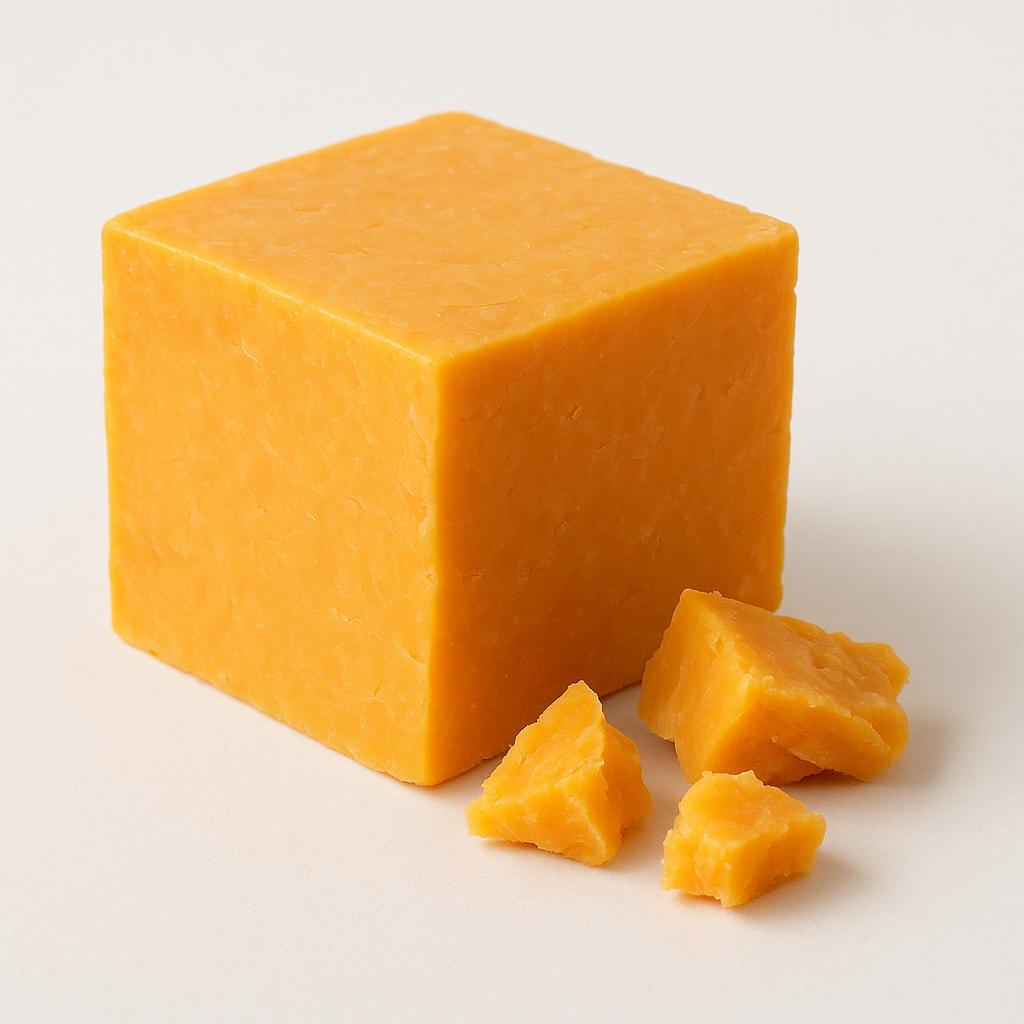
- Firm to hard texture that can become more crumbly with extended aging
- Color ranges from natural pale to orange depending on use of permitted colorants (e.g., annatto)
- Pronounced sharp flavor intensity associated with longer maturation
Compositional Metrics
- Moisture, fat-in-dry-matter, salt, and pH targets are commonly specified by buyers and aligned to applicable international or national cheese standards
- Microbiological criteria and pathogen monitoring programs are central to buyer specifications for ready-to-eat cheeses
Grades
- Codex Alimentarius commodity standards and/or national cheese standards are commonly referenced for baseline composition and quality expectations
- Commercial contracts frequently specify sensory profile, texture, melt, and functional performance (especially for shredded or ingredient use)
Packaging
- Vacuum-sealed blocks (retail and foodservice)
- Foodservice loaves and larger-format blocks in corrugated cartons
- Industrial barrels or bulk packs for further processing into shredded, sliced, or ingredient formats
- Modified-atmosphere or vacuum formats used to reduce oxidation and mold growth during refrigerated distribution
ProcessingExtended aging requires inventory management and controlled temperature/humidity to achieve target flavor and textureFunctional performance (melt, stretch, shred) is a key specification dimension for downstream food manufacturing
Supply Chain
Value Chain
- Raw milk collection and chilling -> pasteurization/standardization -> starter culture addition -> coagulation -> curd cutting and cooking -> cheddaring and milling -> salting -> pressing -> packaging -> controlled aging -> refrigerated distribution
Demand Drivers
- Retail demand for premium aged flavor profiles (mature/extra-sharp positioning)
- Food manufacturing demand for consistent flavor delivery and melt performance (shredded, sliced, ingredient uses)
- Foodservice use in burgers, sandwiches, baked dishes, and prepared foods that rely on cheddar flavor and functionality
Temperature
- Refrigerated storage and transport are required throughout distribution to maintain safety and quality
- Temperature control during aging is critical for consistent maturation outcomes and defect prevention
Atmosphere Control
- Vacuum packaging and, in some formats, modified-atmosphere packaging help manage oxidation and surface mold during refrigerated shelf life
Shelf Life
- Aged cheddar typically has a longer refrigerated shelf life than fresh dairy products, but shelf life depends on packaging integrity, sanitation controls, and maintaining refrigeration
- Once opened, surface contamination and moisture exposure can accelerate spoilage and quality loss
Risks
Animal Disease and SPS Restrictions HighMajor transboundary livestock disease events (e.g., foot-and-mouth disease) can trigger immediate sanitary trade restrictions on dairy products from affected countries, disrupting export programs and tightening global availability for aged cheeses that rely on long planning horizons.Diversify approved origins and plants, monitor WOAH disease status and importing-country SPS notices, and maintain contingency inventory planning given the long maturation lead time for extra-sharp profiles.
Milk Price and Feed Cost Volatility MediumCheddar economics are closely tied to milk pricing cycles and feed/energy costs; volatility can affect production decisions, inventory holding for long-aged cheese, and export competitiveness.Use forward contracting or hedging where available, balance spot vs. aged inventory programs, and diversify supplier base across different production systems.
Food Safety MediumReady-to-eat cheeses require robust controls against pathogens and post-process contamination; recalls and border rejections can materially affect brand trust and trade flows.Strengthen environmental monitoring and sanitation programs, validate pasteurization and HACCP plans, and align microbiological testing and traceability with importing-market requirements.
Trade Policy and Market Access MediumCheese trade is frequently shaped by tariffs, tariff-rate quotas, labeling rules, and compositional standards; policy shifts can re-route trade and change competitiveness for specific cheddar maturities and formats.Track WTO notifications and key importing-market rule changes, qualify multiple destination markets, and ensure label/spec compliance for each route-to-market.
Cold Chain Logistics LowRefrigerated shipping and storage constraints, port congestion, and temperature excursions can reduce shelf life, increase spoilage risk, and raise costs, particularly for long-distance sea freight.Specify temperature-monitoring and packaging standards, use validated reefer routes and carriers, and build buffer time into distribution plans for peak congestion periods.
Sustainability
- Greenhouse gas emissions intensity (enteric methane) and decarbonization pressure across dairy supply chains
- Manure management and nutrient runoff risks in intensive dairy regions
- Feed-supply sustainability (including land-use change risks in some feed commodities used in dairy rations)
- Energy use and refrigerant management in processing plants and cold chains
Labor & Social
- Labor availability and working conditions in dairy farming, processing, and cold-chain logistics (including reliance on migrant and seasonal labor in some regions)
- Animal welfare expectations and compliance with evolving retailer and regulatory standards
- Community impacts associated with concentrated dairy operations (odor, water quality, and local permitting)
FAQ
What is the single biggest global trade risk for extra-sharp cheddar?The most critical risk is animal-disease-driven sanitary (SPS) disruption (such as foot-and-mouth disease), which can lead to immediate import restrictions on dairy from affected origins and quickly interrupt export programs for aged cheeses.
Which countries are major exporters in global cheddar/cheese trade relevant to extra-sharp cheddar?Major exporting countries commonly active in global cheese trade include New Zealand, Ireland, the Netherlands, Germany, France, and Australia, supported by established dairy processing capacity and refrigerated export logistics.
Why does extra-sharp cheddar require different supply planning than younger cheddar?Extra-sharp positioning depends on extended maturation, which means producers must plan milk inputs, production runs, and inventory holding well in advance; this makes the segment more exposed to milk price cycles and to disruptions such as SPS-related trade restrictions.
Sources
Extra Sharp Cheddar Cheese Country Coverage for Suppliers, Export Flows, and Prices
Explore country-level Extra Sharp Cheddar Cheese market pages for supplier coverage, trade flows, and price benchmarks.

Germany

Mexico

Kazakhstan

Netherlands

Italy

Uzbekistan

France

Philippines

United States

Vietnam

Indonesia

New Zealand
All country market pages: Ireland, Thailand, Belgium, Egypt, Nigeria, Poland, Denmark, Greece, Switzerland, United Kingdom, Spain, Austria, Cyprus, Czechia, Japan, Luxembourg, Australia, Sweden, Slovakia, Lithuania, Bulgaria, Canada, Estonia, Nicaragua, Latvia, Turkiye, Hungary, Saudi Arabia, Romania, Portugal, Finland, Uruguay, China, South Korea, United Arab Emirates, Chile, South Africa, India, Morocco, Ukraine, Croatia, Jordan, Serbia, Slovenia, Brazil, Bosnia and Herzegovina, Kuwait, Israel, Norway, Honduras, Dominican Republic, El Salvador, Andorra, Albania, Armenia, Argentina, Azerbaijan, Barbados, Burkina Faso, Bahrain, Burundi, Benin, Bermuda, Brunei, Bolivia, Bahamas, Botswana, Belize, Democratic Republic of the Congo, Ivory Coast, Colombia, Costa Rica, Cuba, Ecuador, Ethiopia, Fiji, Gabon, Gambia, Guatemala, Hong Kong, Iran, Iceland, Jamaica, Kenya, Kyrgyzstan, Cambodia, Laos, Sri Lanka, Liberia, Lesotho, Moldova, Montenegro, Madagascar, Macedonia, Myanmar [Burma], Mongolia, Macao, Malta, Mauritius, Maldives, Malawi, Malaysia, Mozambique, Namibia, Niger, Nepal, Oman, Panama, Peru, Pakistan, Paraguay, Qatar, Singapore, Senegal, Swaziland, Togo, Tunisia, Tanzania, Uganda, Saint Vincent and the Grenadines, Zambia, Zimbabwe
Tridge Ark · Export & Sourcing Feasibility Checks
Extra Sharp Cheddar Cheese — are you buying, or selling?
Either way it's a few questions. We'll come back with where you could buy it, or who you could sell it to.
Free feasibility check, no account required.
Related Extra Sharp Cheddar Cheese Product Categories
Browse parent, sub, derived, and raw-material product market pages related to Extra Sharp Cheddar Cheese.
Parent product: Cheddar Cheese
By clicking “Accept Cookies,” I agree to provide cookies for statistical and personalized preference purposes. To learn more about our cookies, please read our Privacy Policy.