Global Impact of the Argentine Beef Export Ban
The official registration of the temporary closure of meat exports marked an exception for the Hilton Quota and the 481 Quota of the European Union and the United States market. This means all exports that fell into those two quotas or are destined to the US market are clear of the suspension. However, exports to China, which is Argentina’s biggest market, will be affected.
Reasons for the Ban and Producers Union Response
The Government of Argentina announced through an official statement that beef exports would be closed for a period of 30 days. The presidential office has stated that the main reason for the suspension is to protect the domestic price of bovine products as the export demand distorts the domestic market’s price. In addition to this, the government announced that the export suspension is an essential step for the set of emergency measures that seek to order the operation of the sector. The objective of this measure will be to optimize the traceability of exports, restrict speculative practices and avoid tax evasion in foreign trade.
The news of the export closure for Argentinian bovine farmers came with immediate and direct rejections to the measure. The Rural Society (SRA), Rural Argentine Confederation (CRA), Coninagro, and the Agrarian Argentine Federation (FAA) have all come together to announce a commercialization strike for nine days in response to the closure of beef exports. The entities together issued a statement, where they expressed their rejection of the measure by stating that it will undoubtedly harm all of Argentina, saying will make them lose competitiveness in an already challenging global market after the recession caused by the pandemic.
Impact on the Chinese Beef Market
Meat consumption in China has increased rapidly in recent years, driven by improved living standards, higher disposable income, and the rapid expansion of middle-income consumers. In China, however, the decision of Argentina to suspend exports is met with concern, given that the market is currently facing a scarce supply of meat and high values. Adding to this, now the third-largest Chinese supplier won´t be shipping any meat and could push price values higher. China accounts for 35.8% of beef imports globally and, since 2016 is the world´s larger importer. Frozen beef imports in China have increased at an accelerating rate over the last few years, showing a 45% growth rate during the 2016-2020 period, and 2020 showing a 24% increase from the previous year.
China’s beef suppliers have drastically changed over the last years. Five years ago, Australia was China’s largest beef supplier with 33% of the import share, with Uruguay as second providing 21.5% of imports. From 2015, we have seen a substantial increase in overall Chinese imports, and the share of those imports largely shift to South American countries. Brazil and Argentina have since then captured the vast majority of the Chinese import growth. By 2020, Brazil was the main beef supplier to China with 42.7% of the import share, followed by Argentina with 21.2%, Australia with 12.4%, and Uruguay, which is now the fourth-largest supplier with 8.4%.
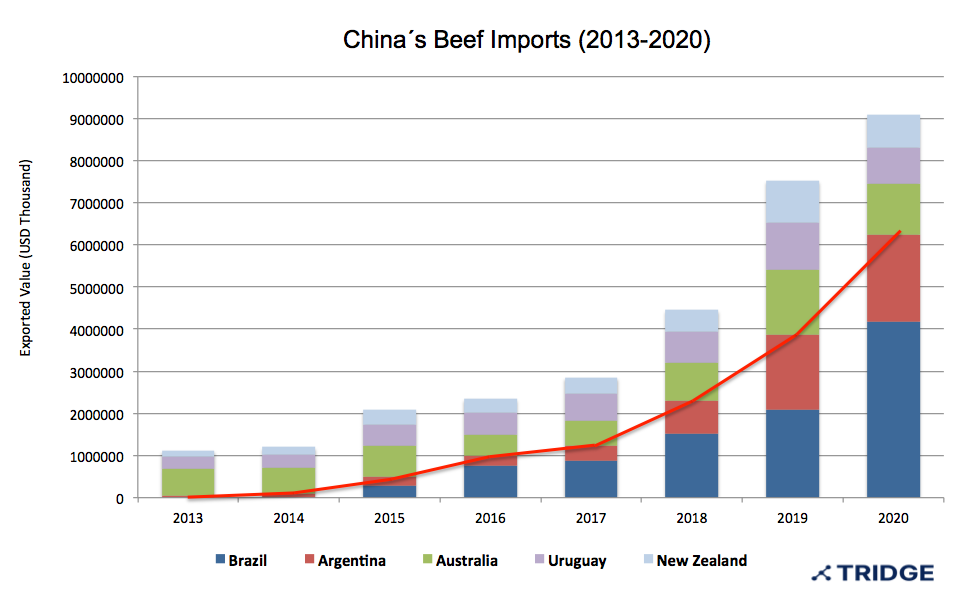
Source: ITC Trade Map, Tridge
Impact on MERCOSUR Beef Suppliers
The close of Argentinan exports will undoubtedly affect meat shipments to China, Argentina's main market, but will also create opportunities for the other MERCOSUR suppliers. Brazil and Uruguay will have a unique opportunity to strengthen their exports to China. With a current trade war between China and Australia that has affected the meat trade among the two countries, China will seek short-term beef suppliers that will be able to alleviate recent shortages on beef products and release pressure on prices.
For the current 2021, Brazilian beef exports to China remained slightly above 60 thousand tons in April, about 7 thousand less than in March and at levels similar to those of the same month of 2020. The average export value was USD 4,948 per ton, with a monthly increase of almost 5% and recording the highest level since June 2020. China doubled the import value in 2020 from Brazil, as it had a 99% value growth increase from the previous year. According to the World Beef Report, Brazil is forecast to increase its beef exports in 2021 by at least 15% from the previous year, and the growth in the Chinese market could be a key factor.
Impact on US Beef Exports
The Argentinan export ban may directly affect other main beef suppliers such as the US and New Zealand, which have been steady suppliers of beef to China over the years. The US has already been significantly increasing its beef exports this 2021 after a 12% decrease last year due to pandemic restrictions. According to the USDA sales report, US beef exports increased by 9% in the first quarter of the year of 2021 from the first quarter of 2020, and it is estimated that exports to China have surged about 28% from the same period last year.
While Argentina is not the top beef exporter in the world, and this ban is only for 30 days, the country is a significant enough exporter and a key source of product for China. The combination of already tight supplies of beef in the market with a suddenly restricted measure like the one Argentina has announced is expected to increase global prices. With the US already experiencing an increase in beef prices, along with very high demand, it is likely that the US will take advantage of the situation and see beef exporters increase shipments over the following months.
Sources:
- Farm Bureau. "Argentina’s Temporary Ban on Beef Exports has Potential Market Impacts."
- Valor Agro. "Campo argentino para 7 días tras cierre de exportaciones: “Tropezamos con la misma piedra.”
- Valor Agro. "Argentina oficializó cierre de exportación de carne con excepción de las cuotas a Europa y EE.UU."