Dried Java Plum Suppliers & Prices in Hong Kong — Market Overview 2026
Raw Materials
Fresh Java Plum
Last Updated
2026-09-13
Key takeaways for search and sourcing teams
- Page data last updated on 2026-09-13.
Sourcing diagnosis
Could you be importing Dried Java Plum from Hong Kong yourself?
Just tell us your spec and the volume you need. We'll check whether it's actually sourceable, and which origins and suppliers fit.
Free diagnosis, no account required.
Dried Java Plum Import Buyer Intelligence and Price Signals in Hong Kong: Buyers, Demand, and Trade Partners
5 import partner companies are tracked for Dried Java Plum in Hong Kong. Exporters and importers can use Supply Chain Intelligence company profiles and analytics to analyze buyer demand, partner density, and downstream channels.
Scatter points are sampled from 100.0% of the full transaction dataset.
Sample Import Transaction and Price Records for Dried Java Plum in Hong Kong
3 sampled Dried Java Plum import transactions in Hong Kong provide date, origin, and trade-country context to benchmark price levels and demand-side trading patterns.
Dried Java Plum sampled import transaction unit prices by date in Hong Kong: 2026-04-06: 3.79 USD / kg, 2025-10-21: 3.79 USD / kg, 2025-09-16: 3.96 USD / kg.
| Date | Reported Product | Unit Price | Exporter | Importer | Origin | |
|---|---|---|---|---|---|---|
| 2026-04-06 | ALO* ******* | 3.79 USD / kg | (-) | (-) | - | |
| 2025-10-21 | ALO* ******* | 3.79 USD / kg | (-) | (-) | - | |
| 2025-09-16 | ALO* ******* | 3.96 USD / kg | (-) | (-) | - |
Top Dried Java Plum Buyers, Importers, and Demand Partners in Hong Kong
Review leading buyer profiles and compare them with 5 total import partner companies tracked for Dried Java Plum in Hong Kong. Exporters and importers can use Supply Chain Intelligence company profiles and analytics to evaluate demand-side partner fit.
(Hong Kong)
Latest Import Transaction: 2026-08-13
Industries: Others
Value Chain Roles: Trade
(Hong Kong)
Latest Import Transaction: 2026-08-13
Industries: Others
Value Chain Roles: Trade
(Hong Kong)
Latest Import Transaction: 2026-08-13
Industries: Others
Value Chain Roles: Trade
(Hong Kong)
Latest Import Transaction: 2026-08-13
Industries: Beverage ManufacturingFood ManufacturingFood PackagingFood Wholesalers
Value Chain Roles: Distribution / WholesaleTrade
(Hong Kong)
Latest Import Transaction: 2026-08-13
Industries: Brokers And Trade AgenciesFood Manufacturing
Value Chain Roles: Distribution / WholesaleTrade
Hong Kong Import Partner Coverage
5 companies
Import partner company count highlights demand-side visibility for Dried Java Plum in Hong Kong.
Use Supply Chain Intelligence analytics and company profiles to identify active Dried Java Plum importers, distributors, and buyer networks in Hong Kong.
Export diagnosis
Your Dried Java Plum — could it sell to these buyers in Hong Kong?
Just tell us what you make. We'll see whether you're ready to export today and which markets suit your offer.
Free diagnosis, no account required.
Price data
Which Dried Java Plum prices in Hong Kong do you need?
We'll open up the full price history and competitor benchmarks. Just tell us which numbers you need and we'll walk you through them.
Classification
Product TypeProcessed Food
Product FormDried
Industry PositionValue-Added Processed Fruit Product
Market
Dried java plum (jamun) in Hong Kong is a niche imported dried-fruit product with little to no domestic primary production. Hong Kong functions as an import-dependent consumer market and regional trading hub, with market access shaped more by food safety and labeling compliance than by tariffs. The Centre for Food Safety (CFS) is the key authority for imported food surveillance, and buyers commonly focus on preservative/additive compliance and contaminant risk management. The product’s shelf-stable nature supports year-round availability, with quality outcomes strongly influenced by moisture control and packaging integrity through distribution.
Market RoleImport-dependent consumer market (net importer)
Domestic RoleRetail and foodservice consumption market for imported dried fruit products; limited domestic agricultural supply for this product
Market GrowthNot Mentioned
SeasonalityYear-round market availability is typical due to the shelf-stable dried format; supply timing mainly depends on origin-country harvest and processing schedules rather than local seasonality.
Specification
Physical Attributes
- Low-moisture dried whole fruit or pieces
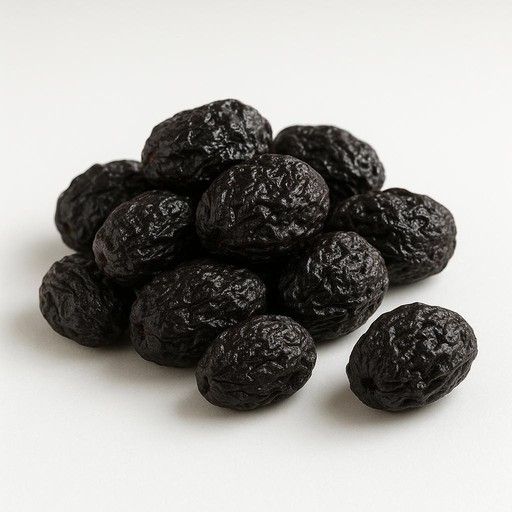
- Dark purple to black appearance typical of the fruit skin/pulp after drying
- Absence of visible mold, excessive stickiness, or foreign matter is a common buyer acceptance expectation
Compositional Metrics
- Moisture control is critical to reduce mold growth and quality deterioration during storage and distribution
- Added sugar/salt (if present) should be consistently declared and controlled by formulation
Packaging
- Moisture- and oxygen-barrier retail pouches (often resealable)
- Bulk cartons with inner polyethylene liners for distribution
- Use of desiccants/oxygen absorbers may be applied to reduce moisture and oxidation risks
Supply Chain
Value Chain
- Overseas processor/packer → exporter → sea/air freight to Hong Kong → importer/wholesaler → retail/e-commerce distribution → consumer
Temperature
- Typically shipped and stored ambient; avoid high heat exposure that can accelerate quality loss
- Humidity control is more critical than refrigeration for dried fruit products
Atmosphere Control
- Moisture barrier packaging and sealed units reduce rehydration and mold risk
- Good ventilation and condensation control in containers and warehouses reduces spoilage risk
Shelf Life
- Shelf stability is generally long relative to fresh fruit, but quality is sensitive to moisture ingress, packaging seal failures, and storage humidity
Freight IntensityMedium
Transport ModeSea
Risks
Food Safety HighNon-compliance on preservatives/additives (e.g., sulfites) or contamination issues (e.g., mold-related hazards) can result in detention, withdrawal, or recall actions in Hong Kong, disrupting market access for a niche imported product with limited substitute suppliers.Use supplier approval with documented HACCP/food-safety certification, require lot-level COA for preservatives/additives and microbiological status, and implement incoming inspection plus humidity-controlled storage.
Regulatory Compliance MediumLabeling or composition non-compliance (ingredient/additive declaration, language, or category-specific labeling rules) can delay listing with modern trade retailers and trigger corrective relabeling or shipment holds.Run a pre-import label and formulation review against Hong Kong e-Legislation requirements and CFS guidance; align final artwork and product specification before shipment.
Logistics MediumMoisture ingress, container condensation, and packaging seal failures can cause quality deterioration (stickiness, clumping, mold), leading to claims or rejection during distribution in Hong Kong’s humid climate.Specify moisture-barrier packaging, use desiccants where appropriate, control warehouse humidity, and implement first-expiry-first-out (FEFO) practices.
Logistics MediumFreight rate spikes or route disruptions can materially increase landed costs for imported dried fruit, affecting price competitiveness in retail and e-commerce channels.Use forward freight planning, consolidate shipments where feasible, and maintain alternate suppliers/routes to reduce exposure to spot-market volatility.
Sustainability
- Packaging waste and recyclability scrutiny (common for imported dried fruit packaged in multi-layer plastic pouches)
Standards
- HACCP
- ISO 22000
- BRCGS Food Safety
FAQ
Is Hong Kong a producer or an importer market for dried java plum (jamun)?Hong Kong is an import-dependent consumer market for dried java plum. The product is typically supplied by overseas processors and distributed locally through importers, wholesalers, and retailers.
Which authorities are most relevant for compliance when importing and selling dried java plum in Hong Kong?Food safety oversight and surveillance are centered on the Centre for Food Safety (CFS) under the Food and Environmental Hygiene Department, while import declaration and customs processes involve Hong Kong Customs and Excise. Legal requirements are accessible via Hong Kong e-Legislation.
What are common risk areas that can disrupt sales of imported dried java plum in Hong Kong?The main risks are food safety non-compliance (such as preservatives/additives issues or contamination), labeling/composition compliance problems, and moisture-related quality deterioration during storage and distribution in humid conditions.
Sources
Other Dried Java Plum Country Markets for Supplier, Export, and Price Comparison from Hong Kong
Compare Dried Java Plum supplier coverage, trade flows, and price benchmarks across countries related to Hong Kong.


Export & sourcing diagnosis
Dried Java Plum in Hong Kong — are you buying, or selling?
Either way it's a few questions. We'll come back with where you could buy it, or who you could sell it to.
Free diagnosis, no account required.
Related Dried Java Plum Product Categories
Browse parent, sub, derived, and raw-material product market pages related to Dried Java Plum.
Raw materials: Fresh Java Plum
By clicking “Accept Cookies,” I agree to provide cookies for statistical and personalized preference purposes. To learn more about our cookies, please read our Privacy Policy.