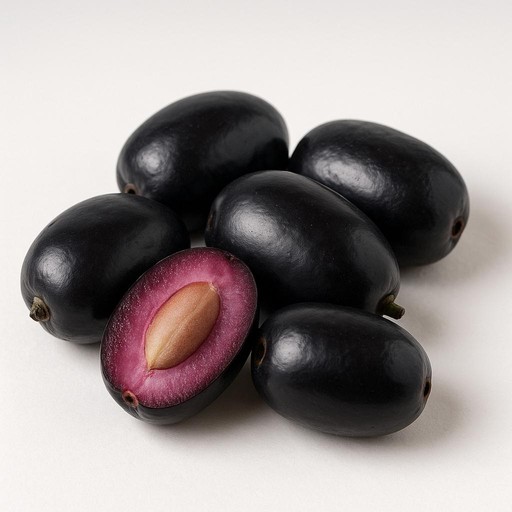
Fresh Java Plum Prices & Trade in Pakistan — Market Overview 2026
Derived Products
Java Plum Juice, Java Plum Juice Concentrate, Dried Java Plum
HS Code
081090
Last Updated
2026-09-13
Key takeaways for search and sourcing teams
- 5 export partner countries and 1 import partner countries are ranked.
- Latest reference year in this page dataset is 2026.
- Page data last updated on 2026-09-13.
Fresh Java Plum Export Supplier Intelligence, Price Trends, and Trade Flows in Pakistan
Use Supply Chain Intelligence company profiles and analytics to validate Fresh Java Plum exporter coverage, partner quality, and route priorities in Pakistan.
Annual Export Value, Volume, and Supplier Market Size for Fresh Java Plum in Pakistan (HS Code 081090)
Analyze 3 years of Fresh Java Plum export volume and value in Pakistan to evaluate supplier market growth, seasonality, and trade volatility.
| Year | Volume | Value |
|---|---|---|
| 2024 | 16,586,404 | 4,217,943 USD |
| 2023 | 10,920,428 | 3,656,355 USD |
| 2022 | 7,489,088 | 4,897,450 USD |
Top Destination Markets for Fresh Java Plum Exports from Pakistan (HS Code 081090) in 2024
For 2024, compare export volume and value across the top 5 destination countries for Fresh Java Plum exports from Pakistan.
| Rank | Country | Volume | Value |
|---|---|---|---|
| 1 | Afghanistan | 12,494,264 | 1,790,735.909 USD |
| 2 | Kazakhstan | 2,825,428 | 849,922.204 USD |
| 3 | United Arab Emirates | 418,100 | 476,723.533 USD |
| 4 | United Kingdom | 139,601 | 309,490.156 USD |
| 5 | Bahrain | 149,912 | 240,286.534 USD |
Sourcing diagnosis
Could you be importing Fresh Java Plum from Pakistan yourself?
Just tell us your spec and the volume you need. We'll check whether it's actually sourceable, and which origins and suppliers fit.
Free diagnosis, no account required.
Fresh Java Plum Import Buyer Intelligence and Price Signals in Pakistan: Buyers, Demand, and Trade Partners
Exporters and importers can use Supply Chain Intelligence company profiles and analytics to analyze Fresh Java Plum buyer demand, partner density, and downstream channels in Pakistan.
Annual Import Value, Volume, and Demand Size for Fresh Java Plum in Pakistan (HS Code 081090)
Track 3 years of Fresh Java Plum import volume and value in Pakistan to assess demand growth and market momentum.
| Year | Volume | Value |
|---|---|---|
| 2024 | 32,190,781 | 17,045,512 USD |
| 2023 | 36,765,988 | 19,576,868 USD |
| 2022 | 36,019,530 | 20,988,213 USD |
Top Origin Supplier Countries Supplying Fresh Java Plum to Pakistan (HS Code 081090) in 2024
For 2024, compare import volume and value across the top 1 origin supplier countries supplying Fresh Java Plum to Pakistan.
| Rank | Country | Volume | Value |
|---|---|---|---|
| 1 | Afghanistan | 32,190,781.169 | 17,045,511.642 USD |
Export diagnosis
Your Fresh Java Plum — could it sell to these buyers in Pakistan?
Just tell us what you make. We'll see whether you're ready to export today and which markets suit your offer.
Free diagnosis, no account required.
Fresh Java Plum Wholesale Supplier Price Trends in Pakistan
Track Fresh Java Plum wholesale supplier price benchmarks and recent export price updates in Pakistan.
Historical Fresh Java Plum Wholesale Supplier Prices in Pakistan (USD/kg)
Yearly average, lower, and upper Fresh Java Plum wholesale prices with YoY changes provide benchmark data for supplier pricing and export competitiveness in Pakistan.
Fresh Java Plum yearly average wholesale prices in Pakistan: 2021: 0.51 USD / kg, 2022: 0.54 USD / kg, 2023: 0.75 USD / kg, 2024: 0.67 USD / kg, 2025: 0.70 USD / kg, 2026: 0.90 USD / kg.
| Year | Average Unit Price | Lower Unit Price | Upper Unit Price | YoY Change |
|---|---|---|---|---|
| 2021 | 0.51 USD / kg | 0.30 USD / kg | 0.68 USD / kg | - |
| 2022 | 0.54 USD / kg | 0.34 USD / kg | 0.75 USD / kg | - |
| 2023 | 0.75 USD / kg | 0.37 USD / kg | 1.20 USD / kg | - |
| 2024 | 0.67 USD / kg | 0.38 USD / kg | 0.91 USD / kg | - |
| 2025 | 0.70 USD / kg | 0.35 USD / kg | 1.13 USD / kg | - |
| 2026 | 0.90 USD / kg | 0.52 USD / kg | 1.35 USD / kg | - |
Latest Fresh Java Plum Wholesale Export Price Updates in Pakistan
Use the latest 5 updates to check current Fresh Java Plum wholesale export price points and origin-level changes in Pakistan.
Fresh Java Plum latest wholesale updates by date in Pakistan: 2026-08-01: 66.48 USD / kg, 2026-08-01: 66.41 USD / kg, 2026-08-01: 139.32 USD / kg, 2026-08-01: 140.99 USD / kg, 2026-08-01: 63.76 USD / kg.
| Date | Entry Name | Unit Price (USD) | Origin Country | |
|---|---|---|---|---|
| 2026-08-01 | Jam** * ****** ********** | 66.48 USD / kg | - | |
| 2026-08-01 | Jam** * ****** ******** | 66.41 USD / kg | - | |
| 2026-08-01 | Jam** * ****** **** **** | 139.32 USD / kg | - | |
| 2026-08-01 | Jam** * ****** ****** | 140.99 USD / kg | - | |
| 2026-08-01 | Jam** * ****** ********** | 63.76 USD / kg | - |
Price data
Which Fresh Java Plum prices in Pakistan do you need?
We'll open up the full price history and competitor benchmarks. Just tell us which numbers you need and we'll walk you through them.
Classification
Product TypeRaw Material
Product FormFresh
Industry PositionPrimary Agricultural Product
Raw Material
Market
Fresh java plum (jamun; Syzygium cumini) in Pakistan is an underutilized seasonal fruit consumed both fresh and in processed forms, but fresh-market marketing is strongly constrained by rapid perishability. A Pakistan horticulture review reports a limited ambient shelf life (about 3 days) and notes that marketing is largely confined to local markets, with postharvest technologies (e.g., cold storage and packaging approaches) discussed as ways to extend the marketing window. Field research in Punjab (2021–22) documents a jamun growing belt/habitat across multiple districts, indicating meaningful local availability in that province. For any cross-border movement of fresh jamun, phytosanitary compliance is a primary bottleneck because jamun is recorded as a host of quarantine-significant fruit flies, and Pakistan’s NPPO (Department of Plant Protection) regulates trade through import permits/release orders and phytosanitary export certification aligned to importing-country requirements.
Market RoleDomestic consumer market with local seasonal production; limited formal export presence due to perishability and SPS constraints
Domestic RoleSeasonal fruit marketed mainly through local/domestic channels; also used for processing into beverages and preserves
SeasonalitySeasonal early-summer availability; flowering typically reported around March–April with fruit development by May–June, so fresh supply is not year-round.
Specification
Physical Attributes
- Deep purple to black skin color at maturity with sweet–sour astringent taste profile
- Highly perishable fruit with limited ambient shelf life reported in horticulture literature
Compositional Metrics
- Reported as rich in antioxidants and associated phenolic compounds in horticulture literature; compositional emphasis often links to astringency and pigmentation
Supply Chain
Value Chain
- Harvest at maturity (tree-ripened) → sorting/handling → rapid movement to local markets → retail sale
- Where quality extension is attempted: postharvest treatments/coatings and cold storage → packaging (including modified-atmosphere concepts) → distribution
Temperature
- Ambient shelf life reported as very short (about 3 days), making rapid handling and (where feasible) temperature management critical for quality retention
- Cold storage and other postharvest interventions are discussed in horticulture literature as tools to extend the marketing window
Atmosphere Control
- Modified-atmosphere packaging (MAP) is discussed in horticulture literature as a shelf-life extension approach for jamun
Shelf Life
- Limited shelf life under ambient conditions (about 3 days) is reported in horticulture literature; this confines marketing largely to local/domestic channels
Freight IntensityMedium
Transport ModeLand
Risks
Phytosanitary HighFresh jamun is recorded as a host of quarantine-significant fruit flies (e.g., Bactrocera dorsalis and Ceratitis capitata), and EPPO reports B. dorsalis as present and widespread in Pakistan; importing countries can require specific treatments/inspections and may reject shipments if phytosanitary conditions are not met.Align pre-export orchard pest monitoring, sorting, and any required quarantine treatment with the importing country’s conditions; ensure DPP inspection/sampling is completed and a phytosanitary certificate is issued for the consignment.
Logistics HighJamun is highly perishable, with horticulture literature reporting an ambient shelf life of about 3 days and marketing largely confined to local markets; longer-distance shipment without robust cold chain/packaging materially increases spoilage and claims risk.Use expedited distribution, strict handling hygiene, and (where feasible) cold storage and protective packaging approaches discussed in horticulture literature to extend the marketing window.
Regulatory Compliance MediumPakistan’s DPP requires process compliance and documentation for phytosanitary export certification (and import permits/release orders for imports); missing or inconsistent documents can cause clearance delays, treatment holds, or rejection.Build a shipment-specific document checklist mapped to DPP requirements and the importing country’s import permit/conditions; submit applications through PSW/DPP workflows early enough for inspection and any lab/treatment steps.
Labor & Social Compliance MediumAlthough not jamun-specific, Pakistan appears on the U.S. DOL ILAB list for forced/child labor concerns in multiple goods (including some agricultural commodities), increasing the likelihood that buyers apply enhanced social-compliance screening to Pakistan agricultural sourcing.Implement supplier codes of conduct, worker age verification, grievance channels, and audit/traceability practices proportional to buyer requirements and identified country risk.
Sustainability
- Post-harvest loss and food-waste risk is structurally high due to very short ambient shelf life; shelf-life extension (cold chain/packaging) is a key sustainability lever discussed in horticulture literature
Labor & Social
- No jamun-specific labor controversy was identified in the consulted sources; however, Pakistan is listed by U.S. DOL ILAB for labor exploitation risks in several other agricultural goods, so buyers often apply broader agricultural labor due diligence in Pakistan supply chains
FAQ
Which documents are commonly required to export fresh jamun from Pakistan?Pakistan’s Department of Plant Protection (DPP) indicates exporters generally need an application for phytosanitary certification, the importing country’s import permit/market-access notification (where applicable), and core shipping documents such as a commercial invoice and packing list. Depending on commodity risk and importing-country conditions, DPP also lists documents such as a traceability certificate and treatment certificate, before issuing the phytosanitary certificate.
Why is exporting fresh jamun from Pakistan often difficult compared with selling domestically?A Pakistan horticulture review reports jamun has a very short shelf life under ambient conditions (about 3 days), which confines marketing largely to local markets and makes longer-distance shipment highly spoilage-prone without strong cold chain/packaging. In addition, jamun is recorded as a host of quarantine fruit flies, so importing countries may require specific phytosanitary measures and documentary compliance that can delay or block shipments if not met.
When is fresh jamun typically available in Pakistan?Reported phenology indicates flowering typically occurs around March–April, with fruit development by May–June, concentrating fresh-market availability in early summer rather than year-round.
Sources
Other Fresh Java Plum Country Markets for Supplier, Export, and Price Comparison from Pakistan
Compare Fresh Java Plum supplier coverage, trade flows, and price benchmarks across countries related to Pakistan.


Export & sourcing diagnosis
Fresh Java Plum in Pakistan — are you buying, or selling?
Either way it's a few questions. We'll come back with where you could buy it, or who you could sell it to.
Free diagnosis, no account required.
Related Fresh Java Plum Product Categories
Browse parent, sub, derived, and raw-material product market pages related to Fresh Java Plum.
By clicking “Accept Cookies,” I agree to provide cookies for statistical and personalized preference purposes. To learn more about our cookies, please read our Privacy Policy.