W23 2024: Onion Weekly Update
.jpg)
1. Weekly News
Brazil
Onion Prices Declined at Brazil's Porto Xavier Border Amid Increased Harvest
Onion prices at Brazil's Porto Xavier (RS) border declined again during W23. The increased harvesting activity in other regions of Brazil, including the Northeast, Cerrado, and São Paulo, has boosted the availability of onions, reducing the reliance on imports from Argentina. Notably, some warehouses have sold out their stock, and importers have reduced their orders. By the end of W23, prices for Argentine onions at the border had dropped by 1.9% week-on-week (WoW), closing at USD 16.42 per 20 kilogram (kg) bag.
Kyrgyzstan
Kyrgyzstan Seeks Solutions Amid Onion Price Collapse in 2023/24 Season
Central Asia experienced a significant collapse in onion prices in the 2023/24 season, prompting local farmers and authorities to search for solutions to sell these products. Kyrgyzstan's Ministry of Water Resources, Agriculture, and Processing Industry suggested storing early onions from the 2024 harvest until prices stabilize. This proposal confused industry specialists. Another measure discussed to support onion exporters was improving logistics, as concluded in a meeting between government agencies, farmers, and traders. It was focused on the current market situation in Kyrgyzstan and global trends, identifying potential markets for Kyrgyz onions. A significant issue is the low prices in Russia and Kazakhstan, making it difficult to sell Kyrgyz onions. Farmers noted the production cost of onions at USD 0.14 to 0.15/kg, while the average price in Russia is 26 rubles per kilogram. However, the logistics cost to deliver onions to Russia averages USD 0.21/kg, leading to losses for exporters. Onion exporters requested assistance from the ministry to resolve these issues.
South Korea
South Korea Projects Increased Mid-Late Onion Production in 2024
South Korea anticipates producing 1,067,000 metric tons (mt) of mid-late onions in 2024, reflecting a 6% increase from 2023's output of 1,004,688 mt but a 3% decline compared to the average production of 1,097,884 mt. According to forecasts from the Korea Rural Economic Institute's Agricultural Observation Center in Jun-24, the projected production stood at 1,067,374 mt for the year. The cultivated area has expanded to 15,858 hectares (ha), marking a 6% increase from 2023 and a 4% rise from the average year. Despite this expansion, the expected yield per 10 ha is 6,731 kg, which is 1% higher than the yield in 2023 (6,685 kg) but 6% lower than the average yield of 7,180 kg. Comparatively, the crop condition in 2024 appears favorable relative to the previous year, which suffered severe damage from downy mildew. Nonetheless, there are significant variations among farms: some are harvesting early due to severe symptoms of leaf tip drying, while others are delaying harvests due to inadequate bulb growth.
Spain
Valencian Onion Producers Face USD 26.85 Million Losses
Spain's Valencian onion producers are experiencing a catastrophic season, with estimated losses surpassing USD 26.85 million. The Unió Llauradora attributes these losses to low prices paid to farmers, coinciding with a bountiful harvest across all Spanish-producing areas and an influx of imported onions on supermarket shelves. Farmers report that the average price at the origin has been around USD 0.11/kg, which barely covers the cost of harvesting. Consequently, many farmers have opted not to harvest their crops, letting them spoil in the fields or rotovating them instead. With production costs ranging from USD 0.27 to 0.32/kg, anything below this threshold results in significant financial losses. The presence of cheaper imported onions exacerbates the problem, pushing local produce out of the market and causing substantial economic damage to Valencian farmers.
2. Weekly Pricing
Weekly Onion Pricing Important Exporters (USD/kg)
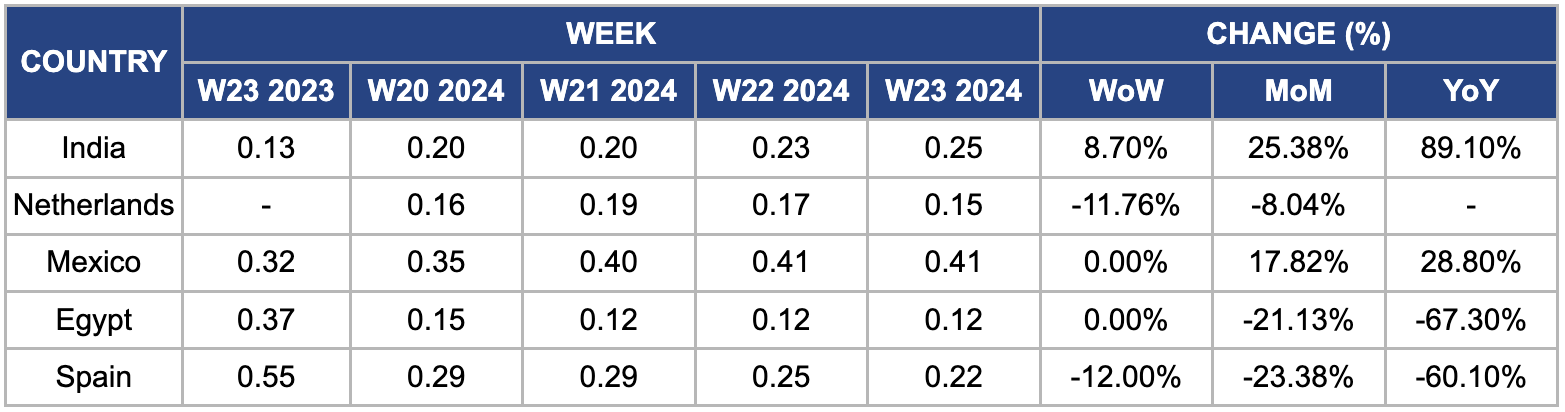
Yearly Change in Onion Pricing Important Exporters (W23 2023 to W23 2024)

India
During W23, onion prices in India increased 8.7% WoW and surged significantly by 89.10% year-on-year (YoY) to USD 0.25/kg due to a slowdown in arrivals and heightened demand ahead of Eid-al-Adha. Traders have started withholding stocks in anticipation of potential relaxation in government interventions aimed at price control. Onions entering the markets from Jun-24 onwards are sourced mainly from stocks held by farmers and traders. Farmers are hesitant to sell from their stocks, anticipating further price hikes due to expected lower yields in the rabi crop for 2023/24.
Netherlands
In W23, yellow Dutch onion prices saw a notable decrease of 11.76% WoW, dropping to USD 0.15/kg from USD 0.17/kg in W22. This decline can be due to sluggish demand and a supply surplus that exceeded expectations. In Jan-24, final estimates for the 2023 onion harvest were revised upward by a few percentage points, which altered market dynamics unfavorably. Additionally, disappointing export figures have significantly dampened demand, further contributing to price drop.
Mexico
In W23, Mexican onion prices held steady at USD 0.41/kg compared to the previous week. However, there was a substantial YoY increase of 28.8% due to a constrained supply of white and red onion varieties. The market anticipates improvements as the Texas onion season begins. Nevertheless, overall onion supplies continue to be notably lower than last year, prompting importing countries such as Mexico and Canada to procure more than usual in recent months.
Egypt
In W23, Egypt's wholesale onion prices held steady at USD 0.12/kg compared to the previous week. However, prices significantly declined 66% YoY due to increased local supply. Farmers expanded onion cultivation following last season's price hike, leading to an abundant harvest. Egypt's onion production now exceeds 3.5 million metric tons (mmt) across 300 thousand acres, reinforcing its status as the fourth-largest producer globally.
Spain
In W23, onion prices in Spain saw a notable decline of 12% WoW, dropping to USD 0.22/kg from USD 0.25/kg in W22. This decrease is due to low prices offered to farmers amidst a plentiful harvest across all Spanish-producing regions. Additionally, there has been a significant presence of imported onions on supermarket shelves, further dampening prices. Farmers have indicated that the average price at origin has been approximately USD 0.11/kg, and is barely sufficient to cover harvesting costs. As a result, many farmers have chosen not to harvest their crops, allowing them to spoil in the fields or opting to rotovate them instead.
3. Actionable Recommendations
Sustaining Competitive Advantage in Egypt's Onion Sector
Egypt can sustain its competitive advantage in the global onion market by focusing on quality assurance and sustainable agricultural practices. Implementing stringent quality control measures and certifications for onion exports will enhance product credibility and meet international food safety standards. Investing in irrigation technologies and soil management practices to optimize onion yield and quality will strengthen Egypt's position as a leading onion exporter. Additionally, diversifying export destinations beyond regional markets and exploring new trade agreements will mitigate market risks and capitalize on the emerging global demand for Egyptian onions. These recommendations aim to address specific challenges and opportunities in the onion sector across different countries, fostering resilience, sustainability, and market competitiveness for global onion producers.
Diversifying Export Strategies for Dutch Onions
To address the decline in yellow Dutch onion prices, exporters should diversify export strategies and explore new international markets with growing demand for premium onion varieties. Leveraging digital marketing platforms and trade fairs to showcase Dutch onions' quality and certifications can attract international buyers and increase export volumes. Enhancing partnerships with global distributors and retailers for direct market access can reduce dependency on traditional export channels and mitigate price volatility in the global onion market.
Improving Supply Chain Efficiency in Mexican Onion Production
Mexico should focus on improving supply chain efficiency in onion production by investing in modern harvesting equipment and logistics infrastructure. Enhancing cold storage facilities and transportation networks will minimize post-harvest losses and ensure timely delivery of onions to domestic and international markets. Collaborating with regional trading partners, such as the United States and Canada, on cross-border onion trade agreements and market access protocols can expand market opportunities and stabilize onion prices throughout the supply chain.
Sources: Eastfruit, Nongmin, NoticiasAgricolas, Campocyl, India Today


