W28 2024: Mango Weekly Update

1. Weekly News
United States
US and Haiti Collaborate to Resume Francisque Mango Exports
The United States (US) Ambassador to Haiti and the Haitian Minister of Agriculture have agreed to intensify efforts to align their agricultural objectives, mainly focusing on resuming the Francisque mangoes exports from Haiti to the US.The United States Department of Agriculture (USDA) suspended mango imports on Oct-22 due to security concerns due to security concerns that hindered pre-clearance inspections in Haiti, significantly impacting Haiti's mango industry and causing annual financial losses of USD 15 to 20 million. The collaborative efforts aim to facilitate the safe and efficient mango export resumption, addressing economic and phytosanitary concerns.
Bangladesh
Bangladesh Mango Exports Drop by 50% Due to Freight Costs and Export Incentive Reduction
Bangladesh's mango exports decreased by 50% year-on-year (YoY) in the 2023/24 season, primarily due to limited aircraft space and increased freight charges. Exporters note that local mangoes cost more than those from India and Pakistan. Additionally, the government's decision to reduce export incentives for agricultural products from 15% to 10% is expected to impact the situation negatively. In 2023, Bangladesh exported 3.9 thousand metric tons (mt) of mangoes to 38 countries, achieving a 73% YoY increase. However, mango exporters have only managed to ship around 700 mt in 2024. The Bangladesh Fruits, Vegetables & Allied Products Exporter's Association (BFVAPEA) recommends allocating specific space on Biman Bangladesh and foreign airlines for perishable export products to improve the situation.
Egypt
Egyptian Mango Season Starts Strong with Increased Volumes and Reduced Prices
According to the Sama for Import Export, the Egyptian mango season began with enthusiasm and optimism. The exporter reports increased volumes and lower launch prices than the previous season. Mango acreage in Egypt steadily increased due to stable demand and successful agricultural practices. Mango production started in areas reclaimed in the Egyptian desert three years ago, with an estimated volume increase of at least 15% over the previous season. Samah for Import and Export is offering lower prices by about 10% due to the increased volume. The company expects customers to appreciate the quality of their mangoes in size and color. It offers various indigenous and international varieties for local and export markets.
India
Uttar Pradesh Eases Mango Tree Pruning Regulations to Enhance Yields and Quality
The Uttar Pradesh government has introduced a new policy to improve yield and quality, allowing farmers to prune mango trees without government approval. This initiative is expected to enhance canopy management, particularly in aged orchards crucial to the state's agriculture. The Central Institute of Subtropical Horticulture (CISH) has developed a pruning technique to rejuvenate old trees by improving light penetration and reducing pesticide use. This method, which involves pruning tertiary branches, is anticipated to enhance tree health and increase yields to 100 kilograms (kg) per tree within two to three years. Additionally, the policy includes guidelines for the structural development of young mango plants.
Malda Mango Exports Hindered by Pricing Disputes and Domestic Demand Surge
Mango exports from Malda, West Bengal, faced significant challenges this season due to unfavorable prices from international buyers and strong domestic market demand. Disagreements over pricing prevented agreements with importers from the United Kingdom (UK) and the United Arab Emirates (UAE). Despite these setbacks, the domestic market showed robust demand, with mangoes selling for USD 1.20 to 1.79 per kilogram (INR 100 to 150/kg at a Delhi expo. Exporters abandoned negotiations with UK and Dubai buyers due to pricing disputes, and their initial efforts to export 1.3 thousand kg of the Himsagar variety were unsuccessful. Additionally, adverse weather conditions caused a 60% YoY decline in mango production, dropping output from 379 thousand tons to 220 thousand tons.
Pakistan
Challenges Facing Pakistan's Mango Export Target Amid Climate Issues and Quality Concerns
Pakistan faces challenges in achieving its mango export target of 100 thousand tons in 2024 due to climate change impacts and quality issues. Mangoes are Pakistan's primary fruit export, shipped to key markets including China, the US, Turkey, Japan, Iran, Afghanistan, the UAE, Saudi Arabia, and Central Asia. The mango production season spans May to August, with Punjab contributing 70% of total production. However, adverse weather and pest outbreaks have caused a 40% decline in Punjab and a 20% YoY drop in Sindh's mango production. The Trade Development Authority of Pakistan (TDAP) will announce the final export figures in Sep-24. Despite setbacks, there's rising demand for Pakistani mangoes in the Middle East, potentially exceeding export expectations this season.
2. Weekly Pricing
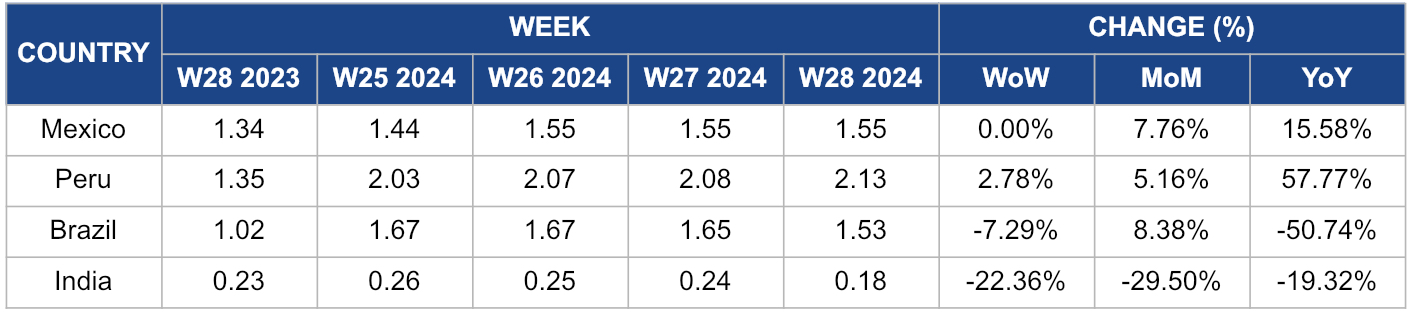
Weekly Mango Pricing Important Exporters (USD/kg)
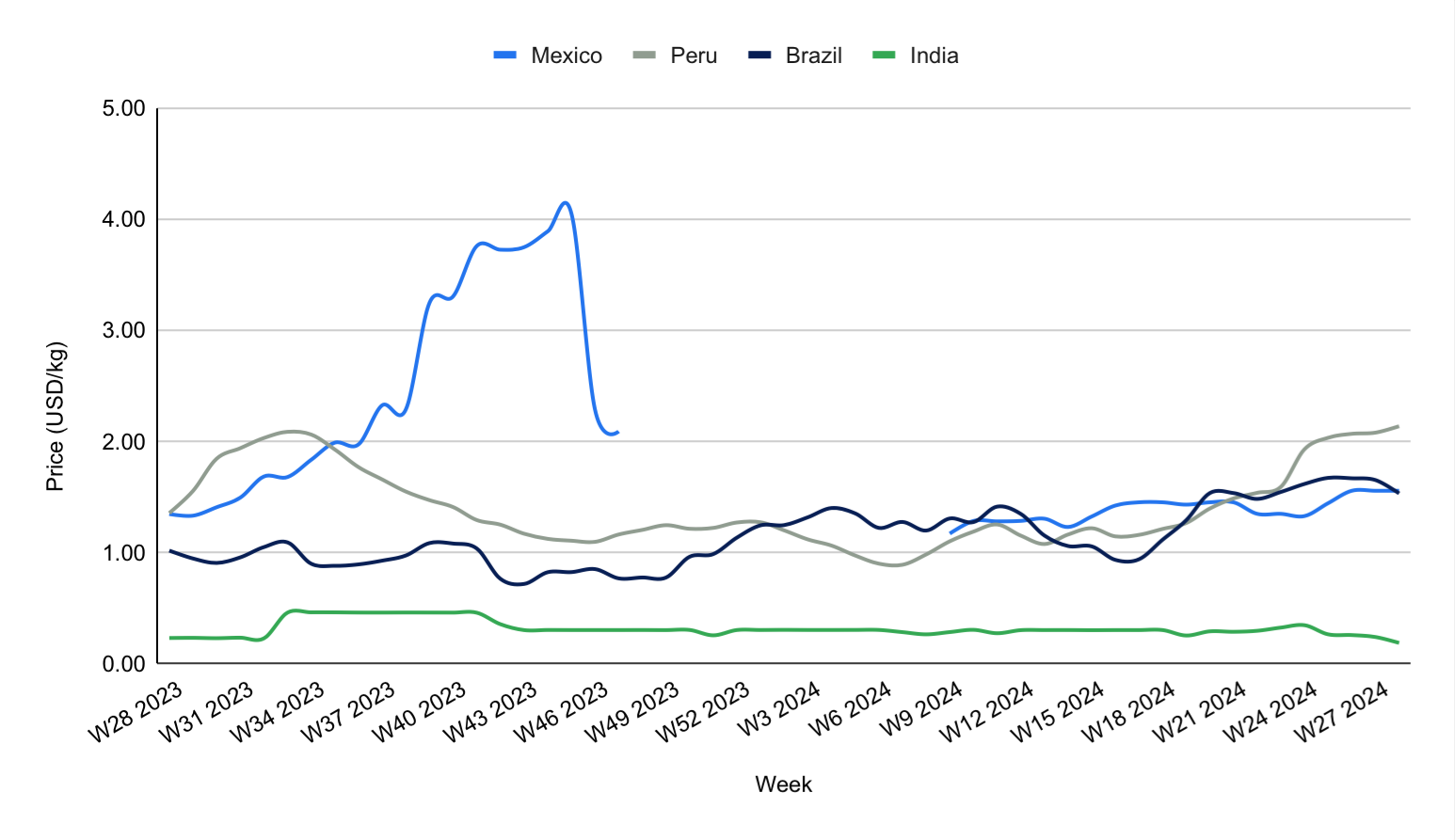
Yearly Change in Mango Pricing Important Exporters (W28 2023 to W28 2024)
Mexico
In W28, mango prices held steady at USD 1.55/kg since W27. This stability and the monthly rise and yearly decline reflect a complex market environment. The steady prices indicate a balance between supply and demand, influenced by strategic supply chain management and marketing efforts. Moreover, Mexico shipped approximately 4.003 million 4-kg boxes of mangoes to the US during W27, slightly down from 4.064 million boxes in the same week last year. Current harvesting and packing activities in primary regions like Colima, Jalisco, Michoacán, Nayarit, and Sinaloa contribute to supply stability.
Peru
In Peru, mango prices increased by 2.78% week-on-week (WoW) to USD 2.13/kg in W28, compared to USD 2.08/kg in W27. Moreover, there is also a 5.16% month-on-month (MoM) increase and a more significant 57.77% YoY increase. This upward trend reflects a combination of factors. The weekly price rise can be due to high and consistent demand from local and international markets and ongoing supply chain optimizations. The MoM increase indicates a recovery from the previous off-season, with market supply gradually stabilizing while demand remains high. The substantial YoY increase underscores the challenges faced during the 2023/24 campaign, including adverse weather conditions that significantly impacted yields and overall market availability. Despite being in the off-season, typically from May to October, the continued strong demand for Peruvian mangoes supports the higher prices observed, especially during the peak season from November to April.
Brazil
Despite high temperatures and rainfall typically expected to reduce supply and increase costs, Brazil’s mango prices decreased by 7.29% WoW to USD 1.53/kg. This contradiction results from a short-term supply increase, market dynamics, variations in quality, and inventory clearance efforts, which have temporarily driven prices down despite the challenging weather conditions.
India
Mango prices in India continued to decrease. Mango prices fell by 22.36% WoW to USD 0.18/kg in W28. This significant weekly decline follows a 6.84% WoW decrease in W27, where prices dropped to USD 0.24/kg. The continued decline is due to an oversupply of mangoes during the peak harvest season (March-April), which exerts downward pressure on prices. Despite these weekly declines, the notable MoM increase of 30.94% and a YoY increase of 10.16% observed in W27 highlight underlying trends of rising consumer demand and improved market conditions over the past month and year. Improved weather conditions impacting mango production and strategic marketing efforts may have contributed to these longer-term trends.
3. Actionable Recommendations
Enhancing Pakistan's Mango Export Strategy Amidst Challenges
Pakistan should implement advanced pest management practices and climate-resilient farming techniques in Punjab and Sindh to mitigate production losses and improve mango quality. Additionally, the TDAP should collaborate closely with exporters to leverage growing demand in Middle Eastern markets and explore new opportunities in emerging markets to achieve and potentially exceed the 100-thousand-ton export target for 2024.
Revitalizing Mango Export Strategy for Malda, West Bengal
Malda mango exporters should diversify their international market portfolio by exploring emerging markets in Southeast Asia and Eastern Europe, where demand for premium mango varieties aligns with competitive pricing strategies. The exporters should collaborate with local agricultural research institutions to adopt climate-resilient farming practices, mitigating production losses caused by adverse weather conditions and ensuring a consistent supply to both domestic and international markets.
Enhancing Bangladesh's Mango Export Strategy
BFVAPEA should collaborate closely with Biman Bangladesh and international airlines to secure dedicated cargo space and negotiate competitive freight rates for mango exports. They should advocate for reinstating or increasing export incentives to mitigate cost differentials and enhance competitiveness against regional rivals like India and Pakistan. Additionally, BFVAPEA should foster partnerships with logistics providers to streamline supply chain operations and ensure timely delivery of high-quality mangoes to global markets, revitalizing Bangladesh's export industry.
Sources:Tridge, Freshplaza, Haitilibre, Bhaskarlive, Ft, Deccanherald, Guojiguoshu, Businesspostbd, Producereport


