
1. Weekly News
Bangladesh
Bangladesh Mango Prices Surge 60% YoY Amid Production Decline
Mango prices in Bangladesh rose by more than 60% year-over-year (YoY) due to a 70% YoY decline in production. This drop is attributed to factors such as insufficient rainfall, damage from the Remal cyclonic storm during May-24, and persistent heatwaves, which have severely impacted yields. Priced between USD 29.04 to 34.16/37 kilogram box (BDT 3,400 to 4,000/37 kg box) on May-24, the Himsagar variety now commands over USD 36.73/37 kg box (BDT 4,300/37 kg box). The newly introduced Amrapali variety, available since Jun-24, is priced between USD 31.60 to 38.43/37 kg box (BDT 3,700 to 4,500/37 kg box). Lastly, Haribhanga mangoes are currently selling for USD 21.35 to 22.21/37 kg box (BDT 2,500 to 2,600/37 kg box).
Iran
Iran Experiences Mango Surplus Amidst Smuggling Concerns
The farming union official in Iran has observed a sudden increase in mango supply, potentially linked to smuggling activities along the Pakistan border. The head of Iran's National Union of Agricultural Products suggested that the recent drop in mango prices could be attributed to an oversupply facilitated through unauthorized channels. The official also highlighted the practice where smugglers exchange mangoes for smuggled fuel along Iran's eastern borders. Concerns were raised about the discrepancy between market prices and hard currency rates, emphasizing issues regarding the health inspections of fruits entering the Iranian market and potential hygiene risks. Iran is taking steps to secure its border with Pakistan to combat smuggling and promote lawful trade.
Egypt
Mango and Banana Crop Losses in Upper Egypt Due to Extreme Heat
Egyptian farmers in southern Upper Egypt are facing significant losses in their mango and banana crops, exacerbated by temperatures exceeding 50 degrees Celsius during the Eid al-Adha period. The intense heat has resulted in mango fruits blackening and rotting and premature falling of banana trees. The Ministry of Agriculture projects record mango production of 1.2 million tons, with exports estimated at 100 thousand tons, mainly from the 'Kalala' variety. The situation is further complicated by inadequate sunlight protection and the cultivation of foreign mango varieties in Lower Egypt.
Mexico
Certification Resumed for Michoacán Mango and Avocado Exports to the US.
Michoacán Governor has resumed certifying mangoes and avocados for export to the United States (US) after a week-long suspension due to an incident involving the United States Department of Agriculture (USDA) inspectors. The certification process aims to ensure that only environmentally certified mangoes and avocados can be exported to the US, preventing land use changes that harm the environment. Michoacán’s Governor plans to meet with the US Ambassador to discuss export issues, emphasizing the importance of addressing labor and security concerns in the avocado industry. A leader in agro-export production, Michoacán contributes nearly one-third of Mexico's agricultural exports. The governor also highlighted the need for a certification system to identify responsible producers, promote forest conservation, and enhance the global competitiveness of Michoacán mangoes and avocados.
Decline in Mexican Mango Shipments to the US Market
According to the National Mango Board (NMB) Week 24 report, Mexico's mango exports to the US market from regions including Chiapas, Jalisco, Michoacán, Nayarit, and southern Sinaloa totaled around 4 million boxes (4 kg) by June 15, 2024. This figure represents a slight decrease compared to the previous season's 4 million boxes for the same period. Moreover, there was a 5% volume decline from W25 (June 22) to W30 (July 27), with arrivals expected from W26 to W31.
Peru
Decline in Peruvian Mango Exports for the 2023/24 Season
Peruvian mango exports for the 2023/24 season dropped by 68.34% compared to the previous campaign. The YoY volume decline was notable, with 64.7 thousand tons shipped by sea, 13.5 thousand tons by air, and 1.7 thousand tons by land. Major markets for fresh mango included the Netherlands, the US, Spain, Germany, England, Canada, South Korea, France, Switzerland, Chile, Belgium, and Russia. Frozen mango exports also declined by 72.72% YoY, with 19.3 million kg shipped during 2023/24. Early indications for the 2024/2025 campaign suggest favorable conditions for flowering and operations going forward.
United States
US Consumption of Peruvian Mangoes Doubles Since 2005
The Peruvian mango industry is experiencing significant growth in the US, with per capita consumption rising from 1.9 pounds (lbs) in 2005 to 3.6 lbs in 2023. The National Mango Board (NMB) aims to entice American consumers with the culture, flavor, and nutritional value of mangoes, promoting them as an everyday necessity. The NMB is focusing on five key pillars such as supplying high-quality mangoes, establishing a strong market presence, educating consumers, penetrating the market through various channels, and providing exemplary services to the industry. The US mango market consumes approximately 550 thousand metric tons (mt) annually, generating an annual Free on Board (FOB) value of USD 800 million.
2. Weekly Pricing
Weekly Mango Pricing Important Exporters (USD/kg)
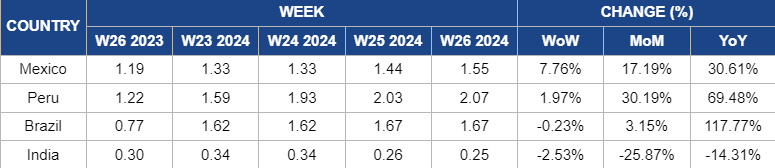
Yearly Change in Mango Pricing Important Exporters (W26 2023 to W26 2024)

Mexico
In W26, the wholesale price of mango in Mexico increased by 7.76% week-over-week (WoW) to USD 1.55/kg, following a price of USD 1.44/kg in W25. There is also a 17.19% month-on-month (MoM) increase from USD 1.33/kg on May-24. Moreover, a 30.61% YoY increase reflects sustained demand in key export markets like Europe and North America. The weekly decrease can be attributed to temporary supply adjustments due to logistical challenges or seasonal factors. However, the monthly and yearly increases indicate overall strong market performance driven by robust consumer demand and favorable growing conditions in major production regions such as Michoacán. Additionally, strategic efforts in marketing and supply chain management continue to support price stability and growth in the mango industry.
Peru
The wholesale prices of mango in Peru increased slightly by 1.97% WoW to USD 2.07/kg in W26, compared to USD 2.03/kg in W25. This modest increase is accompanied by a significant 30.19% MoM rise from USD 1.59/kg last month. The slight weekly increase is due to the adjustments in the market as supply begins to stabilize after the off-season in June.
Despite the off-season, demand for Peruvian mangoes remains strong, contributing to the upward price trend. The market also reacted to the challenges faced during the 2023/24 campaign, where fresh mango exports declined significantly by 68.34%.
Brazil
Mango prices in Brazil remained steady at USD 1.67/kg in W26, unchanged from the previous period. However, they have surged by 117.77% YoY, up from USD 0.77/kg in the same period last year. This stability reflects balanced market conditions in W26. At the same time, the significant YoY increase is due to reduced production in major mango-producing countries like Peru, Brazil, and Mexico, coupled with weather-related challenges that impacted yields and quality.
India
In India, mango prices decreased by 2.53% WoW to USD 0.25/kg in W26, marking a 25.87% MoM decrease and a 14.31% YoY decrease. This drop follows a notable price drop in W25, where prices fell by 23.95% WoW to USD 0.26/kg. The continued decline is primarily due to the significant failure of the Totapuri mango crop in the 2024 season, exacerbated by harsh weather conditions. This crop failure has substantially reduced fruit yield, causing prices to surge compared to the previous year. Moreover, the off-season for mangoes in India, coupled with consumer concerns about fruit quality and affordability, has further contributed to the ongoing price decrease.
3. Actionable Recommendations
Ensuring Sustainable Export Certification for Michoacán Mangoes and Avocados
To mitigate recent challenges and resume stable exports to the US, Michoacán must enhance security measures for USDA inspectors and collaborate closely with local authorities to ensure their safety. Implement rigorous monitoring and compliance mechanisms to certify environmentally responsible mango and avocado production, focusing on forest conservation and sustainable land use practices. Strengthen engagement with the US Ambassador to address labor issues and security concerns in the avocado industry, aiming to restore trust and maintain export quality standards. Enhance market competitiveness by promoting certified products and supporting responsible producers, thereby sustaining Michoacán's significant contribution to Mexico's agricultural exports.
Addressing Price Surges and Production Challenges in Bangladesh's Mango Market
Implement immediate water management solutions to combat drought effects, promote resilient mango varieties, enhance pest control measures, and provide financial and technical support to affected farmers. These steps are crucial to stabilize prices and sustain mango production in Bangladesh amidst climatic challenges.
Mitigating Heat Impact on Mango and Banana Farms in Upper Egypt
Farmers in southern Upper Egypt face severe crop losses from extreme temperatures over 50°C during Eid al-Adha, leading to premature mango fruit rot and banana tree shedding. Despite expecting record mango production of 1.2 million tons, challenges persist due to inadequate sun protection and non-native mango varieties in Lower Egypt. Immediate actions include implementing shade structures, promoting heat-resistant crop varieties, and educating farmers on climate-resilient practices. Early warning systems and crop diversification are essential for mitigating climate risks and sustaining agricultural productivity.
Sources: Tridge, Freshplaza, Portaldelcampo, Agraria, MXfruit, Infobae, Almalnews


