
1. Weekly News
Brazil
Mato Grosso Dominates Brazil’s Corn Exports Despite Yearly Decline
According to the Foreign Trade Secretariat (SECEX), Mato Grosso solidified its position as Brazil's top corn exporter from Jan-24 to Aug-24, contributing 70.35% to the country's total exports. Brazil's corn exports surged to 6.06 million metric tons (mmt) in Aug-24, a 70.67% month-on-month (MoM) increase compared to Jul-24. Total exports reached 17.94 mmt year-to-date, though this reflected a 28.85% decline year-on-year (YoY) compared to the same period in 2023. Mato Grosso's Aug-24 exports rose 42.98% MoM to 4.10 mmt, driven by the state's second-crop corn harvest. Despite this growth, exports were still 24.93% below last year's levels and 5.10% under the five-year average. Analysts anticipate further increases in exports during the second half of 2024 due to the new harvest's increased supply.
Brazilian Corn Export Estimates Revised Upwards for Sep-24
The National Association of Cereal Exporters (ANEC) revised its forecast for Brazilian corn exports in Sep-24, raising the estimate to 6.63 mmt, slightly higher than the earlier estimate of 6.47 mmt. However, corn exports will still be 2.79 mmt lower than the volumes recorded in Sept-23 despite this upward revision.
Kazakhstan
Kazakhstan's Corn Exports Surge in 2023/24 MY
Kazakhstan significantly increased its corn exports during the first 11 months of the 2023/24 marketing year (MY), reaching 158.67 thousand metric tons (mt), more than double the previous season's exports. Tajikistan remained the largest importer, receiving 66.18 thousand mt of corn, up from 44.38 thousand mt last year. Uzbekistan also continued as a significant buyer, and China emerged as a notable importer of Kazakh corn for the first time. This export surge represents a 2.3-fold increase compared to the 67.4 thousand mt exported during the same period in the previous marketing year.
Ukraine
Drought’s Impact on Corn Moisture Levels in Ukraine
Dry conditions at the end of the 2024 season have reduced corn moisture levels, particularly in the Cherkasy and Kirovohrad regions, where averages hover around 12% in some areas. Despite hopes that the leaf surface and root systems will contribute to grain filling, the situation in Kirovohrad Oblast is worse than in Cherkasy. In many areas, corn cobs did not develop properly, and where they did, many were only half-formed due to sterilization of the pollen. Moreover, a recent trend in corn cultivation has emerged: the sowing rate has decreased for the third consecutive year, now at 65,000 seeds per hectare (ha), reflecting a 10% reduction from previous norms.
United States
US Corn Harvest Progressed Ahead of Five-Year Average
As of W37, the United States (US) corn harvest was 9% complete, 3% ahead of the five-year average. The United States Department of Agriculture (USDA) rated 65% of the corn crop as good to excellent, up 1% week-on-week (WoW), surprising analysts who had expected a decline. These ratings mark the highest for this period since 2018, pointing to the likelihood of a large harvest. The USDA also projected record-high US corn yields, positioning the US as the world's largest corn exporter for strong deliveries in the global market. Dry conditions across the Midwest have sped up crop maturation, with 45% of the corn crop now mature, above the five-year average of 38%. This weather is expected to facilitate a smooth harvest in the weeks ahead.
2. Weekly Pricing
Weekly Maize Pricing Important Exporters (USD/kg)
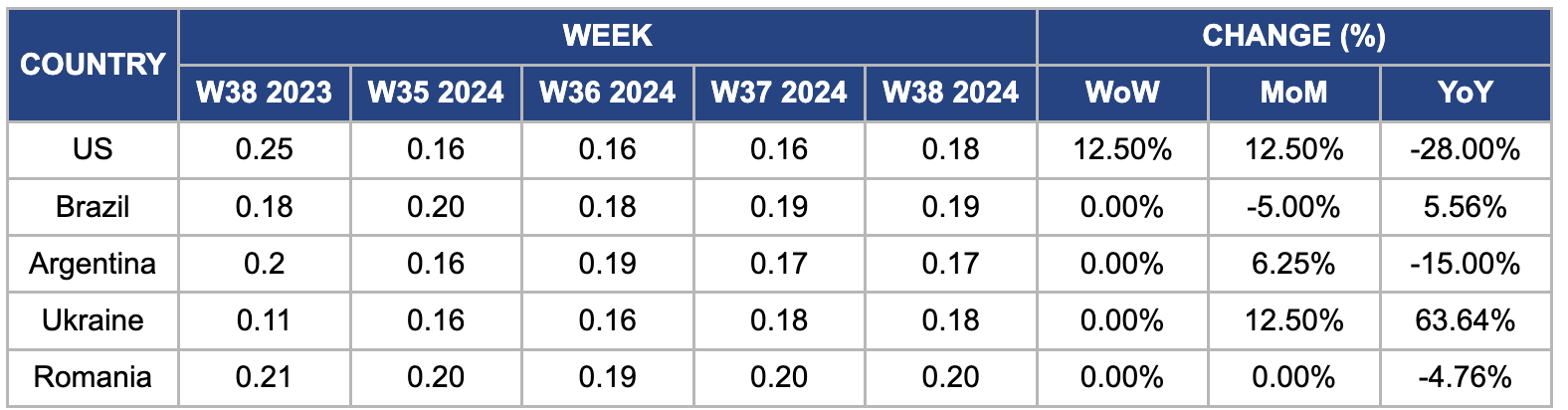
* Varieties: US (feed grade), all others (overall average)
Yearly Change in Maize Pricing Important Exporters (W38 2023 to W38 2024)

* Varieties: US (feed grade), all others (overall average)
* Blank spaces on the graph signify data unavailability stemming from factors like missing data, supply unavailability, or seasonality
US
In W38, US wholesale maize prices rose 12.50% WoW and MoM, reaching USD 0.18 per kilogram (kg). This increase stems from heightened demand, driven by new export sales announced by the USDA and significant purchases from China and Colombia. However, prices fell 28% YoY as the USDA revised its corn production and yield forecasts upward, estimating 15.186 billion bushels and an average yield of 183.6 bushels per acre. This represents a notable increase from the previous estimates of 15.147 billion bushels and 183.1 bushels per acre.
Brazil
In W38, weekly wholesale maize prices in Brazil remained unchanged at USD 0.19/kg. However, prices dropped 5% MoM from USD 0.20/kg due to a projected 3.6% YoY increase in Brazil's corn crop for the 2024/25 season, expected to reach 119.8 mmt, according to the National Supply Company (CONAB). The increase is due to expanded planted areas and improved yields.
Argentina
The wholesale price of Argentine corn remained unchanged WoW at USD 0.17/kg. However, prices increased by 6.25% MoM from USD 0.16/kg in W35 due to severe setbacks in Argentina's corn production owing to an outbreak of corn stunting disease, which has spread from northern regions into Central Argentina and parts of the Pampas. The disease negatively impacts corn crops, reducing quality, delaying input sales, and lowering planting expectations. Consequently, a production shortfall of approximately 21% YoY is anticipated, with the total planted area projected to decline to around 8 million ha. Farmers are also contending with the spiroplasma bacteria and insufficient rainfall in Sept-24, further aggravating the production challenges.
Ukraine
Ukrainian wholesale maize prices remained unchanged WoW in W38. However, prices rose by 12.50% MoM and 63% YoY to USD 0.18/kg due to a severe heat wave in Jul-24, which is expected to impact Ukraine's corn production substantially. As a result, the Ukrainian Grain Association (UGA) forecasts a reduction in the 2024 corn harvest, projecting a drop of 16.3% YoY to 27.2 mmt. In some affected regions, reductions could reach as high as 30% YoY, likely driving prices higher in the coming weeks. Despite these challenges, the Ukrainian government remains cautiously optimistic, with the acting finance minister projecting a more moderate 15% decline in late crop yields.
Romania
In W38, Romanian maize wholesale prices remained unchanged WoW but fell 4.76% YoY to USD 0.20/kg. This YoY price drop is due to early harvest results, which indicated quality issues and have led to several trades being "washed out" recently. As Europe's second-largest grain exporter after France, Romania is facing a significant drop in corn harvests due to one of the worst droughts in recent decades, affecting nearly 2 million ha of farmland. Corn output is expected to decline by 10 to 15% in the upcoming Oct-24 to Sept-25 season, raising concerns about tighter supply.
3. Actionable Recommendations
Adapt to Climatic Challenges and Improve Agricultural Practices
Countries such as Kazakhstan and Ukraine should prioritize adapting their agricultural practices to mitigate the impacts of climatic challenges. This includes adopting resilient crop varieties, such as drought-resistant corn hybrids, and investing in efficient irrigation systems to ensure consistent moisture levels during critical growth periods. Precision farming techniques, such as soil moisture monitoring and targeted fertilization, can optimize inputs and improve overall yields. By enhancing data collection on soil and weather conditions, these countries can make informed decisions that lead to improved corn production. Markets like Southeast Asia can benefit from these efforts as they seek reliable sources of corn for animal feed and biofuel production.
Enhance Production Resilience and Agricultural Innovation
Ukraine and Argentina, which face significant production challenges, including diseases like corn stunting, should invest in innovative agricultural techniques, such as integrated pest management (IPM) strategies and developing genetically modified (GM) corn varieties resistant to pests and diseases. Collaborating with agricultural research institutions to identify and produce disease-resistant varieties will stabilize yields. This approach helps local farmers and creates opportunities for exports to regions like Africa and Eastern Europe, where there is a growing demand for reliable and high-quality corn supplies.
Strengthen Export Strategies and Address Market Dynamics
Brazil and Argentina should enhance their export strategies by diversifying their target markets and building stronger relationships with essential international buyers. For example, both countries should focus on expanding exports to Asia, particularly to China and India, where demand for corn is rising due to increasing livestock production and food processing industries. Strengthening ties with Middle Eastern countries, where food security is a growing concern, could provide new export avenues. Investing in logistics and storage facilities will also help streamline shipping processes, ensuring that products maintain quality during transit. These efforts can facilitate access to currently underserved markets and capitalize on Brazil and Argentina’s competitive pricing.
Sources: Tridge, Portal Do Agronegocio, Zol, Hellenic Shipping News, Superagronom