.jpg)
In W12 in the potato landscape, some of the most relevant trends included:
- Global potato production has grown substantially since 2021, led by China, India, and the US. Technological advancements and expanding cultivation areas supported growth, but climate change and rising input costs remain key challenges.
- The Manitoba potato industry faces severe losses due to order cuts, with some seed growers risking USD 1 million in unsold inventory. Russia struggles with storage limitations and rising equipment costs due to import restrictions. Meanwhile, the UK reports ring rot in Polish potato imports, heightening biosecurity concerns.
- In France and Germany, potato prices rose monthly due to lower harvest volumes and strong processor demand. Meanwhile, Pakistan's potato prices fell due to increased supply from Punjab’s harvest.
1. Weekly News
Global
Global Potato Industry Expands with Higher Yields and Technological Advancements
The global potato industry experienced significant growth over the past four years, driven by technological advancements, expanding cultivation areas, and increasing demand for fresh and processed potato products. In 2023, worldwide potato production surpassed 368 million metric tons (mmt), with China, India, and the United States (US) leading in output. Technological innovations, such as precision farming and climate-resilient varieties, have enhanced yields and expanded cultivation into new regions like Africa and Latin America. Despite challenges like climate change and rising input costs, the industry's resilience is bolstered by ongoing research into disease-resistant varieties and improved storage solutions.
Canada
Manitoba Potato Growers Face Losses Amid Unexpected Order Cuts
The Manitoba potato industry is scrambling to respond as companies cut orders, forcing seed producers and top crop growers to face potentially huge losses. Some larger seed growers will likely lose at least USD 1 million or more in unsold seed sitting in storage. The reason behind the cuts remains unclear, raising questions about a possible connection to the ongoing trade tensions between Canada and the US.
Russia
Russia Faces Storage Challenges for Vegetables Amid High Costs and Equipment Shortages
The high costs of constructing and modernizing vegetable storage facilities and equipment supply difficulties in Russia create significant challenges. Russia produces around 13 to 14 mmt of potatoes and open-field vegetables annually, but storage facilities can accommodate only 8 to 9 mmt. Farmers do not store all produce long-term, as they must invest heavily in building new storage facilities and upgrading existing ones. Since most equipment comes from foreign manufacturers, recent restrictions have made access more difficult, increasing costs and complicating logistics. To help overcome these challenges, Russia's Ministry of Agriculture provides annual support for vegetable storage projects.
United Kingdom
UK Authorities Detect Ring Rot in Polish Potato Imports
Authorities have reported ring rot in two consignments of ware potatoes imported into the United Kingdom (UK) from Poland, calling the situation very alarming. Clavibacter sependonicus causes ring rot, a notifiable disease in Northern Ireland. The UK Plant Health Service (PHS) detected the infection during a routine inspection. The Agriculture, Environment, and Rural Affairs spokesperson in Westminster emphasized that Great Britain, Northern Ireland, and the Republic of Ireland remain free of ring rot. Since the disease thrives in cool climates, it could become established in the UK, leading to significant yield losses and economic damage to the potato sector.
The PHS confirmed that it traced the affected consignments across several locations. Authorities destroyed the remaining ware potato stocks at the source in Poland. Consequently, the UK has increased inspections on potato consignments arriving from Poland.
2. Weekly Pricing
Weekly Potato Pricing Important Exporters (USD/kg)
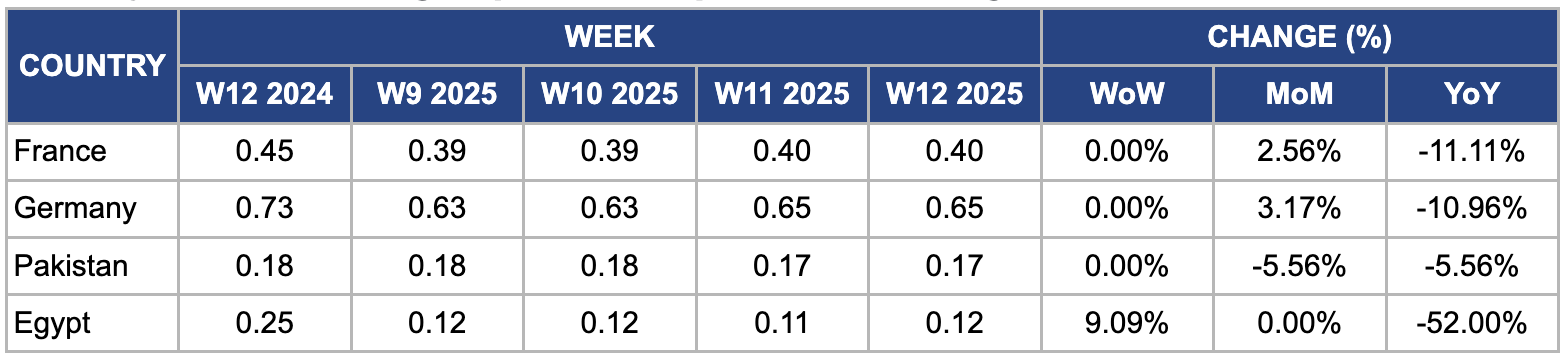
Yearly Change in Potato Pricing Important Exporters (W12 2024 to W12 2025)

France
In W12, France’s potato prices remained stable week-on-week (WoW) at USD 0.40 per kilogram (kg) but rose 2.56% month-on-month (MoM) from USD 0.39/kg in W9. Lower-than-expected storage volumes from the 2024 harvest, which totaled approximately 7.9 mmt compared to 8.3 mmt in 2023, reduced market availability and drove the price increase. Persistent rainfall in key production regions, including Hauts-de-France and Normandy in Feb-25, caused logistical delays, limiting fresh supply. Meanwhile, steady demand from processors and exporters, particularly in Spain and Italy, provided additional support.
Germany
In W12, German potato prices remained stable WoW but increased 3.17% MoM to USD 0.65/kg as strong demand outpaced supply. The Lower Saxony Chamber of Agriculture reported that processors from neighboring countries, particularly the Netherlands and Belgium, ramped up purchases, further tightening available stocks. Adverse weather conditions reduced Germany’s 2024 potato harvest to an estimated 10.3 mmt, down from 10.7 mmt in 2023. With limited free-market industrial potatoes and domestic contract obligations taking priority, supply constraints continued pushing prices higher. Farmers expect prices to remain firm as processor demand persists.
Pakistan
In W12, Pakistan's potato prices remained stable WoW but declined 5.56% MoM and YoY to USD 0.17/kg. The ongoing harvest in Punjab, the country’s key potato-producing region, expanded supply, pushing prices lower. Increased acreage and improved yields boosted market availability while easing inflation and stable input costs, particularly for fertilizers and fuel, reduced production expenses. Furthermore, weaker export demand and improved domestic distribution kept the market well-supplied, preventing price surges.
Egypt
In W12, Egypt's potato prices surged 9.09% WoW to USD 0.12/kg from USD 0.11/kg due to seasonal supply constraints, strong export demand, currency depreciation, and rising production costs. As the winter harvest concluded, fresh potato availability declined, tightening domestic supply. Meanwhile, Egypt’s potato exports increased mainly to the European Union (EU), Russia, and Arab countries, further limiting local availability. The depreciation of the Egyptian pound (EGP) has also raised the cost of imported agricultural inputs, including fertilizers and pesticides, increasing production expenses. Moreover, rising fuel prices have escalated transportation costs, making potato distribution more expensive.
3. Actionable Recommendations
Expand Market Access for Manitoba’s Seed Potato Industry
Manitoba's seed potato growers experienced significant financial losses due to unexpected order cuts. To mitigate these risks and reduce dependence on the US market, growers should actively explore alternative export destinations such as Mexico, Japan, and the Middle East, where demand for high-quality seed potatoes is increasing. Engaging with industry associations, such as the Canadian Potato Council, and leveraging government export promotion programs like the AgriMarketing Program can facilitate trade negotiations and secure new buyers. Manitoba seed growers can collaborate with international agricultural fairs and trade missions to showcase their product quality and establish long-term partnerships. Establishing direct contracts with foreign buyers will create pricing leverage, reducing the risk of sudden order cancellations. By expanding market access, Manitoba’s potato industry can enhance its resilience against trade disruptions and maintain profitability despite shifting demand trends.
Investment in Domestic Storage and Processing in Russia
Russia's potato industry faces significant post-harvest losses due to limited storage capacity. To address this issue, producers should form cooperatives that pool resources to finance the construction and modernization of shared storage facilities. Establishing collective storage units will lower individual investment costs while ensuring better quality preservation, reducing supply fluctuations that lead to price volatility. Furthermore, producers should engage with domestic equipment manufacturers to develop cost-effective storage and processing solutions, minimizing reliance on foreign suppliers, whose equipment availability has become increasingly restricted due to recent trade barriers. Moreover, integrating processing capabilities such as potato dehydration and frozen products will create higher-value products that can be stored longer and sold in domestic and export markets. These investments will help stabilize potato supply, improve farmer profitability, and reduce reliance on seasonal price peaks.
Strengthen Disease Prevention Measures in the UK Potato Supply Chain
The recent detection of ring rot in Polish potato shipments has raised concerns about potential risks to the UK’s domestic production. Strengthening phytosanitary controls is crucial to prevent the disease from establishing itself in the UK. Authorities should mandate pre-export testing for all Polish potato consignments and increase inspections at entry points to detect potential infections before distribution. In addition, local farmers should adopt strict biosecurity protocols, including controlled seed sourcing, regular field inspections, and decontamination procedures for storage and handling facilities. Awareness campaigns targeting importers and distributors will also help enforce early detection and containment strategies. By implementing stringent phytosanitary measures, the UK can safeguard its potato industry from economic losses linked to disease outbreaks, ensuring stable production and market confidence.
Sources: Tridge, Cbc.ca, Fresh Plaza, Fruit Today


