
In W3 in the onion landscape, some of the most relevant trends included:
- Import and export regulations are significantly influencing onion prices, with disruptions affecting countries like Bangladesh, India, and Kenya due to varying import duties and export restrictions. These measures are increasing local prices in Bangladesh and Kenya and causing price volatility in India due to export restrictions.
- Supply chain disruptions are impacting availability and prices, with reduced imports in Kenya and the Netherlands leading to price surges, while other regions like Egypt and Mexico benefit from favorable weather conditions and local supply increases, stabilizing their markets.
- Bangladesh and India seek balance in protecting local agricultural markets and ensuring fair prices for their farmers through government intervention to protect local farmers from international market fluctuations, while in the Netherlands and Spain, export demand and local production cycles dictate price trends.
- Weather conditions and harvest cycles (e.g., cold weather in Mexico and reduced supply in Spain) continue to drive price fluctuations, with countries like Egypt seeing price stability due to favorable growing conditions.
1. Weekly News
Bangladesh
Traders Urge Bangladesh Government to Regulate Onion Imports to Avoid Price Surge
Traders at Sonamasjid Land Port in Bangladesh have urged the government to avoid imposing a ban on onion imports until May-25, warning that such a measure could significantly drive up local onion prices. Instead, they recommend regulating imports to protect both local consumers and farmers. They highlighted that spring onions are harvested between April and June, with efforts in progress to preserve them for year-round availability. While the agriculture ministry has proposed imposing a reasonable duty on onion imports to ensure fair prices for local farmers, the commerce ministry is still reviewing the situation. Bangladesh's annual onion demand is around 2.6 to 2.7 million metric tons (mt), with local production meeting most of this demand and imports, primarily from India, covering the remainder.
India
Indian Farmers Urge Government to Lift Export Duty on Onions Following Bangladesh's Import Tax
Indian farmers and exporters urge the government to remove the 20% export duty on onions. This request comes after Bangladesh imposed a 10% import duty on January 16, 2025. The import duty has negatively impacted onion exports and wholesale prices. With over 20% of India's onion exports directed to Bangladesh, the surge in late Kharif onion supply has intensified the pressure. Daily arrivals at Lasalgaon Agricultural Produce Market Committee (APMC), India’s largest wholesale onion market, have risen from 20 thousand to 22 thousand quintals. However, with a shelf life of less than a month, farmers are being forced to sell at reduced rates, with prices dropping by 44% from USD 41.70 per quintal (INR 3,600 per quintal) in Dec-24 to USD 23.17 per quintal (INR 2,000 per quintal) currently. Farmers warn that continued increases in supply could drive prices even lower, urging the government to lift export restrictions to stabilize domestic markets and support their livelihoods.
Kenya
Onion Prices Surged in Kenya Due to Reduced Imports and Local Shortages
Onion prices in Kenya have surged by 51.4% over the past 12 months, driven by reduced imports from Tanzania, the country’s largest supplier. The onion prices have risen from USD 0.77 per kilogram (KES 99.31/kg) in Jan-24 to USD 1.16/kg (KES 150.4/kg) in Jan-25. This increase is compounded by a local shortage worsened by Tanzania's export restrictions on onions, which has disrupted the supply chain. Kenya relies on Tanzania for about 50% of its onion imports, and the reduced production from local farmers, caused by rising input costs, has further exacerbated the shortage. With the population expected to grow and onion consumption projected to reach 148 thousand metric tons (mt) by 2026, demand is likely to keep rising. This surge in onion prices is contributing to broader food inflation, which has climbed to 7.9%.
Netherlands
Uncertain Onion Market in the Netherlands as Exports Face Mixed Demand
The onion market in the Netherlands is at a turning point, characterized by caution and uncertainty among traders. After strong exports to Africa in Nov-24 and Dec-24, there is hope for continued good export figures into early January. However, demand from regions like the Far East and the Caribbean has been disappointing. While the base price of onions is slightly declining, currently ranging between USD 0.22 and 0.24, no significant drop is expected in the near future. The overall quality of onions is good, with poorer batches already removed from the market, though there are still differing opinions on the overall quality. Despite expectations for increased demand from destinations like the Caribbean and the Far East, local production, particularly from China, has limited the Netherlands' ability to tap into these markets. The impact of major trade events, like Fruit Logistica, is expected to be minimal, with local supply in Eastern Europe playing a more significant role in shaping market prices.
Ukraine
Ukrainian Onion Prices Drop Amid Decline in Quality and Demand
Ukrainian onion producers have significantly reduced prices in W3 due to a sharp decline in the quality of stored onions for the 2024 season and a decrease in demand. As a result, onion prices have adjusted to USD 0.21 to 0.36 per kilogram (UAH 9 to 15/kg), marking a 10% decrease from the previous week. This price drop is further influenced by several producers reopening their storage facilities, which has increased market supply. Despite the decline, current onion prices remain 10% lower than at the same time last year. The price downturn is expected to continue until the end of Feb-25 when demand is expected to revive, and most of the lower-quality stock will be depleted.
2. Weekly Pricing
Weekly Onion Pricing Important Exporters (USD/kg)
Yearly Change in Onion Pricing Important Exporters (W3 2024 to W3 2025)
India
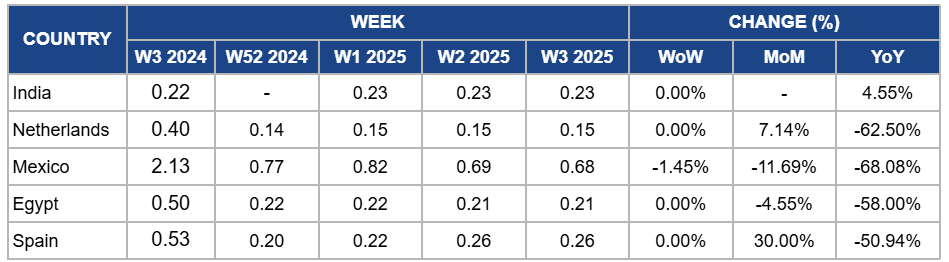
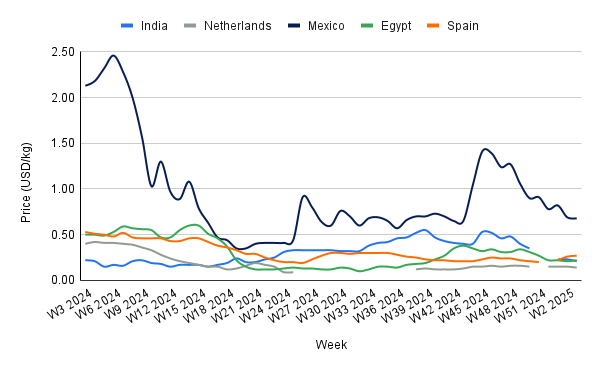
India's onion prices remained stable at USD 0.23/kg in W3, reflecting a 4.55% year-on-year (YoY) rise due to steady local demand and reduced price volatility despite an increase in supply. The increased daily arrivals at Lasalgaon APMC and the growing pressure on prices due to the surge in late Kharif onions have kept prices stable at lower levels. However, the 20% export duty and the 10% import duty imposed by Bangladesh have compounded the challenges, limiting export opportunities and creating downward pressure on wholesale prices. Despite these challenges, the YoY price increase reflects the resilience of the market amidst these ongoing difficulties.
Netherlands
Onion prices in the Netherlands held steady at USD 0.15/kg in W3, with a 7.14% month-on-month (MoM) increase due to moderate improvements in local demand and the steady quality of available onions, which supported price stabilization. However, YoY prices dropped significantly by 62.5% due to weaker export demand from key regions like the Far East and the Caribbean, and increased competition from countries like China, which limited the Netherlands' market access. The decline in export performance, combined with the market's cautiousness and hesitation amid uncertainty in global trade, led to a substantial drop in YoY prices despite steady domestic quality.
Mexico
In Mexico, onion prices slightly declined by 1.45% week-on-week (WoW) to USD 0.68/kg in W3, showing an 11.69% MoM decrease and 68.08% YoY decline. The price drop is due to an increase in the supply of onions as the cold weather from previous weeks began to ease, allowing more onions to reach the market. Additionally, the delayed export season, with shipments starting only in mid-Feb-25, has increased domestic availability, contributing to the price reduction. The significant YoY decline reflects the high prices of the previous year when supply was more limited and market demand was stronger.
Egypt
Egyptian onion prices remained steady at USD 0.21/kg in W3, with a 4.55% MoM decrease and 58% YoY decline due to the continued strong domestic supply resulting from favorable weather conditions, which have ensured a good harvest in key regions like the Nile Delta and Upper Egypt. The increase in local production and government efforts to improve market access and logistics have maintained steady availability in the domestic market. Despite the drop in prices from last year, the market remains stable due to the ample supply, which is helping to meet both local and export demand.
Spain
Onion prices in Spain remained steady at USD 0.26/kg in W3, with a 30% MoM increase due to continued export demand and the ongoing transitional period between harvest cycles, which has limited supply. However, there is a significant drop of 50.94% YoY due to the higher availability of domestic onions last year, which has since been depleted as the Spanish onion harvest concluded earlier, coupled with the impact of weather conditions on last season's production, leading to lower YoY prices.
3. Actionable Recommendations
Regulate Onion Imports to Stabilize Local Prices
Traders at Sonamasjid Land Port should advocate for a more controlled import regulation, rather than a full ban, to avoid inflating local onion prices. By balancing imports with local spring onion harvests, traders can help ensure a steady supply and protect consumer prices and farmer incomes. Furthermore, coordinating with the agriculture ministry to preserve local onions for year-round availability will further stabilize the market.
Manage Onion Supply to Prevent Further Price Declines
Global onion producers should reduce supply to match current demand and avoid oversaturation in the market. Producers can help stabilize prices as demand rises in the coming months by focusing on selling higher-quality stock and depleting lower-quality onions. Strategic storage management and targeted sales will assist in balancing supply and demand.
Address Onion Supply Shortage in Kenya
Kenyan onion traders should diversify their import sources beyond Tanzania to mitigate the supply shortage. They can stabilize prices by exploring new suppliers and investing in local production through improved farming practices. Additionally, farmers should be encouraged to increase local production by adopting cost-effective methods to offset rising input costs and meet growing demand.
Sources: Tridge, Eastleigh Voice, Freshplaza, Msn, Thefinancialexpress, Times of India


