
1. Weekly News
Global
Global Avocado Industry Recovers and Expands Amidst Challenges
The global avocado industry, having faced significant challenges due to the El Niño phenomenon, is now rebounding and focusing on emerging markets. According to the World Avocado Organization (WAO) President, weather patterns in 2023 impacted nearly 90% of avocado-growing regions. However, avocados have demonstrated impressive resilience compared to other crops. As the Peruvian avocado season concludes, with a record crop in South Africa and strong production in other African regions, the industry is positioned to recover. Bard also highlights the sector's efforts to address misconceptions about avocados' environmental impact through a successful "myth-busting campaign."
The transition to La Niña is anticipated to restore favorable growing conditions in Peru. Africa, particularly South Africa and Kenya, is emerging as a primary player in the Chinese avocado market. In Asia, avocado consumption is rising, with China and South Korea experiencing increased demand and India seeing rapid import growth. WAO successfully educated Indian consumers about avocado benefits, supported by new supply sources in Tanzania and Kenya. Led by Mexico, Latin America remains a significant producer, with Colombia and Peru expected to enhance production in the coming years. Europe also shows promising growth, especially in Scandinavian countries and the United Kingdom (UK). WAO aims to boost global avocado consumption by engaging younger generations through digital platforms and encouraging diverse fruit usage.
Brazil
Brazil Gains Access to Costa Rican Avocado Market
The Brazilian Minister of Agricultural Development announced the country's new opportunity to export avocados to Costa Rica during an event in Várzea Grande (MT) on Wednesday, July 31, 2024. Brazil has already opened 167 markets and aims to reach 200 new markets within President Lula’s two-year term. The announcement came during the presentation of TerraClass results at the Brazilian Agricultural Research Corporation (Embrapa) in Brasília (DF).
New Zealand
New Zealand Avocado Industry Seeks Market Diversification and Quality Emphasis Amid Recovery
Following two challenging years of weather-related disruptions, the New Zealand avocado industry is rebounding this season (Sep-24 to Apr-25). The industry is set to improve after Cyclone Gabrielle reduced production to a decade-low of just over 1.3 million Class 1 export trays last season. This season's crop is expected to return to more typical volumes, supporting exports of approximately 2 million trays to Asia and North America, with smaller quantities going to Australia and the Pacific Islands. Historically reliant on the Australian market, New Zealand is now focusing on diversifying its export markets and emphasizing the unique qualities of its avocados, such as superior taste and eating quality. Despite increased competition, there are promising opportunities in North America due to higher prices for Mexican avocados and the conclusion of Peruvian supply. The industry is prioritizing quality and sustainability as consumers increasingly seek information on their food's provenance and environmental credentials.
Peru
Peruvian Avocado Exports Reach Record Value in Jun-24
In Jun-24, Peruvian avocado exports achieved a record-high value, surpassing USD 230 million, despite a 4% year-on-year (YoY) decrease in volume to 117.9 thousand tons. The export value rose by 28% YoY, driven by a 34% YoY increase in the average price, which reached USD 1.95 per kilogram (kg). The Netherlands, the United States (US), and Spain were the top destinations, with the Netherlands importing 31.7 thousand tons for USD 63 million, marking a 43% YoY increase in value. The US imported 27 thousand tons worth USD 57.3 million, a 37% YoY value increase with an average price of USD 2.12/kg. Spain experienced the most significant growth, purchasing 21 thousand tons for USD 39 million, reflecting a 66% YoY increase in value and a 38% YoY rise in average price to USD 1.85/kg.
United States
US Remains Top Importer of Peruvian Avocados
In Q2-24, the US maintained its status as the top market for Peruvian avocados, importing 44.7 thousand tons valued at USD 96 million, representing an 11% YoY increase in volume and a 35% YoY rise in value. The average price of Peruvian avocados in the US rose by 21% YoY to USD 2.15/kg. Fresh avocados dominated the shipments, comprising nearly 99% of the total exports.
2. Weekly Pricing
Weekly Avocado Pricing Important Exporters (USD/kg)
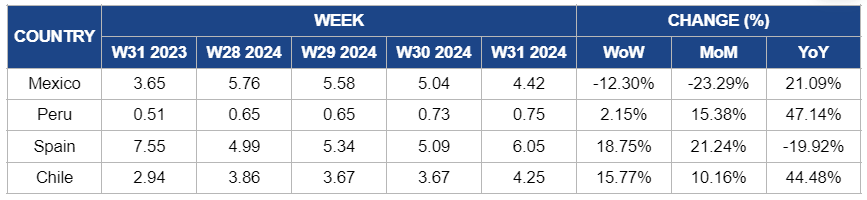
Yearly Change in Avocado Pricing Important Exporters (W31 2023 to W31 2024)

Mexico
Mexico's avocado prices declined by 12.3% week-on-week (WoW) to USD 4.42/kg in W31, with a 23.29% month-on-month (MoM) decrease. This price decline is primarily due to a temporary oversupply in the market as producers rushed to sell their harvests before potential disruptions caused by environmental issues and legal challenges. Despite this short-term decrease, the ongoing water scarcity and illegal reservoir construction in primary producing areas like Michoacán are expected to impact future yields negatively. These environmental concerns and increased scrutiny from lawsuits against major importers could lead to tighter supply and upward pressure on prices in the coming weeks.
Peru
In W31, avocado prices increased by 2.15% WoW to USD 0.75/kg, compared to the previous price of USD 0.73/kg in W30. There is also a 15.38% MoM and a 47.14% YoY increase. This continued price rise is primarily due to the ongoing adverse climatic conditions in Peru, including irregular rainfall and extreme temperatures, which have stressed avocado crops and reduced yields. Additionally, root health and water quality issues persist, further constraining supply. The strict export requirements imposed by destination countries, focusing on traceability and limits on heavy metals and pesticide residues, continue complicating the export process, contributing to the sustained upward pressure on prices.
Spain
In Spain, avocado prices significantly increased by 18.75% WoW in W31 to USD 6.05/kg, compared to USD 5.09/kg in W30. Moreover, there is a 21.24% MoM increase. This sharp rise is due to ongoing limited availability and higher import costs, worsening market volatility in recent weeks. The significant MoM increase highlights the persistent challenges in balancing supply and demand as production struggles to meet market needs. Despite the previous YoY decrease, the current upward trend suggests a tightening market with increasing pressure on prices as availability issues dominate.
Chile
Chilean avocado prices surged by 15.77% WoW to USD 4.25/kg in W31. Moreover, there is a 10.16% MoM and a 44.48% YoY increase. This sharp price rise is due to tightening supply, as domestic production remains lower than usual due to adverse weather conditions. Additionally, the competitive pressure from Mexican avocado imports, which had previously kept prices stable, has lessened, allowing local prices to increase. The strong YoY growth further reflects the ongoing demand for avocados domestically and in export markets despite fluctuations in supply and competition.
4. Actionable Recommendations
Diversify Export Markets with Emphasis on Quality and Sustainability
New Zealand avocado exporters should continue diversifying their export markets by targeting North America and Asia, emphasizing their avocados' superior taste, quality, and sustainability. By capitalizing on the opportunities presented by reduced competition in North America and meeting the growing consumer demand for high-quality and sustainably sourced products, exporters can strengthen their market presence and increase profitability.
Capitalize on Resilience and Emerging Markets Post-El Niño
Global avocado producers and exporters should capitalize on the resilience that avocados have demonstrated during the El Niño phenomenon, where the crop outperformed many others despite adverse weather conditions. Producers should strategically focus on expanding into emerging markets, especially in Africa, where recent strong production levels indicate significant growth potential. Producers should invest in targeted marketing campaigns to effectively enter and establish a presence in these markets, to highlight their avocados' superior quality, taste, and sustainability. In addition to market expansion, producers must continue and amplify the "myth-busting campaign" to address and dispel environmental concerns associated with avocado production. Producers can build greater consumer trust and confidence by actively promoting the crop's relatively low environmental impact and the sustainability practices employed in its cultivation.
Optimize Supply Chain in Chile to Manage Price Surge
Chilean avocado producers and distributors should optimize their supply chain to manage the recent price surge and tighten supply. This can be achieved by enhancing inventory management through real-time tracking systems to monitor stock levels and prevent shortages. Moreover, they should improve distribution efficiency by adopting automated logistics solutions, such as advanced route optimization software and streamlined packing processes, to reduce delivery times and costs. Investing in advanced forecasting tools, such as predictive analytics platforms, can help anticipate market demand more accurately and adjust production and supply strategies accordingly. These measures will stabilize prices, mitigate the effects of adverse weather conditions, and improve responsiveness to market fluctuations in domestic and export markets.
Sources: Tridge, Freshplaza, Fruitnet, AgroPeru, MXfruit, CanalRural,AgroPeru


