W37 2024: Mango Weekly Update

1. Weekly News
Bangladesh
FAO to Support Bangladesh's Mango Export Expansion
The Food and Agriculture Organization (FAO) plans to enhance Bangladesh's mango export capabilities as part of its One Country One Priority Product (OCOP) program. This initiative aims to improve mango production systems, minimize food loss, and build more efficient and sustainable agrifood systems. Launched in 2021, the OCOP program focuses on promoting Special Agricultural Products (SAPs) with unique qualities for global markets. During a recent meeting in Dhaka, FAO representatives discussed the impact of recent floods on agriculture in Bangladesh and the need for technical support to aid recovery and diversify exports. FAO's commitment includes advancing seed technology and providing technical consultation to bolster the country's agricultural development, particularly after setbacks from flooding affecting 11 of 23 districts.
Côte d'Ivoire
Ivory Coast Mango Season Ends with Focus on Quality and Future Growth
As planned, the mango season in Ivory Coast ran from April 12 to the end of May with no extension granted despite requests due to climate change impacts. While the season faced challenges, including reduced quantities and suboptimal coloring, leading to delayed air exports, the campaign concluded with a focus on dried mango products from Ivory Coast and Senegal. The focus on air freighted mangoes continues, as they are known for their superior color and uniform size, typically packed in 6 kg cartons. However, these mangoes are more expensive due to higher shipping costs and their premium quality. including specialized markets and high-end restaurants. The next harvest is set for Apr-25, with plans to increase production capacity and ensure high-quality standards through better orchard management and GlobalGAP certification.
Mexico
Southern Sinaloa Mango Sector Faces Challenges from Anthracnose Disease
In Southern Sinaloa, Mexico, the mango sector is grappling with significant challenges, particularly from anthracnose, a disease severely impacting fruit quality. The 2024 mango season experienced multiple setbacks, including drought, untimely flowering, and falling temperatures, leading to an average year in earnings. The emergence of anthracnose, which causes black spots on mangoes and is exacerbated by poor hygiene during harvesting, resulted in a 20% year-on-year (YoY) loss in production. Although dehydrators purchased the affected mangoes at a reduced price this season, they have indicated that they will not continue this practice next year unless preventive measures are implemented. Mango prices during the season ranged between USD 0.10 and 0.16 per kilogram (MXN 2 and 3/kg). The sector's leader has urged producers to adopt better practices and use fertilizers to address the disease and improve future outcomes.
Peru
Peruvian Mango Campaign Sees Price Surge Amid Strong Demand
The new Peruvian mango season has started with promising early results, especially for the Edward variety. According to Soluciones Comerciales y Agrícolas (SOCAGRO), the campaign has begun robustly, with prices rising contrary to initial projections. This price increase is due to strong local and regional demand, including significant interest from Ecuador and Colombia, which has driven collection point prices to USD 0.45/kg (PEN 1.70/kg). The staggered production of the Edward mango has led to limited supply, further pushing prices up. While some companies have already started purchasing, anticipating further price hikes, others are waiting for the market to stabilize. The Edward mango's versatility allows SOCAGRO to achieve multiple harvests annually, ensuring a steady supply in the Piura region through Mar-24.
Peruvian Mango Becomes Key Agricultural Export in 2024
In 2024, Peruvian mangoes rank as the sixth most important agricultural export, with Europe, particularly the Netherlands, Spain, and the United Kingdom (UK), as key markets. Nearly 28% of exports go to the United States (US), where Mexico poses intense competition. Last year, unfavorable weather in Piura and Casma affected mango yields, especially during the flowering phase. In 2024, better flowering is expected to improve quality, though smaller mangoes may not be suitable for export. As production rises by the end of 2024, producers are encouraged to stagger harvests to avoid oversupply and stabilize prices.
Spain
Spanish Mangoes Gain Popularity Amid Inflation
The Spanish mango season is underway, running from Sep-24 until early Nov-24. The main varieties available are the Osteen and the higher-priced Irwin, with smaller amounts of Kent mangoes appearing towards the end of the season. This year, Spanish mangoes are experiencing a strong market reception despite slight price increases due to inflation. In particular, the Osteen variety is gaining popularity as a high-quality yet reasonably priced option from European cultivation. Früchtewelt GmbH, a leading distributor of exotic and regional fruits in Munich, notes the growing presence of Spanish mangoes in the market, reflecting their increasing importance. The trend is complemented by a rise in online retail, becoming a significant channel for exotic fruits, including kiwi berries from Portugal and regional young ginger, alongside traditional imports.
2. Weekly Pricing
Weekly Mango Pricing Important Exporters (USD/kg)
* Varieties: Mexico (Manilla), Peru (Kent), Brazil (Tommy), and India (overall average)
Yearly Change in Mango Pricing Important Exporters (W37 2023 to W37 2024)

* Varieties: Mexico (Manilla), Peru (Kent), Brazil (Tommy), and India (overall average)
* Blank spaces on the graph signify data unavailability stemming from factors like supply unavailability, missing data, or seasonality
Mexico
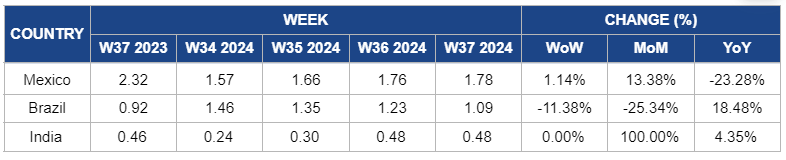
Mexico's mango prices rose slightly by 1.14% week-on-week (WoW) to USD 1.178/kg in W37, marking a 13.38% increase month-on-month (MoM). This is due to ongoing limited availability from unfavorable weather conditions, including droughts and extreme heat in key growing areas like Sinaloa and Nayarit, which have impacted harvest volumes. However, there is a 23.28% YoY decline due to improved production in 2024 compared to the severe supply shortages caused by similar weather challenges in W37 2023, which had driven prices higher last year.
Brazil
In Brazil, mango prices declined by 11.38% WoW to USD 1.09/kg in W37, with a 25.34% MoM decrease. This is due to a continued rise in domestic supply as the harvest season advances, alongside weakening export demand from key markets. Major producing regions, such as the São Francisco Valley, are experiencing peak production, further adding to the downward pressure on prices. However, YoY prices increased by 18.48% due to last year’s lower production levels, which were affected by unfavorable weather conditions, leading to reduced supply and more robust export demand in W37 2023.
India
In W37, mango prices in India remained steady at USD 0.48/kg. This is due to balancing domestic demand and available supply, as exporters prioritize international markets while local demand remains robust. Additionally, mango prices increased by 100% MoM, driven by tight supply following the market's recovery from last year's oversupply, caused by favorable growing conditions resulting in a larger-than-expected harvest. The 4.35% YoY increase reflects the gradual price rebound from the previous year's lower levels.
3. Actionable Recommendations
Implement Disease Management and Improved Harvesting Practices
Mango producers in Southern Sinaloa should implement disease management strategies by using fungicides to combat anthracnose and adopting proper harvesting hygiene to prevent contamination. Additionally, applying fertilizers to strengthen plant health and improve fruit quality will help mitigate future losses. These measures will reduce the impact of anthracnose, increase production efficiency, and ensure that affected mangoes are marketable, preventing further financial setbacks for the industry.
Capitalize on Early Season Demand with Strategic Marketing
Peruvian mango producers should capitalize on the promising early season results for the Edward variety by implementing strategic marketing campaigns to highlight the quality and availability of their products. This includes engaging with local and regional buyers in Ecuador and Colombia to secure contracts early in the season. Additionally, producers should coordinate their harvest schedules to maximize supply during peak demand periods, ensuring consistent pricing and market presence. Producers can enhance their market share and profitability by actively promoting the Edward mango's versatility and unique selling points.
Stagger Harvests to Stabilize Prices and Meet Market Demand
Peruvian mango producers should implement staggered harvesting strategies as production rises by the end of 2024. This will help prevent market oversupply, ensure a steady flow of export-quality mangoes, and maintain stable prices. Producers must also focus on timing exports to key markets such as Europe and the US, where competition is high, particularly from Mexico. Producers can maximize profitability and market presence throughout the season by carefully managing harvests and export schedules.
Sources: Tridge,Daily Observer, Agraria, Freshplaza, Eastfruit


