
1. Weekly News
Chile
Breakthrough Avocado Propagation Technology Licensed to Boost Latin American Production
Australia’s University of Queensland (UQ) has licensed a groundbreaking tissue culture propagation technology to Grupo Hijuelas to revolutionize avocado production in Chile and Latin America. Developed by a UQ professor and her team, this innovative method generates hundreds of plants from a single tissue, significantly increasing production, improving quality, and reducing costs and time. Grupo Hijuelas expressed optimism about the collaboration, which promises to enhance regional agricultural research and development. The technology drastically reduces the time to produce clonal rootstocks, enabling higher yields for avocado growers.
South Africa
China Receives First Shipment of South African Avocados
China received its first shipment of 22 metric tons (mt) of avocados from South Africa, successfully passing the entry quarantine in Shanghai. This milestone benefits from streamlined customs processes for African imports and highlights the growing agricultural trade between the two countries. Looking back on Aug-24, South Africa joined Kenya and Tanzania in gaining access to China's avocado market. In the first eight months of 2024, China's imports of African agricultural products reached USD 3.9 billion (RMB 28.47 billion), with Shanghai contributing USD 859.3 million (RMB 6.12 billion), reflecting a 15.5% year-on-year (YoY) increase.
Morocco
Morocco Set to Harvest Over 90 Thousand Tons of Avocados This Season
Moroccan avocado farms hire seasonal workers to harvest an expected crop of over 90 thousand mt, with more than 80 thousand mt slated for export. The current harvest focuses on three smooth-skinned varieties: Fuerte, Bacon, and Zitano, with plans to introduce the popular Hass variety. The harvest season runs from late September to December, creating direct and indirect employment, particularly in the Moulay Bousselham and Larache regions. Industry professionals emphasize the high quality of this first campaign and the water efficiency of avocado cultivation compared to other crops.
Peru
Peru's Avocado Exports Surged Despite Volume Drop
As of W33, Peru exported 499 thousand mt of avocados valued at USD 1.04 billion, showing a 12% YoY decline in volume but an 11% YoY rise in export value. The increase in export value is driven by a 31% YoY rise in avocado prices, averaging USD 2.16 per kilogram (kg) in Aug-24. The Netherlands remains the top destination for Peruvian avocados, receiving 32% of shipments, followed by Spain with 20% and the United States (US) with 13%. Although export volumes to primary markets like Spain and the US have declined, higher prices have helped maintain profitability. Peru's main avocado-producing regions, including Lima, La Libertad, Ica, and Lambayeque, have experienced a limited supply, which, alongside reduced exports from other Southern Hemisphere producers, has contributed to high prices.
Cusco Avocado Producers Secure Major Export Deal with Costa Rica
Avocado producers from Limatambo and Mollepata in Cusco, Peru, have signed a commercial agreement with California Agro Export to export 50 tons of Hass avocados weekly to Costa Rica starting in the 2025 campaign. This achievement marks a significant step toward expanding into international markets, contributing to rural development and job creation. Supported by over 9 thousand personalized technical assistance services, producers have improved avocado quality through advanced pruning, fertilization, irrigation, and pest control techniques. Initially focused on Limatambo and Mollepata, the project is expanding to other regions, aiming to position Cusco as a primary player in the global avocado market.
2. Weekly Pricing
Weekly Avocado Pricing Important Exporters (USD/kg)
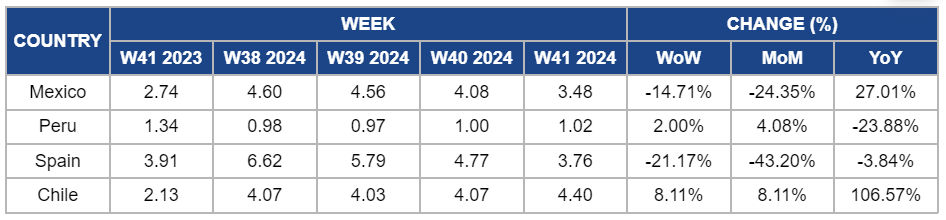
Yearly Change in Avocado Pricing Important Exporters (W41 2023 to W41 2024)

Mexico
Avocado prices in Mexico have steadily dropped to USD 3.48/kg in W41, down 14.71% WoW and 24.35% MoM. This price decline is driven by local market saturation, where high production volumes exceed domestic demand, particularly for larger fruit. Additionally, pressures from the US export market contribute to this trend. However, YoY prices remained high, a 27.01% YoY increase due to strong demand and inflationary pressures in Mexico, reflected by the National Consumer Price Index (NCPI) and rising production costs, which continue to elevate overall pricing compared to the previous year.
Peru
In Peru, avocado prices slightly increased by 2% WoW and 4.08% MoM in W41. The price increase is due to ongoing limited supply from primary producing regions like Lima and La Libertad, coupled with reduced exports from other Southern Hemisphere producers, keeping demand high. However, YoY prices declined significantly by 23.88% due to a slowdown in export volumes to major markets like Spain and the US, leading to lower overall market demand than last year.
Spain
In W41, Spain's avocado prices fell by 21.17% WoW to USD 3.76/kg. This marks a 43.20% MoM drop and a 3.84% YoY decrease, driven by an oversupply caused by the early arrival of green-skinned varieties to the market. Additionally, a water shortage has limited production volumes, which increased competition and pushed prices down, combined with the import of avocados from other regions. Despite the overall high-quality crop, the early availability of imports has disrupted the market balance, contributing to these significant price drops.
Chile
Chilean avocado prices in W41 increased by 8.11% WoW and MoM to USD 4.40/kg. The price also significantly increased by 106.57% YoY due to a significant rise in export demand, which has heightened logistical pressures. Additionally, reduced avocado supply from competing Southern Hemisphere producers and Chile’s expanding export capacity, boosted by investments in port infrastructure, have contributed to the sharp price increase. The high-quality avocados and tight market conditions have further driven up prices.
3. Actionable Recommendations
Leverage South African Avocado Imports to Enhance Market Presence in China
South African avocado exporters should build on the successful entry into the Chinese market by expanding their presence at key trade events like the China International Import Expo. By increasing their participation in the Expo and strengthening relationships with Chinese distributors, they can capitalize on the growing demand for African agricultural products. This proactive approach will ensure greater visibility and demand for South African avocados in China, further solidifying their market position.
Boost Export Efficiency Amid High Prices
Peruvian avocado exporters should improve logistics and market diversification to maintain profitability despite declining export volumes. By enhancing supply chain efficiency and exploring emerging markets beyond the traditional destinations, exporters can mitigate risks associated with reduced exports to major buyers. Strengthening relationships with buyers in less saturated markets, alongside maintaining quality standards, will ensure continued demand even as volumes decrease.
Explore New Markets to Address Avocado Oversupply
Spanish avocado producers and distributors should adjust their sales strategies to address the current oversupply and price drops by targeting new distribution channels, such as local organic markets or high-end retailers, and exporting to emerging markets like the Middle East or Eastern Europe. Expanding their customer base and tapping into regions with growing demand for premium avocados can alleviate price pressures and better balance supply with demand. Additionally, aligning harvest schedules with market conditions and limiting imports during peak production times will help stabilize prices and reduce market disruptions.
Sources: Tridge, Agraria, China, Ecomercioagrario, Freshfruitportal, FOOD&HOME, Freshplaza, MXfruit, Portalfruticola, Producereport


